

We flagged it down in Livewire. But I just have to mention it. Following last week’s blood letting, Ron DeSantis is now canning more than a third of his campaign staff as his campaign continues to bleed out.
Jeffries Calls Out ‘MAGA Republicans,’ ‘Conspiracy Theories’ As McCarthy Changes Tone On Biden Impeachment Inquiry
House Minority Leader Hakeem Jeffries (D-NY) snapped back at MAGA House Republicans’ “conspiracy theories” on Tuesday afternoon, less than a day after House Speaker Kevin McCarthy (R-CA) publicly claimed the ongoing probes into President Joe Biden and his family are “rising to the level of impeachment inquiry.”
Continue reading “Jeffries Calls Out ‘MAGA Republicans,’ ‘Conspiracy Theories’ As McCarthy Changes Tone On Biden Impeachment Inquiry”Freedom Caucus Members Who Are Delaying Appropriations Process Downplay Effect Of Shutdowns
House Freedom Caucus loyalist Rep. Bob Good (R-VA) downplayed the seriousness of a possible government shutdown on Tuesday as the House’s far-right flank drags out the appropriations process, threatening to cripple hundreds of thousands of government employees and Americans who receive services from them.
Continue reading “Freedom Caucus Members Who Are Delaying Appropriations Process Downplay Effect Of Shutdowns”Decades Of Public Messages About Recycling In The US Have Crowded Out More Sustainable Ways To Manage Waste
This article is part of TPM Cafe, TPM’s home for opinion and news analysis. It was originally published at The Conversation.
You’ve just finished a cup of coffee at your favorite cafe. Now you’re facing a trash bin, a recycling bin and a compost bin. What’s the most planet-friendly thing to do with your cup?
Many of us would opt for the recycling bin – but that’s often the wrong choice. In order to hold liquids, most paper coffee cups are made with a thin plastic lining, which makes separating these materials and recycling them difficult.
In fact, the most sustainable option isn’t available at the trash bin. It happens earlier, before you’re handed a disposable cup in the first place.
In our research on waste behavior, sustainability, engineering design and decision making, we examine what U.S. residents understand about the efficacy of different waste management strategies and which of those strategies they prefer. In two nationwide surveys in the U.S. that we conducted in October 2019 and March 2022, we found that people overlook waste reduction and reuse in favor of recycling. We call this tendency recycling bias and reduction neglect.
Our results show that a decadeslong effort to educate the U.S. public about recycling has succeeded in some ways but failed in others. These efforts have made recycling an option that consumers see as important – but to the detriment of more sustainable options. And it has not made people more effective recyclers. https://www.youtube.com/embed/Q_Va-AIliDw?wmode=transparent&start=0 Recycling rules vary widely across the U.S., leaving consumers to figure out what to do.
A global waste crisis
Experts and advocates widely agree that humans are generating waste worldwide at levels that are unmanageable and unsustainable. Microplastics are polluting the Earth’s most remote regions and amassing in the bodies of humans and animals.
Producing and disposing of goods is a major source of greenhouse gas emissions and a public health threat, especially for vulnerable communities that receive large quantities of waste. New research suggests that even when plastic does get recycled, it produces staggering amounts of microplastic pollution.
Given the scope and urgency of this problem, in June 2023 the United Nations convened talks with government representatives from around the globe to begin drafting a legally binding pact aimed at stemming harmful plastic waste. Meanwhile, many U.S. cities and states are banning single-use plastic products or restricting their use.
Upstream and downstream solutions
Experts have long recommended tackling the waste problem by prioritizing source reduction strategies that prevent the creation of waste in the first place, rather than seeking to manage and mitigate its impact later. The U.S. Environmental Protection Agency and other prominent environmental organizations like the U.N. Environment Programme use a framework called the waste management hierarchy that ranks strategies from most to least environmentally preferred.
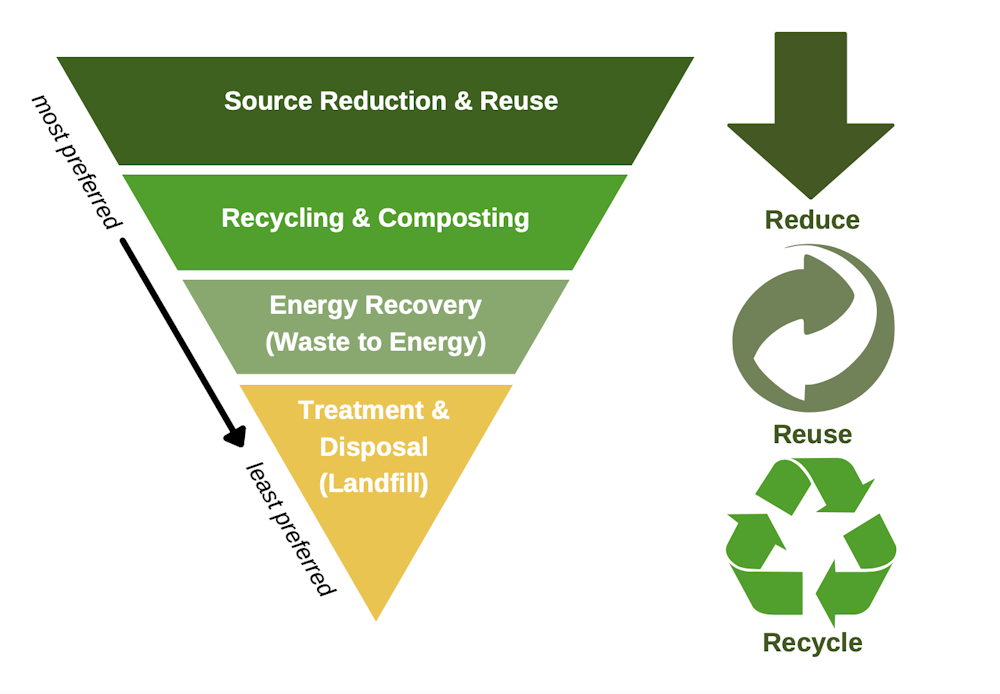
The familiar waste management hierarchy urges people to “Reduce, Reuse, Recycle,” in that order. Creating items that can be recycled is better from a sustainability perspective than burning them in an incinerator or burying them in a landfill, but it still consumes energy and resources. In contrast, reducing waste generation conserves natural resources and avoids other negative environmental impacts throughout a product’s life.
R’s out of place
In our surveys, participants completed a series of questions and tasks that elicited their views of different waste strategies. In response to open-ended questions about the most effective way to reduce landfill waste or solve environmental issues associated with waste, participants overwhelmingly cited recycling and other downstream strategies.
We also asked people to rank the four strategies of the Environmental Protection Agency’s waste management hierarchy from most to least environmentally preferred. In that order, they include source reduction and reuse; recycling and composting; energy recovery, such as burning trash to generate energy; and treatment and disposal, typically in a landfill. More than three out of four participants (78%) ordered the strategies incorrectly.
When they were asked to rank the reduce/reuse/recycle options in the same way, participants fared somewhat better, but nearly half (46%) still misordered the popular phrase.
Finally, we asked participants to choose between just two options – waste prevention and recycling. This time, over 80% of participants understood that preventing waste was much better than recycling.
Recycling badly
While our participants defaulted to recycling as a waste management strategy, they did not execute it very well.
This isn’t surprising, since the current U.S. recycling system puts the onus on consumers to separate recyclable materials and keep contaminants out of the bin. There is a lot of variation in what can be recycled from community to community, and this standard can change frequently as new products are introduced and markets for recycled materials shift.
Our second study asked participants to sort common consumer goods into virtual recycling, compost and trash bins and then say how confident they were in their choices. Many people placed common recycling contaminants, including plastic bags (58%), disposable coffee cups (46%) and light bulbs (26%), erroneously – and often confidently – in the virtual recycling bins.
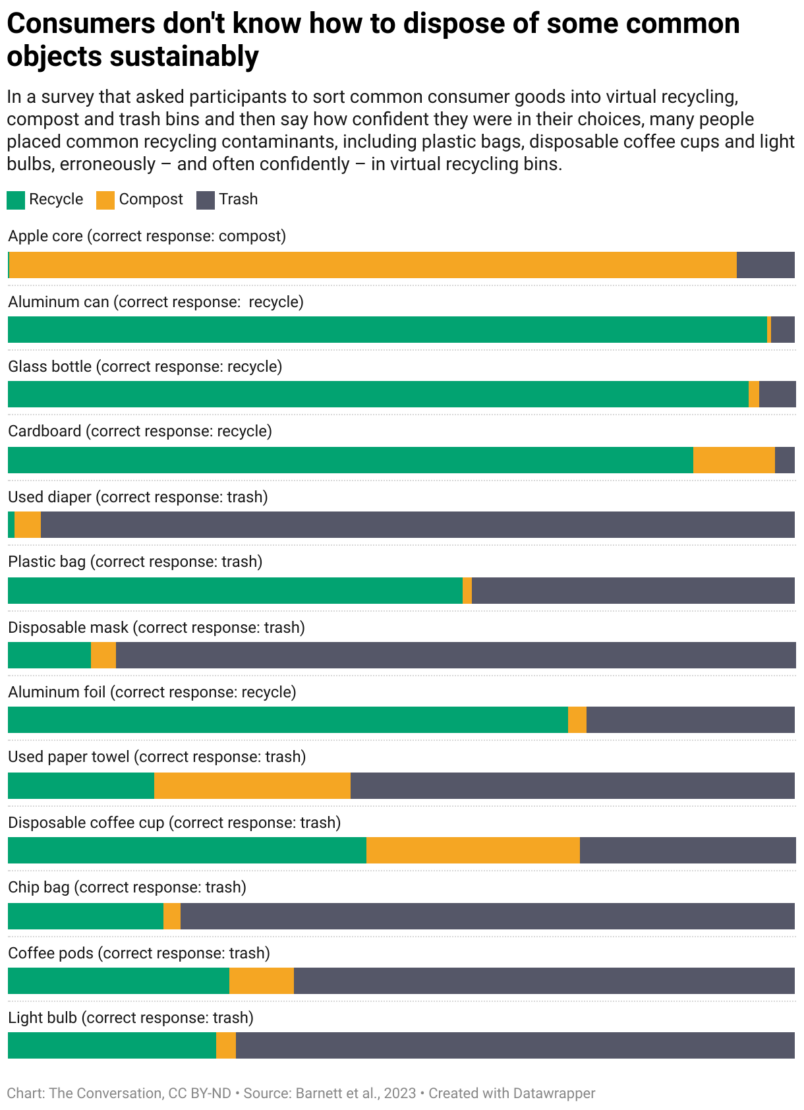
This is known as wishcycling – placing nonrecyclable items in the recycling stream in the hope or belief that they will be recycled. Wishcycling creates additional costs and problems for recyclers, who have to sort the materials, and sometimes results in otherwise recyclable materials being landfilled or incinerated instead.
Although our participants were strongly biased toward recycling, they weren’t confident that it would work. Participants in our first survey were asked to estimate what fraction of plastic has been recycled since plastic production began. According to a widely cited estimate, the answer is just 9%. Our respondents thought that 25% of plastic had been recycled – more than expert estimates but still a low amount. And they correctly reasoned that a majority of it has ended up in landfills and the environment.
Empowering consumers to cut waste
Post-consumer waste is the result of a long supply chain with environmental impacts at every stage. However, U.S. policy and corporate discourse focuses on consumers as the main source of waste, as implied by the term “post-consumer waste.”
Other approaches put more responsibility on producers by requiring them to take back their products for disposal, cover recycling costs and design and produce goods that are easy to recycle effectively. These approaches are used in some sectors in the U.S., including lead-acid car batteries and consumer electronics, but they are largely voluntary or mandated at the state and local level.
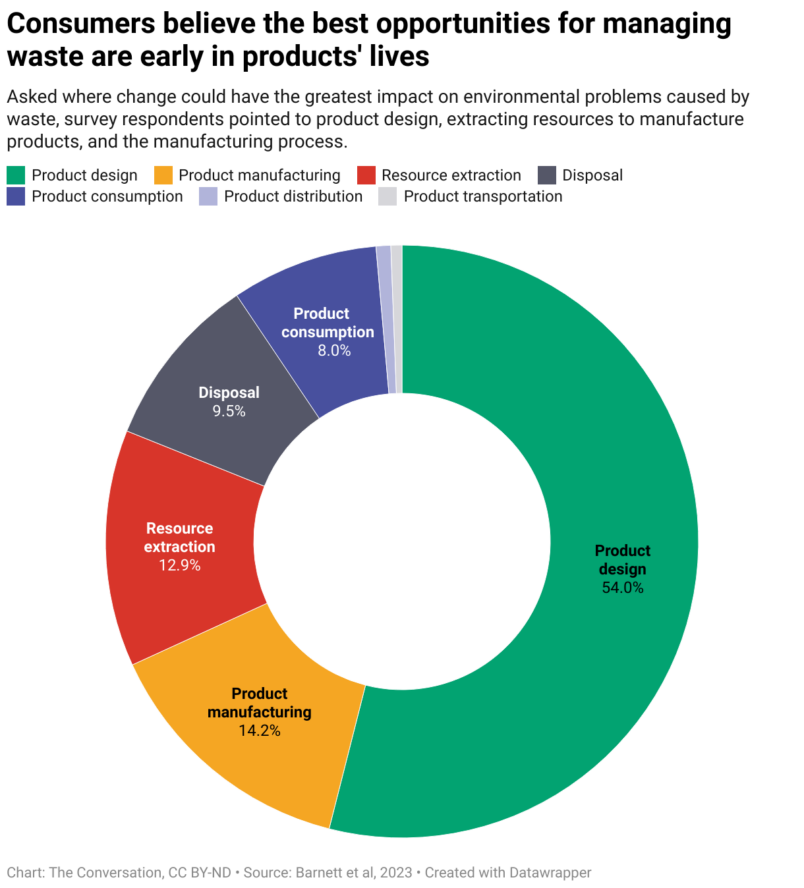
When we asked participants in our second study where change could have the most impact and where they felt they could have the most impact as individuals, they correctly focused on upstream interventions. But they felt they could only affect the system through what they chose to purchase and how they subsequently disposed of it – in other words, acting as consumers, not as citizens.
As waste-related pollution accumulates worldwide, corporations continue to shame and blame consumers rather than reducing the amount of disposable products they create. In our view, recycling is not a get-out-of-jail-free card for overproducing and consuming goods, and it is time that the U.S. stopped treating it as such.
This article is republished from The Conversation under a Creative Commons license. Read the original article.

Taking a Look at Israel’s Unending Constitutional Crisis
A couple days ago I got this email from TPM Reader PT. I was sort of delaying responding because it’s a really complex question. So I’ve decided to post the question and reply here. I preface by noting I’m not an expert on Israeli politics. I don’t live there. But I have followed it closely for many years. So I put it forward on that basis.
From PT …
Continue reading “Taking a Look at Israel’s Unending Constitutional Crisis”It feels like this whole year I’ve been trying to understand the situation in Israel — specifically the fact that the governing coalition wants to make a fundamental change to the country’s political organization and is facing furious pushback from the citizenry. My first thought was that it had a certain “Leopards Eating People’s Faces Party” energy to it: Netanyahu’s overriding priority is to ensure that he isn’t prosecuted for corruption, which means that his overriding priority is to destroy the court system in Israel; hence if you elect a governing coalition that includes him and makes him PM, destruction of the court system is a given. So how do we arrive in a place where everyone knows that Netanyahu’s goal is to destroy the court system, the electorate elects a government that will make him PM, and then the electorate protests when he does what everyone knows he’s going to do.
After thinking about it some more, I have a somewhat different take:
How Early Did Trump’s 2020 Election Overturn Conspiracy Start?
A lot of things happened. Here are some of the things. This is TPM’s Morning Memo. Sign up for the email version.
Jack Smith Reaches All The Way Back To February 2020
An intriguing new report yesterday found that Special Counsel Jack Smith has been inquiring about a February 2020 White House meeting as part of his investigation of Trump’s effort to overturn the 2020 election.
That is far earlier than we generally understood Smith to be looking. It’s even earlier than when we at TPM have generally regarded as the starting point for conspiracy. We’ve pegged it as April 2020, when the COVID pandemic prompted a nationwide wave of changes to voting practices in the interest of public health. Trump saw expanded voting as a threat to his re-election and began the drumbeat of claims about massive election fraud.
To be clear, the CNN report suggests not so much that the conspiracy started in February 2020, but that as late as February 2020 Trump was generally positive and upbeat about the prospects for a safe and secure election:
In the meeting with senior US officials and White House staff, Trump touted his administration’s work to expand the use of paper ballots and support security audits of vote tallies. Trump was so encouraged by federal efforts to protect election systems that he suggested the FBI and Department of Homeland Security hold a press conference to take credit for the work, four people familiar with the meeting told CNN.
Those details offer a stark contrast to the voter-fraud conspiracy theories Trump began spreading publicly just weeks later and continued to use to question the 2020 election results.
At that point, we didn’t fully realize that COVID was already rapidly spreading in the United States; Trump was preparing to tout the steps he’d taken to protect the election; and he hadn’t yet started making his wild and unfounded election fraud claims. It’s as if Smith has reached all the way back in time to find the last pristine, pre-bamboozlement moment so that he can contrast Trump’s actions and mindset from before and after the switch flipped to election fraud inanity.
Don’t Forget The Big Picture
One more point on the CNN report about how far back Jack Smith is looking. I don’t have doubt that the 2020 coup attempt grew out of Trump’s attacks on COVID-era voting workarounds. That’s a neat, clean, logical starting point for the conspiracy.
But big picture, don’t forget that the first impeachment was all about Trump’s re-election, too. His pressure on Ukrainian President Volodymyr Zelenskyy to manufacture dirt on Joe Biden peaked with the July 2019 “perfect call.” It’s all of a piece: the lying, scheming, conspiring, and taking affirmative steps to hold on to power no matter what.
And, not incidentally, that is why you can’t separate what House GOP chairs Jim Jordan and James Comer are doing now with the powers of their offices to paint Joe Biden as the godfather of a sprawling crime family. Again, it’s all of a piece.
The Failed Decapitation Of Trump’s Own DOJ
Former Trump DOJ official Richard Donoghue has been interviewed in Special Counsel Jack Smith’s Jan. 6 probe.
Interesting …
Rudy G protégé Bernie Kerik coughed up a trove of documents to Special Counsel Jack Smith on Sunday.
McCarthy Warns Of Biden Impeachment
Speaker Kevin McCarthy (R-CA), who is struggling to hold his conference together enough to pass this year’s appropriations bills, is leaning harder into a Biden impeachment. I don’t think those two things are unrelated.
Border War
The Justice Department has sued Texas over Gov. Greg Abbott’s buoy barrier in the Rio Grande.
Great Read
WaPo: How right-wing news powers the ‘gold IRA’ industry
Telling
Get Ready To Stretch Your Brain
The new Oppenheimer film is a chance to explore the mind-bending scale of of kilotons v. megatons:
Barbie Is Uncompromisingly Subversive

I saw Barbie Sunday evening, but I wanted to wait a day to let my reaction to it settle before writing about it. I walked out of the theater feeling exhilarated that a Hollywood blockbuster (which I rarely go see) had somehow against all odds managed to be uncompromisingly subversive. After two nights of sleep, my feeling hasn’t changed.
What got me to go see it in the first place was Greta Gerwig commenting that she couldn’t believe they let her make this movie. That intrigued me, but I still went in expecting a few broad, inoffensive, waves of the hand toward the well-worn and familiar criticisms of the Barbie doll – before Gerwig’s ambitions would buckle and the movie veer back into the tired cliches of Hollywood storytelling with a heavy dose of commercialism and product placement.
That’s not what Barbie the movie is about at all. It’s bitingly subversive from beginning to end. It started so well that I began to feel tense anticipating when it would go off the rails and turn into schlock. But fairly early on, there’s a lol moment when the Indigo Girl’s “Closer to Fine” begins playing and I realized, with delight, that Gerwig and Noah Baumbach had managed to steer this pink convertible of a film straight and true despite Warners Bros. Discovery, Mattel, and all the commercial pressure that a summer blockbuster brings to bear.
Could you find a more sophisticated critique of the patriarchy? Sure. Could you find one that with an opening weekend haul of $155 million, meaning millions of unsuspecting bubble gum conservatives in red states got an unexpected blast of feminist theory?
I saw it in Bethesda, within the DC liberal bubble. I’m really curious how it plays in more conservative environs. If you had that experience, shoot me an email. Link just below.
Like Morning Memo? Let us know!
Where Things Stand: The One Tennessee Three-er The GOP Failed To Expel Weighs Blackburn Challenge
The retired school teacher who ultimately survived an expulsion vote brought by her Republican colleagues in the Tennessee state House earlier this year — part of an effort that did ultimately expel two of her younger, Black colleagues — is reportedly planning to challenge Sen. Marsha Blackburn (R-TN) for her seat next year.
No Democrat has won a statewide race since 2006, when then-Gov. Phil Bredesen secured his reelection. But a face-off between Blackburn — who has a history of staunch opposition to tightening gun control — and state Rep. Gloria Johnson, (D) whose expulsion vote was predicated on her support for children and parents protesting lax gun laws in the state legislature, could test the energizing power of gun reform in a state recently racked by a deadly school shooting.
Continue reading “Where Things Stand: The One Tennessee Three-er The GOP Failed To Expel Weighs Blackburn Challenge”About That Florida Curriculum
You’ve probably seen coverage of the firestorm over Florida’s newly updated African-American history curriculum. Most of the coverage has (understandably) focused on the quote that suggest that slaves were taught skills which they could use for their own benefit. (“Slaves developed skills which, in some instances, could be applied for their personal benefit.”) I read the entire updated curriculum. So I wanted to share my take. As most of you know, I have a PhD in American history, with a focus on the colonial period but covering the full sweep of American history. I haven’t been professionally engaged with the literature for about 25 years. But I generally keep up.
Overall the text isn’t as clownish as that one quote might suggest — a low bar. But there are still pretty major problems. As is usually the case with educational standards, they tend to be ones of emphasis and omission rather than outright fabrication. Along the way, there’s a decent amount of general sloppiness and a hard-to-miss affirmative action for right-wing Black intellectuals. I want to focus on three points. These are by no means exhaustive. They’re just the ones that struck me as most glaring and also illustrative.
Continue reading “About That Florida Curriculum”Abbott: We Need Rio Grande Buoys To Protect From Invasion
You can take our Rio Grande buoys from our cold, dead hands, Texas Gov. Greg Abbott (R) told the Biden administration in a Monday letter.
Continue reading “Abbott: We Need Rio Grande Buoys To Protect From Invasion”Dead Bounce Ron and the High Roller / Private Jet Doom Loop
As we continue to watch the ignominious collapse of Ron DeSantis’s campaign (predicted many months ago by yours truly but not like I’m focusing on that or anything), there’s a curious bit of backstory I’m reminded of. But before we get to that I wanted to flag this weekend New York Times article. It’s so passively devastating I think DeSantis’s estate might have a plausible wrongful death claim against the authors.
Most of the attention to this article has focused on a scooplet about that infamous gay/trans-bashing video. The story was that it was put together by some unknown fan in the DeSantis-o-sphere. The campaign simply picked it up and amplified it. The Times reports that in fact it was produced by a campaign staffer who then gave it to a Ron fan site to release so that the campaign could then pick it up from the fan. In other words, the campaign laundered it out for some plausible deniability.
My takeaway from the piece was different: The campaign appears to be trapped in a sort of people-hating, private-jet-taking death loop. We learn from the article that Ron and wife Casey really, really like flying on private jets, which of course cost a ton of money. I confess that I’m not a huge fan of flying. But if I were, a private jet would probably be pretty cool. But it’s also not hard to see their extreme attachment to private jets as part of or at least a symbol of not liking being around regular people. Maybe not liking being around anybody at all. Some people just want the privacy to unwind with a handful of pudding.
Continue reading “Dead Bounce Ron and the High Roller / Private Jet Doom Loop”