A couple days ago I got this email from TPM Reader PT. I was sort of delaying responding because it’s a really complex question. So I’ve decided to post the question and reply here. I preface by noting I’m not an expert on Israeli politics. I don’t live there. But I have followed it closely for many years. So I put it forward on that basis.
From PT …
It feels like this whole year I’ve been trying to understand the situation in Israel — specifically the fact that the governing coalition wants to make a fundamental change to the country’s political organization and is facing furious pushback from the citizenry. My first thought was that it had a certain “Leopards Eating People’s Faces Party” energy to it: Netanyahu’s overriding priority is to ensure that he isn’t prosecuted for corruption, which means that his overriding priority is to destroy the court system in Israel; hence if you elect a governing coalition that includes him and makes him PM, destruction of the court system is a given. So how do we arrive in a place where everyone knows that Netanyahu’s goal is to destroy the court system, the electorate elects a government that will make him PM, and then the electorate protests when he does what everyone knows he’s going to do.
After thinking about it some more, I have a somewhat different take:
Jack Smith Reaches All The Way Back To February 2020
An intriguing new report yesterday found that Special Counsel Jack Smith has been inquiring about a February 2020 White House meeting as part of his investigation of Trump’s effort to overturn the 2020 election.
That is far earlier than we generally understood Smith to be looking. It’s even earlier than when we at TPM have generally regarded as the starting point for conspiracy. We’ve pegged it as April 2020, when the COVID pandemic prompted a nationwide wave of changes to voting practices in the interest of public health. Trump saw expanded voting as a threat to his re-election and began the drumbeat of claims about massive election fraud.
To be clear, the CNN report suggests not so much that the conspiracy started in February 2020, but that as late as February 2020 Trump was generally positive and upbeat about the prospects for a safe and secure election:
In the meeting with senior US officials and White House staff, Trump touted his administration’s work to expand the use of paper ballots and support security audits of vote tallies. Trump was so encouraged by federal efforts to protect election systems that he suggested the FBI and Department of Homeland Security hold a press conference to take credit for the work, four people familiar with the meeting told CNN.
Those details offer a stark contrast to the voter-fraud conspiracy theories Trump began spreading publicly just weeks later and continued to use to question the 2020 election results.
At that point, we didn’t fully realize that COVID was already rapidly spreading in the United States; Trump was preparing to tout the steps he’d taken to protect the election; and he hadn’t yet started making his wild and unfounded election fraud claims. It’s as if Smith has reached all the way back in time to find the last pristine, pre-bamboozlement moment so that he can contrast Trump’s actions and mindset from before and after the switch flipped to election fraud inanity.
Don’t Forget The Big Picture
One more point on the CNN report about how far back Jack Smith is looking. I don’t have doubt that the 2020 coup attempt grew out of Trump’s attacks on COVID-era voting workarounds. That’s a neat, clean, logical starting point for the conspiracy.
But big picture, don’t forget that the first impeachment was all about Trump’s re-election, too. His pressure on Ukrainian President Volodymyr Zelenskyy to manufacture dirt on Joe Biden peaked with the July 2019 “perfect call.” It’s all of a piece: the lying, scheming, conspiring, and taking affirmative steps to hold on to power no matter what.
And, not incidentally, that is why you can’t separate what House GOP chairs Jim Jordan and James Comer are doing now with the powers of their offices to paint Joe Biden as the godfather of a sprawling crime family. Again, it’s all of a piece.
The Failed Decapitation Of Trump’s Own DOJ
Former Trump DOJ official Richard Donoghue has been interviewed in Special Counsel Jack Smith’s Jan. 6 probe.
Interesting …
Rudy G protégé Bernie Kerik coughed up a trove of documents to Special Counsel Jack Smith on Sunday.
McCarthy Warns Of Biden Impeachment
Speaker Kevin McCarthy (R-CA), who is struggling to hold his conference together enough to pass this year’s appropriations bills, is leaning harder into a Biden impeachment. I don’t think those two things are unrelated.
Border War
The Justice Department has sued Texas over Gov. Greg Abbott’s buoy barrier in the Rio Grande.
Great Read
WaPo: How right-wing news powers the ‘gold IRA’ industry
The new Oppenheimer film is a chance to explore the mind-bending scale of of kilotons v. megatons:
Still can't believe a blockbuster film brought in millions of people and then sat them down for 3h featuring Edward Teller arguing with Oppenheimer about fission vs fusion bombs.
If you came away curious about that debate, here are some of the parameters & stakes involved 🧵1/21 pic.twitter.com/QbebRxcPpS
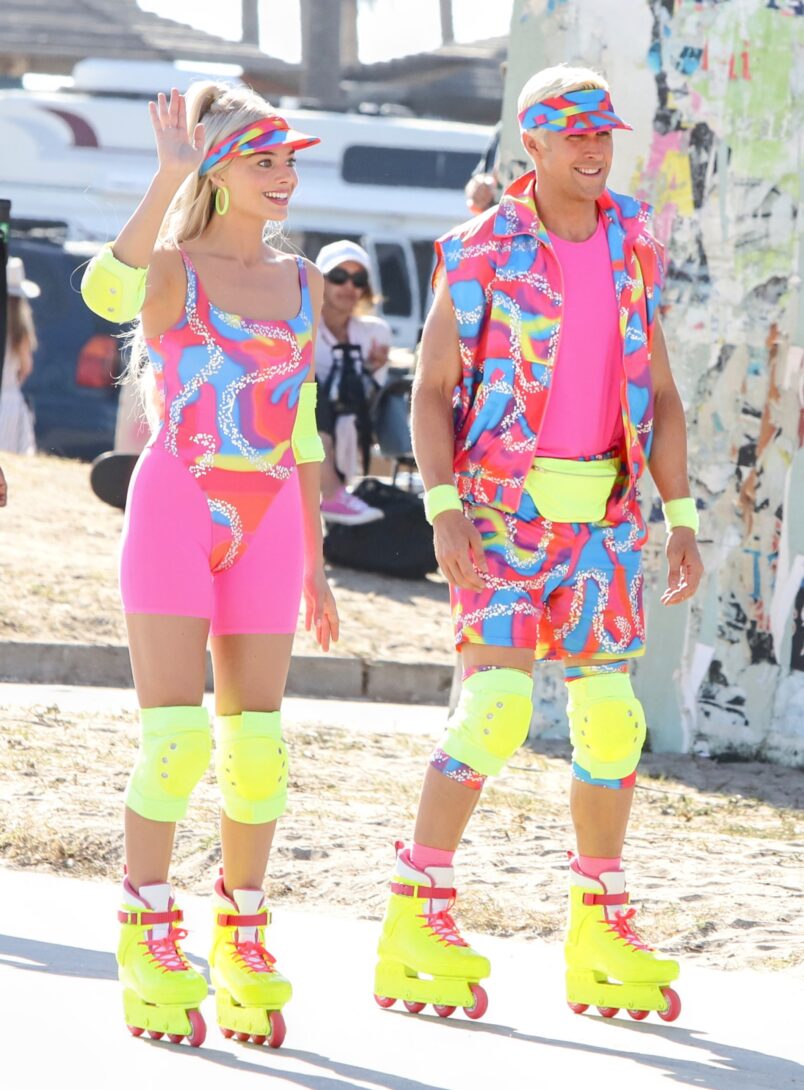
LOS ANGELES, CA – JUNE 28: Margot Robbie and Ryan Gosling are seen rollerblading on the set of “Barbie” on June 28, 2022 in Los Angeles, California. (Photo by MEGA/GC Images)
I saw Barbie Sunday evening, but I wanted to wait a day to let my reaction to it settle before writing about it. I walked out of the theater feeling exhilarated that a Hollywood blockbuster (which I rarely go see) had somehow against all odds managed to be uncompromisingly subversive. After two nights of sleep, my feeling hasn’t changed.
What got me to go see it in the first place was Greta Gerwig commenting that she couldn’t believe they let her make this movie. That intrigued me, but I still went in expecting a few broad, inoffensive, waves of the hand toward the well-worn and familiar criticisms of the Barbie doll – before Gerwig’s ambitions would buckle and the movie veer back into the tired cliches of Hollywood storytelling with a heavy dose of commercialism and product placement.
That’s not what Barbie the movie is about at all. It’s bitingly subversive from beginning to end. It started so well that I began to feel tense anticipating when it would go off the rails and turn into schlock. But fairly early on, there’s a lol moment when the Indigo Girl’s “Closer to Fine” begins playing and I realized, with delight, that Gerwig and Noah Baumbach had managed to steer this pink convertible of a film straight and true despite Warners Bros. Discovery, Mattel, and all the commercial pressure that a summer blockbuster brings to bear.
Could you find a more sophisticated critique of the patriarchy? Sure. Could you find one that with an opening weekend haul of $155 million, meaning millions of unsuspecting bubble gum conservatives in red states got an unexpected blast of feminist theory?
I saw it in Bethesda, within the DC liberal bubble. I’m really curious how it plays in more conservative environs. If you had that experience, shoot me an email. Link just below.
The retired school teacher who ultimately survived an expulsion vote brought by her Republican colleagues in the Tennessee state House earlier this year — part of an effort that did ultimately expel two of her younger, Black colleagues — is reportedly planning to challenge Sen. Marsha Blackburn (R-TN) for her seat next year.
No Democrat has won a statewide race since 2006, when then-Gov. Phil Bredesen secured his reelection. But a face-off between Blackburn — who has a history of staunch opposition to tightening gun control — and state Rep. Gloria Johnson, (D) whose expulsion vote was predicated on her support for children and parents protesting lax gun laws in the state legislature, could test the energizing power of gun reform in a state recently racked by a deadly school shooting.
You’ve probably seen coverage of the firestorm over Florida’s newly updated African-American history curriculum. Most of the coverage has (understandably) focused on the quote that suggest that slaves were taught skills which they could use for their own benefit. (“Slaves developed skills which, in some instances, could be applied for their personal benefit.”) I read the entire updated curriculum. So I wanted to share my take. As most of you know, I have a PhD in American history, with a focus on the colonial period but covering the full sweep of American history. I haven’t been professionally engaged with the literature for about 25 years. But I generally keep up.
Overall the text isn’t as clownish as that one quote might suggest — a low bar. But there are still pretty major problems. As is usually the case with educational standards, they tend to be ones of emphasis and omission rather than outright fabrication. Along the way, there’s a decent amount of general sloppiness and a hard-to-miss affirmative action for right-wing Black intellectuals. I want to focus on three points. These are by no means exhaustive. They’re just the ones that struck me as most glaring and also illustrative.
As we continue to watch the ignominious collapse of Ron DeSantis’s campaign (predicted many months ago by yours truly but not like I’m focusing on that or anything), there’s a curious bit of backstory I’m reminded of. But before we get to that I wanted to flag this weekend New York Times article. It’s so passively devastating I think DeSantis’s estate might have a plausible wrongful death claim against the authors.
Most of the attention to this article has focused on a scooplet about that infamous gay/trans-bashing video. The story was that it was put together by some unknown fan in the DeSantis-o-sphere. The campaign simply picked it up and amplified it. The Times reports that in fact it was produced by a campaign staffer who then gave it to a Ron fan site to release so that the campaign could then pick it up from the fan. In other words, the campaign laundered it out for some plausible deniability.
My takeaway from the piece was different: The campaign appears to be trapped in a sort of people-hating, private-jet-taking death loop. We learn from the article that Ron and wife Casey really, really like flying on private jets, which of course cost a ton of money. I confess that I’m not a huge fan of flying. But if I were, a private jet would probably be pretty cool. But it’s also not hard to see their extreme attachment to private jets as part of or at least a symbol of not liking being around regular people. Maybe not liking being around anybody at all. Some people just want the privacy to unwind with a handful of pudding.
One aspect of the Mar-a-Lago case that hasn’t gotten much attention lately but deserves mentioning: The accommodations and multiple chances over many months for Trump to surrender the documents effectively narrowed the window for a prosecution and created the circumstances we’re in now.
I don’t think that was avoidable, but I also don’t think the government should be punished on both ends. Let me explain.
The government bent over backwards throughout 2021 and deep into 2022 to accommodate Trump and secure the missing classified documents. That all took time. The August 2022 search of Mar-a-Lago came almost 19 months after the end of Trump’s presidency.
I know you’re thinking: For chrissakes, why continue to accommodate Trump?!?! I think that was the right thing to do on the merits, but also practically. If the government hadn’t been deferential and accommodating, they risked getting beat up by judges along the way. It could have been hard to secure search warrants and possibly even subpoenas if the government hadn’t given Trump enough time to demonstrate his bad faith and unfair dealing over the classified documents.
But the effect is one that U.S. District Judge Aileen Cannon and judges on appeal should keep in mind. By doing the proper thing and giving Trump plenty of time to comply with the demand to return documents, the government is now in the position of having to deal with external consequences like: (i) Trump declaring his candidacy for president in 2024 before the government indicted him; (ii) Trump more effectively making the bogus claim that the government is interfering in the election; (iii) the Bragg prosecution in NYC beating the MAL case to the punch and creating new scheduling challenges; and (iv) narrowing the very tight window to bring the MAL case to trial before the 2024 election.
The government, unlike the defense, has to serve multiple masters: its own institutional imperatives, its own desire to win, the defendant’s rights, and the public interest. That makes things more complicated for prosecutors, as they should be. But it also means that prosecutors should be judged on their conduct in total, which in this case means giving them credit for the accommodations they made on the front end and not punishing them for it.
Aileen Cannon Is Gonna Be A Wild Card
The new trial schedule for the Mar-a-Lago prosecution of Trump is not on its face insane. I was hoping for a March or April trial date so that if it gets delayed again (which seems inevitable) there would be plenty of cushion to re-schedule it over the summer and still get it done before Election Day. The May trial date she landed on, though, still provides a little such cushion. So it’s not alarming.
Two things in her pre-trial schedule do jump out:
Giving Trump a month to argue with prosecutors over a protective order over the classified information in the case. The law requires entry of such an order (i.e., it’s not optional), and it shouldn’t take that long for the parties to confer. It feels like she’s rewarding Trump for failing to confer with prosecutors in the first place. But it’s not the end of the world.
On the back end of her schedule, there’s a tight crunch between when she will rule on the handling of classified information at trial and the start of the trial itself. It sets up a situation where any appeals of her ruling will likely delay trial. This is fixable, though, in future schedule adjustments. So again not the end of the world.
All of these little delays and accommodations add up, and the truth is if Cannon keeps making little concessions here and there, none of which on their own give grounds for appeal or provoke public outrage, then she can effectively delay the trial past election in a way that won’t be challengeable – and won’t even provoke much outcry if it’s too late.
The Meadows Texts Keep On Giving
The WaPo highlights a Mark Meadows text that the Jan. 6 committee had access to:
In a text message that has been scrutinized by federal prosecutors, Meadows wrote to a White House lawyer that his son, Atlanta-area attorney Blake Meadows, had been probing possible fraud and had found only a handful of possible votes cast in dead voters’ names, far short of what Trump was alleging. The lawyer teasingly responded that perhaps Meadows’s son could locate the thousands of votes Trump would need to win the election. The text was described by multiple people familiar with the exchange.
Jack Smith Talks To Brian Kemp
The Georgia governor confirmed he’s spoken with Special Counsel Jack Smith’s team as part of its Jan. 6 probe.
The NYT looks into the group that is serving as a pipeline for supposed whistleblowers that Republicans are using to fuel their bogus investigations of Biden.
Put Them On The Spot
Even though they know it won’t pass this Congress, Senate Democrats are eager to get Republicans on the record voting against Supreme Court ethics reform.
Alabama On Collision Course With SCOTUS
GOP lawmakers in Alabama have jammed through another congressional map with a single majority Black district in defiance of the recent Suprme Court ruling.
In Memoriam
On Tueday, President Biden is expected to establish a national monument to Emmett Till and his mother, consisting of three sites in Illinois and Mississippi.
Mike Pence’s only chance of winning the GOP nomination in 2024 is if Trump is somehow knocked out of the race. Pence is positioning himself as the heir apparent were some misfortune to befall Trump. He’s Trump without the baggage. Trump with honor, perhaps. But it requires Pence to thread an elephant through the eye of a needle, which is awkward and ends up looking like this:
Dana Bash to Pence after he claims he's not worried about Trump's rhetoric: "That's pretty remarkable that you're not concerned about it given the fact that they wanted to hang you on January 6." pic.twitter.com/PTuI664FjP
This article is part of TPM Cafe, TPM’s home for opinion and news analysis. It was originally published at The Conversation.
About 400,000 years ago, large parts of Greenland were ice-free. Scrubby tundra basked in the Sun’s rays on the island’s northwest highlands. Evidence suggests that a forest of spruce trees, buzzing with insects, covered the southern part of Greenland. Global sea level was much higher then, between 20 and 40 feet above today’s levels. Around the world, land that today is home to hundreds of millions of people was under water.
Scientists have known for awhile that the Greenland ice sheet had mostly disappeared at some point in the past million years, but not precisely when.
In a new study in the journal Science, we determined the date, using frozen soil extracted during the Cold War from beneath a nearly mile-thick section of the Greenland ice sheet.
A brief look at the evidence beneath Greenland’s ice sheet and the lessons its holds.
The timing — about 416,000 years ago, with largely ice-free conditions lasting for as much as 14,000 years — is important. At that time, Earth and its early humans were going through one of the longest interglacial periods since ice sheets first covered the high latitudes 2.5 million years ago.
The length, magnitude and effects of that natural warming can help us understand the Earth that modern humans are now creating for the future.
A world preserved under the ice
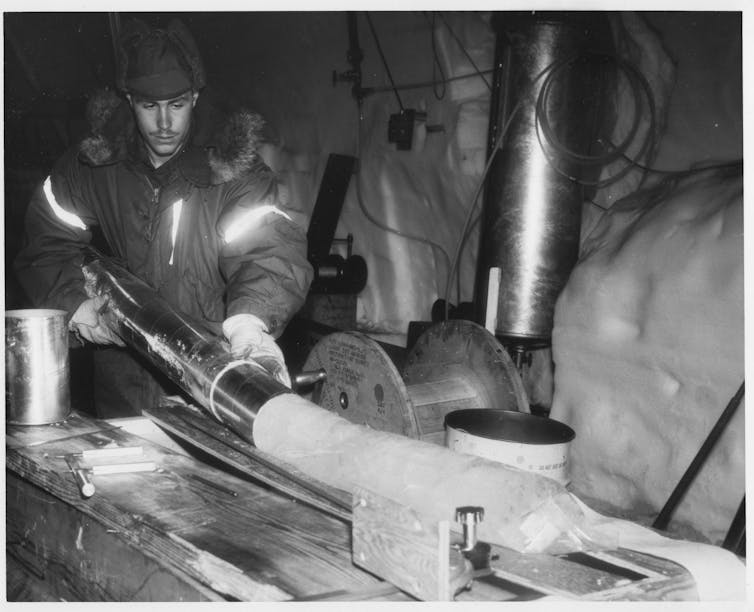
In July 1966, American scientists and U.S. Army engineers completed a six-year effort to drill through the Greenland ice sheet. The drilling took place at Camp Century, one of the military’s most unusual bases — it was nuclear powered and made up of a series of tunnels dug into the Greenland ice sheet.
The drill site in northwest Greenland was 138 miles from the coast and underlain by 4,560 feet of ice. Once they reached the bottom of the ice, the team kept drilling 12 more feet into the frozen, rocky soil below.
George Linkletter, working for the U.S. Army Corps of Engineers Cold Regions Research and Engineering Laboratory, examines a piece of ice core in the science trench at Camp Century. The base was shut down in 1967. U.S. Army Photograph
In 1969, geophysicist Willi Dansgaard’s analysis of the ice core from Camp Century revealed for the first time the details of how Earth’s climate had changed dramatically over the last 125,000 years. Extended cold glacial periods when the ice expanded quickly gave way to warm interglacial periods when the ice melted and sea level rose, flooding coastal areas around the world.
For nearly 30 years, scientists paid little attention to the 12 feet of frozen soil from Camp Century. One study analyzed the pebbles to understand the bedrock beneath the ice sheet. Another suggested intriguingly that the frozen soil preserved evidence of a time warmer than today. But with no way to date the material, few people paid attention to these studies. By the 1990s, the frozen soil core had vanished.
Several years ago, our Danish colleagues found the lost soil buried deep in a Copenhagen freezer, and we formed an international team to analyze this unique frozen climate archive.
In the uppermost sample, we found perfectly preserved fossil plants — proof positive that the land far below Camp Century had been ice-free some time in the past — but when?
Exquisitely preserved fossils of more than 400,000-year-old moss, on the left, and a sedge seed on the right, found in the soil core from beneath the Greenland ice sheet, help tell the story of what lived there when the ice was gone. Halley Mastro/University of Vermont
Dating ancient rock, twigs and dirt
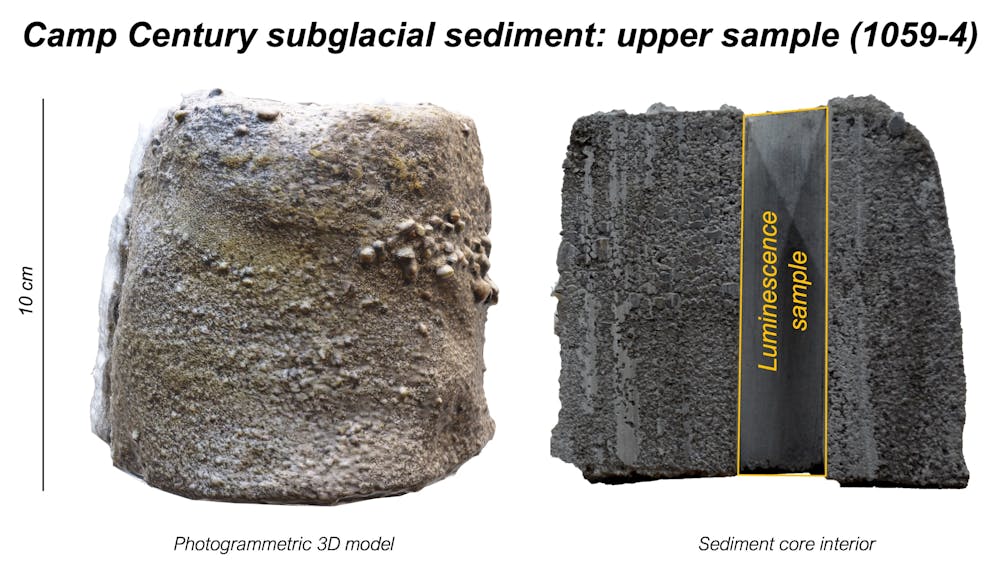
Using samples cut from the center of the sediment core and prepared and analyzed in the dark so that the material retained an accurate memory of its last exposure to sunlight, we now know that the ice sheet covering northwest Greenland — nearly a mile thick today — vanished during the extended natural warm period known to climate scientists as MIS 11, between 424,000 and 374,000 years ago.
The uppermost sample of the Camp Century sub-ice sediment core tells a story of vanished ice and tundra life in Greenland 416,000 years ago. Andrew Christ/University of Vermont
To determine more precisely when the ice sheet melted away, one of us, Tammy Rittenour, used a technique known as luminescence dating.
Over time, minerals accumulate energy as radioactive elements like uranium, thorium, and potassium decay and release radiation. The longer the sediment is buried, the more radiation accumulates as trapped electrons.
In the lab, specialized instruments measure tiny bits of energy, released as light from those minerals. That signal can be used to calculate how long the grains were buried, since the last exposure to sunlight would have released the trapped energy. https://www.youtube.com/embed/TpZVa7O863A?wmode=transparent&start=0 How optically stimulated luminescence works.
Paul Bierman’s laboratory at the University of Vermont dated the sample’s last time near the surface in a different way, using rare radioactive isotopes of aluminum and beryllium.
These isotopes form when cosmic rays, originating far from our solar system, slam into the rocks on Earth. Each isotope has a different half-life, meaning it decays at a different rate when buried.
By measuring both isotopes in the same sample, glacial geologist Drew Christ was able to determine that melting ice had exposed the sediment at the land surface for less than 14,000 years.
Ice sheet models run by Benjamin Keisling, now incorporating our new knowledge that Camp Century was ice-free 416,000 years ago, show that Greenland’s ice sheet must have shrunk significantly then.
At minimum, the edge of the ice retreated tens to hundreds of miles around much of the island during that period. Water from that melting ice raised global sea level at least 5 feet and perhaps as much as 20 feet compared to today.
Warnings for the future
The ancient frozen soil from beneath Greenland’s ice sheet warns of trouble ahead.
During the MIS 11 interglacial, Earth was warm and ice sheets were restricted to the high latitudes, a lot like today. Carbon dioxide levels in the atmosphere remained between 265 and 280 parts per million for about 30,000 years. MIS 11 lasted longer than most interglacials because of the impact of the shape of Earth’s orbit around the sun on solar radiation reaching the Arctic. Over these 30 millennia, that level of carbon dioxide triggered enough warming to melt much of the Greenland’s ice.
Today, our atmosphere contains 1.5 times more carbon dioxide than it did at MIS 11, around 420 parts per million, a concentration that has risen each year. Carbon dioxide traps heat, warming the planet. Too much of it in the atmosphere raises the global temperature, as the world is seeing now.
Over the past decade, as greenhouse gas emissions continued to rise, humans experienced the eight warmest years on record. July 2023 saw the hottest week on record, based on preliminary data. Such heat melts ice sheets, and the loss of ice further warms the planet as dark rock soaks up sunlight that bright white ice and snow once reflected.
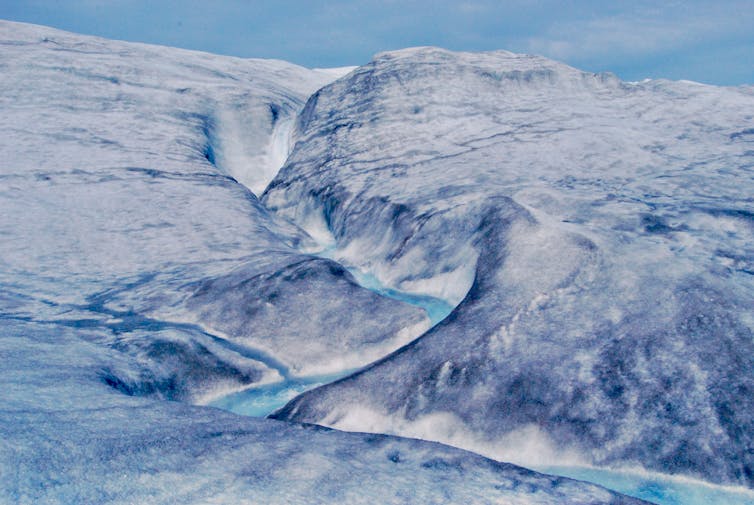
At midnight in July, meltwater pours over the Greenland ice sheet in a meandering channel. Paul Bierman
Even if everyone stopped burning fossil fuels tomorrow, carbon dioxide levels in the atmosphere would remain elevated for thousands to tens of thousands of years. That’s because it takes a long time for carbon dioxide to move into soils, plants, the ocean and rocks. We are creating conditions conducive to a very long period of warmth, just like MIS 11.
Unless people dramatically lower the concentration of carbon dioxide in the atmosphere, evidence we found of Greenland’s past suggests a largely ice-free future for the island.
Everything we can do to reduce carbon emissions and sequester carbon that is already in the atmosphere will increase the chances that more of Greenland’s ice survives.
The alternative is a world that could look a lot like MIS 11 — or even more extreme: a warm Earth, shrinking ice sheets, rising sea level, and waves rolling over Miami, Mumbai, India and Venice, Italy.
To hear them tell it, House Republicans are solely focused on fiscal conservatism, on undercutting the appropriations levels agreed to in the Kevin McCarthy-Joe Biden debt ceiling law so they can “rein in federal spending.”
That’s what they’d like to be fighting about. But their actions, the riders they’ve larded up these bills with, reveal a different priority: an obsession with fighting battles in the culture war, a fixation on extinguishing any semblance of abortion access in particular, no matter the repeatedly demonstrated political radioactivity of the issue post-Dobbs.
A new episode of The Josh Marshall Podcast is live! This week, Josh and Kate discuss the potential, looming Donald Trump indictment in Jack Smith’s January 6 case and House Republicans’ torpedoing of the government funding process.
You can listen to the new episode of The Josh Marshall Podcast here.