A Brief History Of The Ku Klux Klan Acts: 1870s Laws To Protect Black Voters, Ignored For Decades, Now Being Used Against Trump

This article is part of TPM Cafe, TPM’s home for opinion and news analysis. It was originally published at The Conversation.

In the indictment against former President Donald Trump and his role in the Jan. 6 violent attack against the U.S. Capitol, special prosecutor Jack Smith charged the former president with violating four different federal laws – and Trump pleaded not guilty to each one of them on Aug. 3, 2023.

Three of the charges in United States of America v. Donald J. Trump are fairly easy to understand. They require a jury to determine whether Trump tried to overturn the lawful results of the 2020 election and if he knowingly conspired to obstruct the certification of results on Jan. 6, 2021, all in an attempt to remain in the White House.

But the fourth charge against Trump – of conspiring against the rights of the voters to cast ballots and have them fairly and honestly counted – is more complicated, and it comes from a dark time in U.S. history.

As a historian who studies and writes about democracy and the American South, I believe the 1870s have something to teach us about the fourth count in the Jan. 6 case against Trump.

Ku Klux Klan Acts

The indictment asserts that Trump knowingly conspired “to injure, oppress, threaten, and intimidate one or more persons in the free exercise and enjoyment of a right and privilege secured to them by the Constitution and laws of the United States – that is, the right to vote, and to have one’s vote counted.”

That quote comes from a series of laws enacted in the 1870s called the Ku Klux Klan Acts. They are officially known as the Enforcement Acts because they empowered the federal government to enforce the Civil War amendments – the 13th, 14th and 15th amendments that freed enslaved people and guaranteed equal protection of the laws and the right to vote.

As the Brennan Center for Justice points out, in the 20th century the Supreme Court has ruled that all sorts of election infringements violate the Enforcement Acts, including stuffing ballot boxes and bribing voters. A suspect doesn’t have to commit violence against Black voters to violate the law.
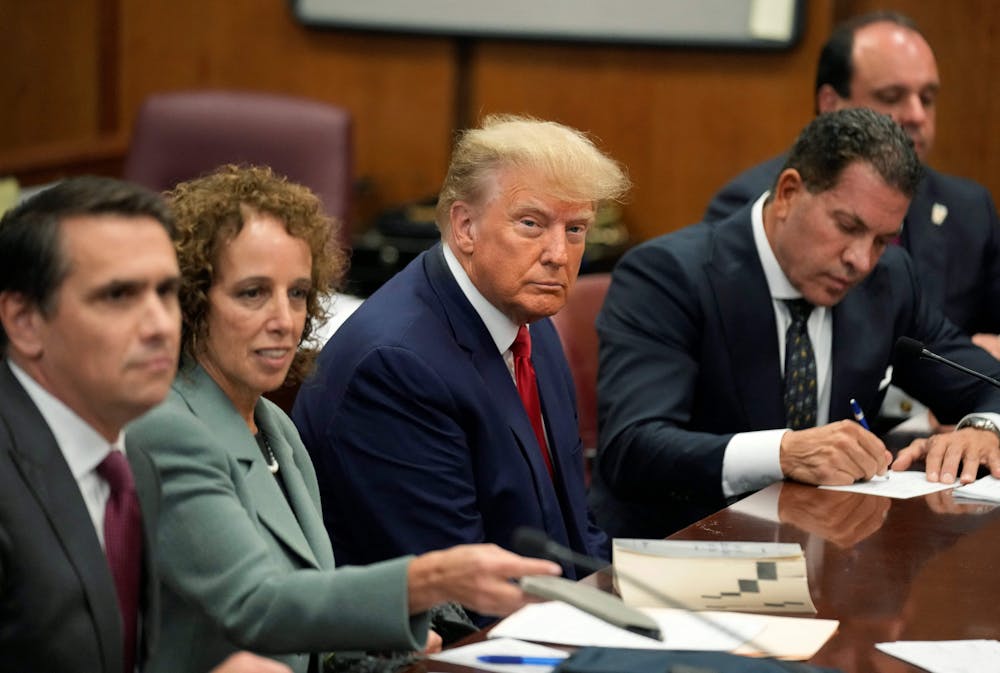
Five people sitting on one side of a table with papers on the table in front of them.
Former President Donald Trump with his attorneys inside the courtroom during his arraignment at the Manhattan Criminal Court on April 4, 2023. Seth Wenig/AFP via Getty Images

Retreat from democracy

When the Ku Klux Klan tried to steal the 1872 presidential election by killing and intimidating newly enfranchised Black men, federal troops swooped into South Carolina and arrested hundreds of Klansmen. The Department of Justice secured convictions in 140 cases by using the law that is being used to prosecute Trump.

Congress had to expand the attorney general’s staff into an entire department of government to handle the excessive case load.

The Klan prosecutions worked.

The 1872 election was relatively free and fair. In South Carolina, where the Black population outnumbered the white population, President Ulysses Grant, who had commanded the Union Army in the Civil War and led it to victory over the Confederacy, won with 75% of the vote.

After Grant was reelected, many champions of Black rights lapsed into what historians often characterize as a moral fatigue. According to historian Eric Foner’s “Reconstruction: America’s Unfinished Revolution,” a “resurgence of overt racism” in the North triggered a “retreat from Reconstruction.”

The turning point was at Colfax, Louisiana.

Just before Easter in 1873, federal soldiers steamed up Louisiana’s Red River to investigate reports of yet another wave of white terrorism against Black citizens.

As later described by Col. T.W. DeKlyne, as the soldiers approached the town of Colfax, they saw neglected neglected crops and abandoned farmhouses. They followed a trail of corpses to the charred, smoking remains of the courthouse, whose grounds were strewn with more dead bloating in the sun. Some were burnt. Others had been shot, execution style, in the back of the head.

In his history of the Colfax massacre, journalist Charles Lane estimated that between 62 and 81 Black men were killed, most after they surrendered to the white militia.

Despite the bloodshed, Louisiana officials did nothing to hold the murderers accountable.

But federal attorneys indicted 98 men. Nine stood trial, including one William Cruikshank, who Lane described as the “burly, self-confident” plantation owner who had supervised the executions.

Cruikshank was convicted not of murder but of the federal crime of conspiring to violate the civil and voting rights of Americans – the same crime that Trump is charged with.

The case was appealed to the Supreme Court, where justices heard all sorts of arguments on the authorities of state and federal governments to enforce voting rights laws. But the real issue was whether the federal government, 11 years after the end of the Civil War, still had the will to protect the civil rights of Black people.
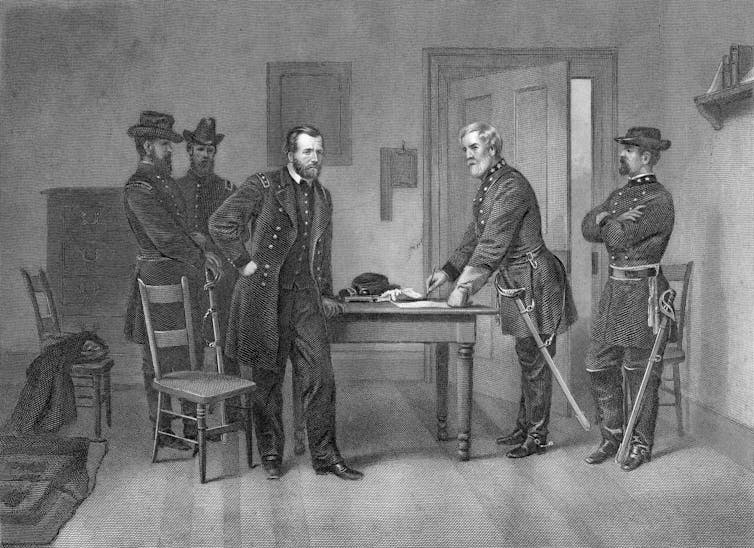
A white man dressed in a dark military uniform stands at a table with another white man dressed in a military uniform.
In this illustration, Gen. Ulysses S. Grant, left, accepts the surrender of Gen. Robert E. Lee. Getty Images

The Supreme Court set William Cruikshank free, and white supremacists established racist regimes in every Southern state for nearly 100 years thereafter.

According to Nicholas Lemann, professor emeritus at Columbia University, the Civil War did not end in 1865 at Appomattox Court House – the Virginia village where Confederate Gen. Robert E. Lee surrendered his forces to Union Gen. Ulysses S. Grant.

The last battle, he contends, was fought at Colfax, and the South won. The South staged unfair elections for the nearly the next 100 years. Not until the Voting Rights Act of 1965 did the federal government signal it would force states to hold free and fair elections.

Civil War amendments today

The latest retreat by the Supreme Court from defending Black civil rights might have begun in 2013, in its Shelby County v. Holder ruling, in which the justices abolished a key part of the 1965 Voting Rights Act that ensured federal oversight of voting rules in areas with a history of discrimination. The 5-4 majority held that states could be trusted to guarantee citizens’ voting rights.

Writing in dissent, Justice Ruth Bader Ginsburg compared enforcing the Civil War amendments to “battling the Hydra,” the multiheaded monster that sprouted new heads after one was defeated.

In North Carolina, for instance, the Republican lawmakers tried to put what is known as the “independent state legislature theory” into practice. That theory holds that state legislatures are the supreme authority in federal elections.

But in the Moore v. Harper case, Chief Justice John Roberts disagreed and wrote in the 6-3 majority opinion on June 27, 2023, that the “federal court must not abandon their own duty to exercise judicial review” over elections.

Given this long history of advance and retreat, it’s not surprising, then, that special counsel Jack Smith, in his use of a law to prosecute Trump that dates back to the Reconstruction Era’s laws protecting the Black vote, has reasserted the Department of Justice’s power to enforce the Civil War amendments.

This article is republished from The Conversation under a Creative Commons license. Read the original article.

The Conversation

Is Dead Bounce Ron Going YOLO?

There’s a big flutter in GOP primary election news today that Dead Bounce Ron (formerly known as Ron DeSantis) is edging his way up to denouncing the Big Lie. In Iowa today he declared that “all those theories that were put out did not prove to be true” and, even worse, that they were “unsubstantiated.” TPM Reader AB told me it could be a tipping point: “If the other candidates finally call Trump out as a loser, and he has to run on the lame ass claim he actually won within his own party, it could pierce his armor.” While noting that it could just be wishful thinking, he insisted that “once Trump gets branded a loser by members of his own party he could go down fast.”

As you’ll see from the first quote, DBR leveled the accusation in the passive voice, both substantively and grammatically. He didn’t even use the guy’s name! Indeed, as per usual, the purported swipes at Trump tell us not so much about any true slackening of Trump’s domination but rather the vast extent of it.

Continue reading “Is Dead Bounce Ron Going YOLO?”

Multimillion-Dollar ‘Disinformation Campaign’ Seeks To Make Ohio’s Big Abortion Vote About ‘Sex Change’ Operations

Lil Miss Hot Mess, a prominent drag queen, realized about a week ago that she had been pulled into a fight over abortion in Ohio, which is over a thousand miles from her current home. The news came via a message from a friend, who tipped Lil Miss Hot Mess off that she was starring in an ad paid for by the group Protect Women Ohio. The commercial warned an upcoming ballot measure, “State Issue 1,” would allow “out-of-state special interest groups” to “enshrine late-term abortion in our constitution and abolish parental rights so someone can take your child to get an abortion or sex change operation without your consent.” Along with this ominous message, the ad featured footage of Lil Miss Hot Mess participating in a “Drag Story Hour” event alongside images of happy families with prepubescent children. 

Continue reading “Multimillion-Dollar ‘Disinformation Campaign’ Seeks To Make Ohio’s Big Abortion Vote About ‘Sex Change’ Operations”

Mike Pence’s Vaguely Inspiring Supervised Visit with His Dignity

There’s this strong tendency with some people, that whenever you point to any comment from former Vice President Mike Pence that’s non-terrible, to immediately chime in, “It’s too late!” “He had his chance!” “Pathetic!”

But really all those things are a given and yet it’s still worth noting even his most trivial shifts in the direction of salvaging some frail shadow of dignity. I say this all to preface the observation that Trump’s coup indictment and his own conspicuous role in the indictment narrative and chain of evidence seem finally to have convinced Pence that this is a divide he simply cannot straddle. You’re either on Team Coup or you’re not.

Some quotes from the 48 hours after the indictment was handed down.

Continue reading “Mike Pence’s Vaguely Inspiring Supervised Visit with His Dignity”

Tennessee Dems Expelled After Gun Protest Win Back Seats In Special Election

Reps. Justin Pearson of Memphis and Justin Jones of Nashville both comfortably reclaimed their legislative seats in the Tennessee House in a Thursday special election.

Continue reading “Tennessee Dems Expelled After Gun Protest Win Back Seats In Special Election”

Don’t Miss The Import Of Jack Smith’s Comments About Jan. 6

A lot of things happened. Here are some of the things. This is TPM’s Morning Memo. Sign up for the email version.

Context Matters

In his brief 2-minute remarks at Main Justice Tuesday, Special Counsel Jack Smith placed the new indictment of former President Trump squarely in the context of the hundreds of other federal prosecutions related to the Jan. 6 attack.

Here’s the key line from Smith:

Since the attack on our Capitol, the Department of Justice has remained committed to ensuring accountability for those criminally responsible for what happened that day. This case is brought consistent with that commitment.

In tying this case directly to the Capitol attack and the other prosecutions – even though the charges against Trump don’t yet include seditious conspiracy or anything akin to incitement to riot – Smith has made this prosecution the ultimate prize as DOJ worked its way up the ladder from random rioters to Oath Keepers and Proud Boys to the White House itself.

For the federal judges in DC who have handled dozens of Jan. 6 cases each, the context is clear. Trump is the big fish. And his conduct will be judged with that broader context firmly in mind. So too will sentencing occur in the context of the hefty prison terms handed down for the worst of the rioters and the right-wing extremist groups who formed an initial vanguard for the attack.

Remember Oath Keepers founder Stewart Rhodes has the longest prison sentence to date: 18 years. No federal judge in DC could sentence Trump without having that context firmly in their minds.

The Third Trump Arraignment

  • WaPo: Packed courtroom, somber defendant. A recap of Donald Trump’s arraignment
  • NYT: Four takeaways from Trump’s court appearance.
  • Bloomberg: Trump’s ‘Very Sad Day for America’ Went About as Expected
  • Politico: Donald Trump, Jack Smith and a historic glance

Notable

Jarring Moment

CNN reported that rival campaigns were complaining that Trump sucks up all the oxygen – while CNN was using O.J.-style coverage of Trump motorcading from the airport to the DC federal courthouse live with a reporter and cameraperson embedded.

When A Trial?

  • Politico: “Depending on whom you ask, Donald Trump’s trial on charges that he sought to subvert the 2020 election could happen in 70 days. Or in three years.”
  • TPM’s Josh Marshall: “[I]t’s clear that pushing the trial out past the election is an almost existential goal for Trump and his lawyers.”

Who Is Co-Conspirator 6?

The identity of the sixth unindicted co-conspirator remains unconfirmed, but a couple of clues as to who it is NOT.

And So It Goes …

WaPo: Jeffrey Clark is GOP star after trying to use DOJ to overturn election

Still Can’t Get Enough?

Here’s some more reading on the latest Trump indictment:

  • Just Security: The principal author of the Jan. 6 committee report compares it to the Trump indictment
  • Empty Wheel: The Elements Of Offense In The Trump Jan. 6 Indictment

Kagan: SCOTUS Struggling To Agree On Ethics Code

A couple of key quotes from a public appearance by Supreme Court Justice Elena Kagan at the Ninth Circuit Judicial Conference in Portland, Oregon:

“It’s not a secret for me to say, we’ve been discussing this issue, and it won’t be a surprise to know that the nine of us have a variety of views about this — and about most things,” Kagan said, drawing laughter from hundreds of lawyers and judges attending a judicial conference. “We’re nine freethinking individuals.”

“It just can’t be that the court is the only institution that somehow is not subject to checks and balances from anybody else. We’re not imperial. … Can Congress do various things to regulate the Supreme Court? I think the answer is: yes.”

Tennessee Three Members Re-Elected

Expelled Tennessee Democratic state Reps. Justin Pearson and Justin Jones were overwhelmingly re-elected to the House in special elections.

Justice Done

Six white former Mississippi sheriff’s deputies pleaded guilty to federal civil rights violations for torturing two Black men in January.

Stand Strong

The College Board would not bend to Florida’s demand to change sections of the AP race, gender, and sexual orientation – and then recommended that Florida schools no longer offer the class.

What A Fiasco

Texas A&M has reached a $1 million settlement with Kathleen McElroy, the Black journalism professor from the University of Texas whom it tried to hire then jerked around under pressure from regents and out of fear of a backlash from conservative lawmakers.

Noted In Passing

Sen. Dianne Feinstein (D-CA) has granted power of attorney for legal matters to her daughter.

Remembering An Alt-Weekly Legend

Phoenix New Times co-founder Jim Larkin, a feisty, relentless, fearless publisher in his heyday, has died of suicide just a week before his re-trial on federal criminal charges related to his prior ownership of Backpage. A previous prosecution ended in a mistrial.

Uh-Oh …

WaPo: The world just got its first real taste of what life is like at 1.5 degrees Celsius

Small Silver Linings

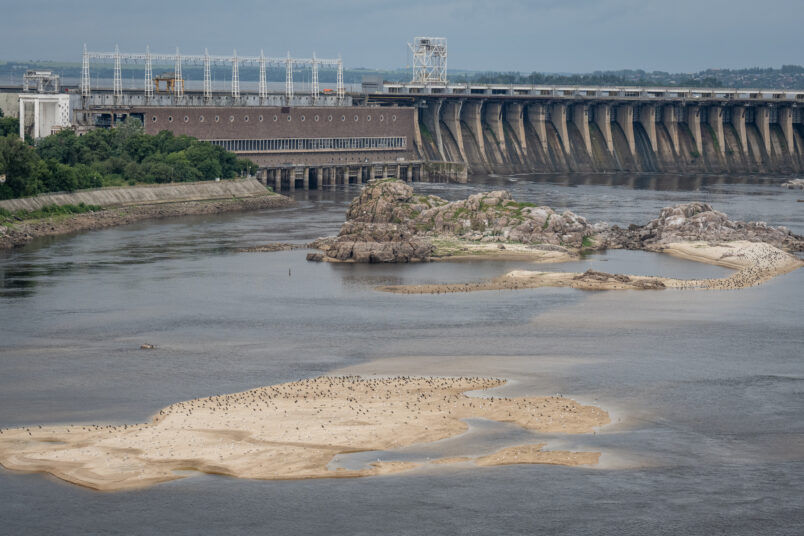
ZAPORIZHZHIA, UKRAINE – JULY 28: The sandy riverbed can be seen below the Zaporizhzhia hydroelectric dam, as Ukrainians cope with dramatic changes to their landscape after Russia blew up the Kakhovka Dam on June 6, which emptied the miles-long reservoir behind it, causing extensive flooding downstream, and lowering water levels of the Dnipro River, which has left boats, docks, and industries dependent on the water struggling in Zaporizhzhia, Ukraine, on July 28, 2023. (Photo by Scott Peterson/Getty Images)

The destruction of Ukraine’s Kakhovka dam and the resultant draining of the reservoir behind it has exposed a wealth of artifacts for archaeologists.

Like Morning Memo? Let us know!

Bluster, Menace and Trial Calendars

I deliberately avoided getting pulled into today’s play-by-play and drama. I kept up on it by dropping in on our team’s live blog. But with the day over, every account and image I’ve seen of today’s events reads like a man, yes, overcome by rage but even more overcome by fear. His Truth Social platform has a bit of an air of The Wizard of Oz, bellowing and menace. But out from behind the curtain he’s a much smaller figure.

The simple fact is that if Donald Trump isn’t elected in November 2024, there’s a good chance he’ll spend a good part or most of the rest of his life in prison. That would terrify anyone. Especially someone who experiences powerlessness, being dominated as a kind of death.

Continue reading “Bluster, Menace and Trial Calendars”

Where Things Stand: Arizona Republicans Realize That Hand Counting Ballots Is Actually Really Annoying

An Arizona county run by Republicans recently voted against moving forward with plans to try to get rid of electronic ballot-counting machines and to conduct the tabulation of the 2024 election by hand. While initially propelled in part by conspiracy theories about voting machines, the all-Republican county board of supervisors determined that ultimately moving to a hand count would be too expensive and the methodology too unreliable.

Continue reading “Where Things Stand: Arizona Republicans Realize That Hand Counting Ballots Is Actually Really Annoying”

Senate Dems Ask Roberts To ‘Ensure’ Alito Recuse From Key Tax Case

Democrats on the Senate Judiciary Committee asked Chief Justice John Roberts to “take appropriate steps” so that Justice Samuel Alito would recuse himself from a tax case that the Court agreed to hear next term, as well as any cases involving laws that regulate the High Court.

Continue reading “Senate Dems Ask Roberts To ‘Ensure’ Alito Recuse From Key Tax Case”