

A mass of documents gathered in the course of a defamation lawsuit against the proponents of the Big Lie is out, providing depositions with those who led the fight to overturn last year’s election and records that shed new light on the effort.
Continue reading “5 Points On The Newly Released Testimony Of Rudy! Sidney! And The Big Lie Gang”Police Killings In The US Have Been Undercounted By More Than Half In Official Statistics
This article is part of TPM Cafe, TPM’s home for opinion and news analysis. It first appeared at The Conversation.
The number of people killed by police officers in the U.S. has been massively underreported in official statistics over the past four decades, with an additional 17,000 deaths over that period, according to our new research.
Continue reading “Police Killings In The US Have Been Undercounted By More Than Half In Official Statistics”Don’t Be Surprised About Facebook and Teen Girls. That’s What Facebook Is.
You’ve probably seen the latest controversy about Facebook/Instagram leading vulnerable teenagers to anorexia, fat-shaming content that seems almost designed to send teenage girls and some boys into spirals of self-loathing and unsafe behaviors. What jumps out to me about this latest controversy is that most people still don’t grasp that things like this are close to inevitable because of what Facebook is. It’s foundational to the product. It is not surprising.
Let me explain. First, set aside all morality. Let’s say we have a 16 year old girl who’s been doing searches about average weights, whether boys care if a girl is overweight and maybe some diets. She’s also spent some time on a site called AmIFat.com. Now I set you this task. You’re on the other side of the Facebook screen and I want you to get her to click on as many things as possible and spend as much time clicking or reading as possible. Are you going to show her movie reviews? Funny cat videos? Homework tips? Of course, not. If you’re really trying to grab her attention you’re going to show her content about really thin girls, how their thinness has gotten them the attention of boys who turn out to really love them, and more diets. If you’re clever you probably wouldn’t start with content that’s going to make this 16 year old feel super bad about herself because that might just get her to log off. You’ll inspire or provoke enough negative feelings to get clicks and engagement without going too far.
Continue reading “Don’t Be Surprised About Facebook and Teen Girls. That’s What Facebook Is.”Trump DOJ’er Jeffrey Clark Should Face Probe For Role In Election Theft Attempt, Lawyers Say
A group of high-profile lawyers on Tuesday called for the Washington, D.C. Court of Appeals to investigate Jeffrey Clark, a former Department of Justice official, for his efforts to have the DOJ declare the 2020 election results unreliable.
Continue reading “Trump DOJ’er Jeffrey Clark Should Face Probe For Role In Election Theft Attempt, Lawyers Say”Are We Heading to a Debt Default Filibuster Carve-out?
I’m starting to think this latest bout of debt limit hostage taking will end with a filibuster carve out. On its face that seems highly improbable given the resistance through the year from Manchin and Sinema. And I think Manchin has said no way to this specifically. So it seems really improbable. But we’re down to very improbable outcomes and this is starting to seem like the least improbable one.
Let’s walk through the scenarios.
Continue reading “Are We Heading to a Debt Default Filibuster Carve-out?”The Work Continues After Progressives Rescue Two-Track Infrastructure Plan
Negotiations over the $3.5 trillion reconciliation bill for President Joe Biden’s Build Back Better plan are back on after House Speaker Nancy Pelosi (D-CA) ultimately declined to bring the bipartisan infrastructure bill (BIF) to a vote last week due to progressives’ threat to sink it if it were put to a vote before the reconciliation package is ready.
The White House and Democratic leaders are working to hammer out a deal with Sens. Joe Manchin (D-WV) and Kyrsten Sinema (D-AZ), who both complain that the price for reconciliation — $3.5 trillion — is too high. Manchin’s put his top line at $1.5 trillion, and Sinema has yet to say publicly what she wants.
Pelosi told her Democratic colleagues on Saturday that she wants to pass BIF before October 31.
Follow our live coverage below:
Bar Complaint Filed Against Coup-Planning Lawyer John Eastman In California
Disbarment For Couping?
A nonpartisan election integrity group is demanding an investigation into whether John Eastman, the conservative legal scholar who mapped out a potential plan for then-Vice President Mike Pence to steal the 2020 election for Trump, engaged in professional misconduct.
- The States United Democracy Center sent a letter to the California bar association on Monday requesting that the state bar examine whether Eastman “violated his ethical obligations as an attorney by filing frivolous claims, making false statements and engaging in deceptive conduct.”
- The letter’s signatories included two former California Supreme Court justices plus an ex-GOP governor and an Obama official.
- “Is it now a disbarrable offense to engage in political speech, First Amendment protected?” Eastman asked in response to the group’s complaint while hinting that he might fire back with a defamation suit.
- The bar complaint comes as other Trumpland lawyers, including Rudy Giuliani and Sidney Powell, face bar investigations for misusing the courts to overturn the election.
Garland Defends DOJ’s Handling Of Jan. 6 Insurrectionist Cases
Attorney General Merrick Garland is on the defensive after observers (including a judge) criticized what they see as prosecutors’ kid glove treatment of the people who stormed the Capitol on Jan. 6.
- The prosecutors are “making determinations in every case about what charge fits the offense, what charge fits the law,” Garland argued during a discussion at The New Yorker Festival on Monday.
- The criticism is “part of the territory for any prosecutor in any case,” the attorney general added.
Sinema Gets Confronted By Activists Again
Protesters greeted Sen. Kyrsten Sinema (D-AZ) at Ronald Reagan Washington National Airport yesterday after she returned from a trip to her home state for a medical appointment (according to her office) and a fundraiser in Phoenix:
During Sinema’s flight, a woman claiming to be a DACA recipient tried to talk to the senator about using the reconciliation bill to build a pathway to citizenship for undocumented immigrants.
- The activist asks Sinema to commit to including immigration reform in the legislation. The senator largely ignored her.
- New York Times opinion writer Michelle Goldberg’s latest column has an incredible anecdote about Sinema organizing a protest against then-Sen. Joe Lieberman (D-CT) in 2003, whom she called “a shame to Democrats.”
- “I don’t even know why he’s running,” Sinema said at the time. “He seems to want to get Republicans voting for him — what kind of strategy is that?”
Top State Official Blasts Biden’s Trumpian Treatment Of Haitian Migrants
Harold Koh, a political appointee at the State Department who is leaving his position as a senior legal adviser, has circulated a memo internally blasting the Biden administration’s “inhumane” expulsions of Haitian migrants at the border via Trump’s Title 42 policy.
- Koh pointed to Biden’s declaration that the shocking images of Border Patrol agents charging at migrants on horseback were “not who we are.”
- “The same could be said of current illegal and inhumane policy of Title 42 expulsions,” Koh wrote. “It simply is not worthy of this Administration that I so strongly support.”
- Koh’s internal memo came less than two weeks after the U.S. special envoy to Haiti, Daniel Foote, resigned in protest over the Biden administration’s “deeply flawed” policies on Haitian refugees.
- “I will not be associated with the United States inhumane, counterproductive decision to deport thousands of Haitian refugees and illegal immigrants to Haiti, a country where American officials are confined to secure compounds because of the danger posed by armed gangs to daily life,” Foote wrote in a particularly blistering letter to Secretary of State Antony Blinken.
Facebook Goes Kaput
Facebook, along with its other services (Instagram, WhatsApp and Facebook Messenger), went down for more than five hours yesterday, a tragic day for COVID-19 vaccine truthers:
- More seriously, this New York Times article lays out the disturbing extent to which the global population depends on Facebook and its apps, particularly WhatsApp.
- The crash came the day before Facebook whistleblower Frances Haugen’s scheduled Senate hearing today to testify on how Facebook and its products “harm children,” “stoke division” and “weaken our democracy” by amplifying misinformation and extremism, according to her opening statement.
- Haugen gave a blockbuster interview on “60 Minutes” where she explained how Facebook failed to prevent the spread of the extremism that led to the Jan. 6 Capitol insurrection.
Desantis’ Wife Is Diagnosed With Cancer
Florida Gov. Ron DeSantis (R) announced yesterday that his wife, Casey, has been diagnosed with breast cancer.
Curiosities Across The Pond
Can our British readers please explain what Boris Johnson’s trying to do here?
Do you like Morning Memo? Let us know!
Where Things Stand: An Insider Account Of Facebook In The Days Before The Insurrection
Facebook, Instagram and other applications owned by the social media giant are all down today. The company is describing the outage as “networking issues,” while tech sleuths and new reports suggest the problem might be bigger than that.
I won’t speculate on technology as I know nothing about technology. But the outage comes just one day after a previously anonymous former Facebook executive and whistleblower went on “60 Minutes” to make new allegations concerning the company’s apathy about the dangerous spread of far-right disinformation on the platform.
Continue reading “Where Things Stand: An Insider Account Of Facebook In The Days Before The Insurrection”‘Consider This A Light Warning,’ Alleged Arsonist Warned In Note To Texas Dems
In the aftermath of an alleged attempted arson aimed at the Travis County, Texas Democratic Party headquarters last Wednesday, investigators said they recovered a note from the remnants of the blaze.
Continue reading “‘Consider This A Light Warning,’ Alleged Arsonist Warned In Note To Texas Dems”US Supreme Court Gets Set To Address Abortion, Guns and Religion
This article is part of TPM Cafe, TPM’s home for opinion and news analysis. It first appeared at The Conversation.
The Supreme Court begins its annual term on Oct. 4, 2021, with a packed agenda highlighted by three claims of violations of constitutional rights. One is about religious rights. A second is about gun rights.
And the biggest case this year is a challenge to abortion rights. Several states are asking the justices to reconsider Roe v. Wade – the landmark 1973 ruling that established the constitutional right for a woman to terminate a pregnancy, regardless of the moral beliefs of other citizens.
Abortion
The case is Dobbs v. Jackson Women’s Health. The Mississippi legislature passed the Gestational Age Act in 2018, banning abortions after 15 weeks. The law was challenged and is currently on pause until the Supreme Court hears arguments on Dec. 1, with a decision expected by June 2022.
Since 1973, the Supreme Court has recognized a fundamental right for a woman to make her own decision about bearing a child, up until the point of viability – when the fetus can survive on its own outside of the womb, which is at approximately 24 weeks of gestation.
However, several states have passed laws intentionally challenging the constitutionality of Roe by lowering the threshold to 15 weeks, as in Mississippi, or six weeks, as in Texas. The Republican legislatures of those states are hoping that a more conservative Supreme Court will overturn or modify the 1973 ruling.
Public opinion on abortion has remained remarkably stable in an era of political polarization. From the 1970s to now, around 20% of Americans have consistently believed abortion should be illegal under all circumstances. Another slightly larger group has believed it should be legal under all circumstances. And the largest group of Americans – around 50% – has favored legal availability with some restrictions.
The core legal question since 1973 – and especially with the case before the court – is what kind of restrictions should be permissible.
The justices will consider the longstanding debate over whether the Constitution protects a right to choose, or instead whether abortion falls outside of the realm of rights and squarely in the realm of majority rule to be decided by regular legislation.
But there is also a second question addressed in Roe, which is more often overlooked: whether a fetus is a person who also has rights, or instead whether a fetus is an aspect of the pregnant woman, whose rights are predominant. The Constitution provides no guidance on that second critical question, which is at the heart of the Mississippi case.
The court in 1973 decided that personhood does not emerge at conception nor wait until birth, but emerges during the course of the pregnancy at the point of viability. Hence, according to Roe, states could ban abortion after 24 weeks, but not before.
As an observer of constitutional politics, I suspect that if the court were ruling on this question for the first time, likely six of the justices would assert that the Constitution contains no specific right to abortion, instead leaving that decision to each state. They may also believe that decisions on the emergence of personhood, and therefore when abortion could be limited, are best left to individual states.
But Roe has been in force for almost 50 years and is often considered a “super precedent,” with even more force than other longstanding decisions. Chief Justice John Roberts has displayed a high regard for following precedent, while some of the more conservative justices like Samuel Alito and Clarence Thomas believe that precedent is no reason to prolong what they believe to be an error. Whether the court will leave Roe undisturbed, overturn Roe entirely, or maintain the principle of abortion rights while allowing states to lower the threshold of fetal personhood from 24 weeks to 15 weeks – or lower – is difficult to predict.
Guns
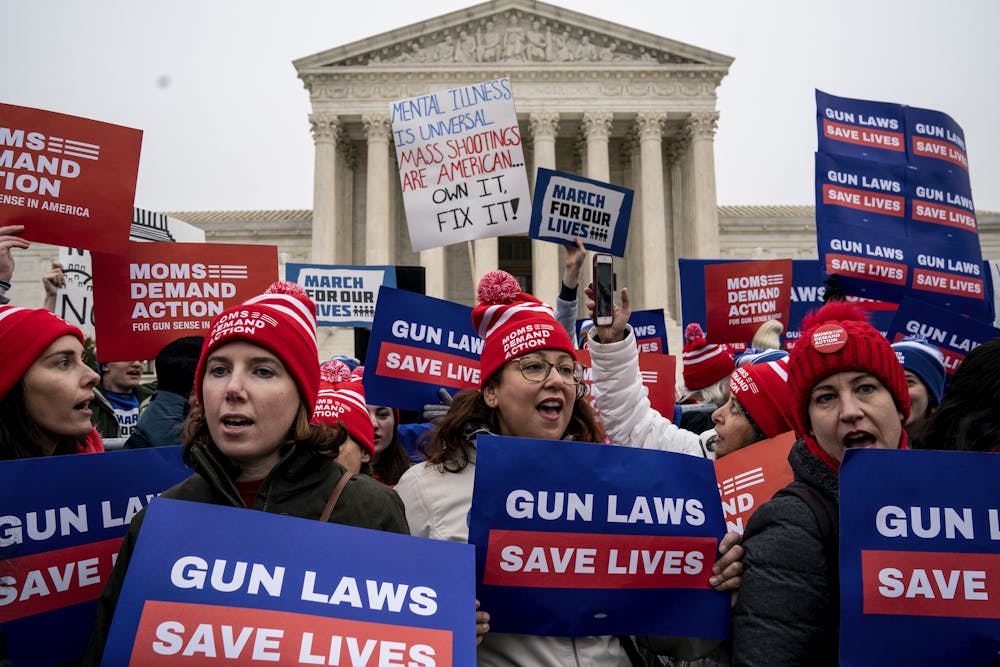
The court first recognized a fundamental right of citizens to bear arms for personal protection in the landmark rulings in D.C. v. Heller in 2008 and MacDonald v. Chicago in 2010. What has not been decided is how far the right extends outside the home. Can local governments limit the right to just protecting the home, or do citizens have a broader right to carry concealed weapons while out in society?
In New York Rifle & Pistol Association v. Bruen, the plaintiffs argue that the Second Amendment requires something more than the current practice of limiting licenses to carry concealed firearms to rare circumstances. Technically a private citizen can be granted a permit, but the stringent requirements in New York mean that in practice almost no licenses are issued.
In the plaintiffs’ view, a rule requiring a “proper cause” to award a license – such as being in imminent danger from a known source – limits the right to select people, rather than applying the Bill of Rights to ordinary people. The court will have to draw the lines regarding where, and to whom, the Second Amendment extends.
Religion
A clear trend on the current court is toward greater protection of religious liberty. This traces back to the controversial Hobby Lobby ruling in 2014, which allowed religious businesses to claim exemption from health care laws they say infringe on their beliefs. Most recently, in Fulton v. Philadelphia in June 2020, the court ruled in favor of a religious charity that had been excluded from the city of Philadelphia’s adoption programs because the organization refused to serve same-sex couples who wished to adopt or foster a child.
Many of the recent rulings expanding religious liberty were decided 7-2 or even 9-0 among the justices, with only the two most liberal justices, Ruth Bader Ginsburg and Sonia Sotomayor, sometimes dissenting. Now Sotomayor stands alone in rulings that would go 8-1, or, with the two more moderate liberals dissenting as well, 6-3.
However, when religion meets public education, the divide on the court becomes more dramatic between the conservatives and the liberals. In 2020, five justices struck down the exclusion of a US$150 tax credit for private school tuition when applied to a religious school, saying that if a state provides a benefit regarding private secular schools, it cannot deny the same opportunities to parents who choose religious schools. Four justices dissented on the grounds that any funding that benefits religious schools violates the First Amendment by creating impermissible entanglement between the government and religion.
This year, the court must decide if the same principle applied in the scholarship ruling applies at a larger scale. The state of Maine, where many communities do not have local public schools, reimburses a student’s tuition to attend private schools. But it doesn’t pay the same tuition for private religious schools.
In Carson v. Makin, the court will determine if a state may deny a public benefit on the grounds that it will be used to pay for explicit religious instruction, or whether the First Amendment demands entirely equal financial treatment of religious and secular private schools.
In each of these three major cases, a now conservative-dominated court – especially after the death of Justice Ruth Bader Ginsburg, who was replaced by Amy Coney Barrett – may move American constitutional law in a new direction.
Morgan Marietta is an associate professor of Political Science at the University of Massachusetts Lowell.
This article is republished from The Conversation under a Creative Commons license. Read the original article.