

Allen West, the Republican contender for Texas’ governorship and former party chair, was hospitalized with COVID Saturday night.
Continue reading “Allen West Hospitalized With COVID, Tweets Through It”Cheney Slams Scalise For ‘Perpetuating’ Big Lie: It’s An ‘Attack’ On ‘Constitutional Republic’
Rep. Liz Cheney (R-WY) rebuked her former fellow GOP leader, House Minority Whip Steve Scalise (R-LA), on Sunday for upholding ex-President Donald Trump’s lie that the 2020 election was stolen (it wasn’t).
Continue reading “Cheney Slams Scalise For ‘Perpetuating’ Big Lie: It’s An ‘Attack’ On ‘Constitutional Republic’”A Secretive Counterterrorism Team Interrogated Dozens of Citizens at the Border, Government Report Finds
This story first appeared at ProPublica. ProPublica is a Pulitzer Prize-winning investigative newsroom. Sign up for The Big Story newsletter to receive stories like this one in your inbox.
A new government report has revealed that a secretive counterterrorism team interrogated dozens of American activists and journalists at the border as part of the Trump administration’s sweeping response to fears about a large migrant “caravan” that was making its way to the United States’ southern border.
A ProPublica story in May first revealed the involvement of the counterterrorism team. But the new report, from the Department of Homeland Security’s inspector general, shows the unit’s assignment was far broader than previously known.
According to the report, at least 51 U.S. citizens were flagged for interrogation — often based on evidence as flimsy as once having ridden in a car across the border with someone suspected of aiding the caravan.
Thirty-nine of those Americans crossed the border shortly after being flagged and were detained and interrogated. All of those interrogations, the report found, were conducted by members of the Tactical Terrorism Response Team, a little-known unit of Customs and Border Protection trained in counterterrorism, not immigration issues. The existence of the inspector general’s report was first disclosed by Politico.
Tarek Ismail of the City University of New York, who’s been investigating the role of the counterterrorism units and is part of a Freedom of Information Act lawsuit seeking documents on them, told ProPublica that he’d never seen the unit’s work detailed in a government report before. “There’s so little information out there about the TTRT that it’s astounding that the report talks about them in such a matter-of-fact way, as if it’s nothing to be concerned about,” he told ProPublica.
In the fall of 2018, thousands of Central Americans migrating together for safety had become a fixation of President Donald Trump and his administration. The federal government sent a surge of intelligence and security forces to the southern border in what it dubbed Operation Secure Line, which ultimately led to the dragnet interrogations.
The government initially maintained that it was investigating confrontations between migrants and agents. But the Trump administration then said it was looking into whether activists were abetting smuggling by “encouraging” migrants to enter the U.S.
Taylor Levy, one of the citizens targeted by CBP’s effort (and who was involved in the FOIA case that first disclosed the counterterrorism agents’ involvement this spring), told ProPublica the new report validated her suspicions. “I’m not paranoid, my friends aren’t paranoid. This really did happen. It was a targeted campaign of surveillance,” she said.
In one case, the inspector general’s report says, two lawyers were flagged for interrogation because they had previously crossed the border with someone suspected of running a WhatsApp group associated with the caravan. In another case, a U.S. citizen was flagged for crossing into the U.S. with someone who was, months later, identified as a potential caravan organizer.
The report notes that citizens are only supposed to be flagged for border interrogations when they are suspected of criminal activity themselves. But officials were either unaware of the decades-old policy or ignored it. At least two senior officials told investigators that people could be stopped for questioning for “virtually any reason,” according to the report.
In a response included with the report, CBP agreed to update its training to clarify that flags “should only be created for law enforcement purposes.” It did not say it would limit future interrogations to people suspected of criminal activity themselves.
CBP referred ProPublica to its published response to the inspector general’s report, and it did not comment on whether any agents had been or would be disciplined in response to the report’s findings.
Schiff Blasts GOP For Becoming ‘An Autocratic Cult Around’ Trump
Rep. Adam Schiff (D-CA), who chairs the House Intelligence Committee and serves on the panel investigating the Jan. 6 attack on the Capitol, on Sunday criticized the Republican Party by characterizing it as “an autocratic cult around Donald Trump” that is “not interested in governing.”
Continue reading “Schiff Blasts GOP For Becoming ‘An Autocratic Cult Around’ Trump”Jayapal: Biden ‘Agrees With’ $3.5 Trillion Reconciliation Price Tag Despite Lower Topline Proposal
Rep. Pramila Jayapal (D-WA), chair of the Congressional Progressive Caucus, on Sunday said that President Biden “agrees with” the reconciliation package’s $3.5 trillion price tag after she reportedly urged him against straying too far from that figure amid centrists putting up a fight over it.
Continue reading “Jayapal: Biden ‘Agrees With’ $3.5 Trillion Reconciliation Price Tag Despite Lower Topline Proposal”Coons Says ‘Timing May Not Have Been Best’ When Schumer Blasted GOPers After Debt Ceiling Extension Passed
Sen. Chris Coons (D-DE) on Sunday said that although he understands Senate Majority Leader Chuck Schumer’s (D-NY) frustration with Republicans over their weeks-long standoff on the debt ceiling, he thinks the timing of Schumer’s fiery remarks on the floor shortly after 11 Republicans helped advance a two-month debt ceiling extension “may not have been the best.”
Continue reading “Coons Says ‘Timing May Not Have Been Best’ When Schumer Blasted GOPers After Debt Ceiling Extension Passed”The Winter of Our Discontent
This is truly the season of Democrats’ discontent. Ezra Klein has this piece about David Shor, which is an interesting and illuminating read on its own terms but is also a window into these anxious, verging on frenzied intra-Democratic debates. You’ll find neologisms like “popularism” which is a sort of hipster, data-science rebranding of what a generation of Democrats have ridiculed as poll-tested, consultant-driven campaigning. Which doesn’t mean it’s wrong!
The idea is that Democrats, clustered in major cities and lead by a cadre of hyper-educated activists and campaign professionals, have political views that are much to the left of the average voter and much more to the left than they realize. Given the range of structural factors weighted against them – electoral college, gerrymandering, Big Lies, etc. – their only hope is to mercilessly review their policy wishlists, choose the ones that poll really well and shut up about the rest.
Continue reading “The Winter of Our Discontent”Yellen Doubles Down On Support For Nixing The Debt Ceiling
Treasury Secretary Janet Yellen on Sunday reiterated her support for axing the debt ceiling days after 11 Republicans helped Democrats pass a two-month extension, following Senate Minority Leader Mitch McConnell (R-KY) backtracking from his brinksmanship on the debt ceiling in an offer to Majority Leader Chuck Schumer (D-NY).
Continue reading “Yellen Doubles Down On Support For Nixing The Debt Ceiling”The Press Keeps Getting It Wrong: The Democrats Are NOT Divided
This article is part of TPM Cafe, TPM’s home for opinion and news analysis.
Historians describe Franklin D. Roosevelt’s 1936 presidential victory (with 60.8% of the popular vote), Lyndon Johnson’s 1964 triumph (61.1%), and Ronald Reagan’s 1984 win (58.8%) as “landslide” elections. Likewise, in 2018, the San Diego Union-Tribune and many other news outlets described Democrat Gavin Newsom’s defeat of Republican John Cox for the California governorship by a 62% to 32% margin as a “landslide.” When a recent poll found that 65% of Americans support vote-by-mail during the COVID pandemic, a USA Today headline proclaimed that the support was “overwhelming.” Reporting on a survey showing that 73% of American voters supported President Biden’s plan to withdraw U.S. troops from Afghanistan, another news outlet, The Hill, described it as an “overwhelming majority.” A news story reporting that 94% of American voters embrace universal background checks for gun-buyers called that support “near unanimous.” A few years ago, another news story used the same phrase — “near unanimous” — when 61 of 64 coaches (95.3%) ranked the University of Alabama football team as the best in the country.
Currently, 96% of Democrats in Congress support President Biden’s social safety net and clean energy reconciliation package, but the the media have consistently described the Democrats as “deeply divided,” “fractious,” “feuding,” and even “in disarray” over the plan. “The Democrats are at war with each other,” said Washington Post reporter Robert Costa on a recent episode of the Bill Maher show.
In the Senate, 48 of the 50 Democrats (96%) embrace the Biden legislation. Senators Joe Manchin of West Virginia and Krysten Sinema of Arizona, typically described as “moderates” or “centrists,” are the only hold-outs.
In the House, 210 out of 220 Democrats (again, 96%) have indicated that they will vote for Biden’s plan, which would invest $3.5 trillion over ten years in child care, education, health care, and climate change. Only 10 House Democrats (also described as “moderates” or “centrists”) — Carolyn Bourdeaux (Georgia), Ed Case (Hawaii), Scott Peters and Jim Costa (California), Henry Cuellar, Filemon Vela, and Victor Gonzalez (Texas), Jared Golden (Maine), Josh Gottheimer (NJ), and Kurt Schrader (Oregon) — are not yet on board the Biden plan.
The 95-member House Progressive Caucus initially embraced Senator Bernie Sanders’ plan for a $6 trillion (over ten years) package, but agreed to support Biden’s much trimmed-down $3.5 trillion alternative. As a result, almost every Democrat in Congress — all the progressives and liberals and even most of the so-called moderates — agree on the Biden plan.
In other words, the Democrats are quite unified. But they are being held hostage by a handful of corporate-friendly Democrats. The problem is that the Democrats’ margins in both chambers are so slim that they can’t afford defections. The Democrats are clinging to an eight-seat majority in the House. The Senate is split between 50 Democrats and 50 Republicans, requiring Vice President Kamala Harris to break ties votes. As a result, even a small number of defectors can derail the Democrats’ agenda — forcing Biden to make huge cuts or killing the plan altogether — which gives the tiny handful of hold-outs undue influence.
This doesn’t mean that 96% of elected Democrats who support the Biden plan agree on every policy issue, from abortion to bank regulation to military spending. Some disagree with parts of the president’s plans, but are willing to swallow their concerns for the sake of unity. By embracing Biden’s Build Back Better plan, they recognize the importance of restoring Americans’ faith in the ability of the federal government to address fundamental problems and to help the country recover from the existential crisis we faced, and that still persists, because of Trump and Trumpism.
Soon after Biden took office in January, he, House Speaker Nancy Pelosi, and Senate Majority Leader Chuck Schumer agreed to draft two bills that reflected key parts of the president’s campaign promises. One involved a $1 trillion (over ten years) public-works infrastructure plan, about $550 billion of which would be new spending not previously allocated by Congress. The other focused on expanding the nation’s social safety net and addressing climate change, and would cost $3.5 trillion over ten years — though that figure is misleadingly high, as explained below.
In August, the Senate approved a $1 trillion physical infrastructure plan to rebuild roads, replace water pipes that have toxic lead, expand broadband internet, shore up coastlines against climate change, modernize the electric grid, protect public utility systems from cyber attacks, pay for new public transportation, and upgrade airports and railroads. Speaker Pelosi has postponed a vote on that bill; Biden, Schumer and Pelosi have all insisted that both bills should move in unison.
The safety net and climate change plan is stuck primarily because Manchin and Sinema won’t go along. Manchin has demanded that at least $2 trillion be lopped off Biden’s plan, which would result in a $1.5 trillion bill — an amount that Rep. Cori Bush (D-MO) dismissed as “crumbs.” Sinema won’t even say what her ideal figure is.
The Build Back Better plan would expand Medicare and, for the first time, provide dental, vision, and hearing coverage to the 60 million elderly and disabled Americans who rely on it. It would expand health care for roughly four million low-income people in the states (most of which are run by Republicans) that have refused to expand Medicaid on their own. The provision to expand the Child Tax Credit to $300 a month per child under six and $250 a month per child age 6 to 17 would cut child poverty by half, according to some estimates. The Biden plan would also offer free public pre-kindergarten and two years of free community college and provides 12 weeks of paid family and medical leave, which would guarantee that all Americans have the time to care for themselves and their families and loved ones.
The plan also includes provisions to deal with climate change and cut greenhouse gas emissions, including a clean-electricity program designed to significantly reduce fossil fuel emissions from U.S. power plants by 2035. It would invest billions of dollars to build 500,000 electric-vehicle charging stations and update the electrical grid to make it more effective during extreme weather events.
The Republicans and the handful of Democratic dissenters typically describe the plan as “massive,” “big government,” and “unprecedented.”
In fact, the plan would only amount to roughly 1.5% of the country’s gross domestic product. This is a smaller increase than that of President Franklin Roosevelt’s New Deal (which included Social Security and unemployment insurance) and President Lyndon Johnson’s Great Society programs (which included Medicare and Medicaid).
Even the $3.5 trillion figure is misleading. It would stretch over ten years, a fact that many news reports ignore or downplay. One expert estimated that the total cost is less than three dollars (actually $2.88) a day.
Moreover, the $3.5 trillion would be offset by $2.9 trillion in new revenue, according to recent estimates. So the actual cost is just $0.6 trillion.
To pay for the plan, Biden proposed raising the corporate tax rate from 21 percent to 26.5 percent on companies’ annual income over $5 million. He’s also proposed restoring the top tax rate to 39.6 percent on individuals earning more than $400,000 — or $450,000 for couples — plus a 3 percent surtax on wealthier Americans with adjusted income over $5 million a year. As such, the plan would partially reverse the trillions that the Trump administration and the Republican Congress gave away to the wealthy and big business in tax cuts through their signature legislative achievement of the Trump era. Moreover, Biden’s plan would reduce federal taxes for eight out of 10 households.
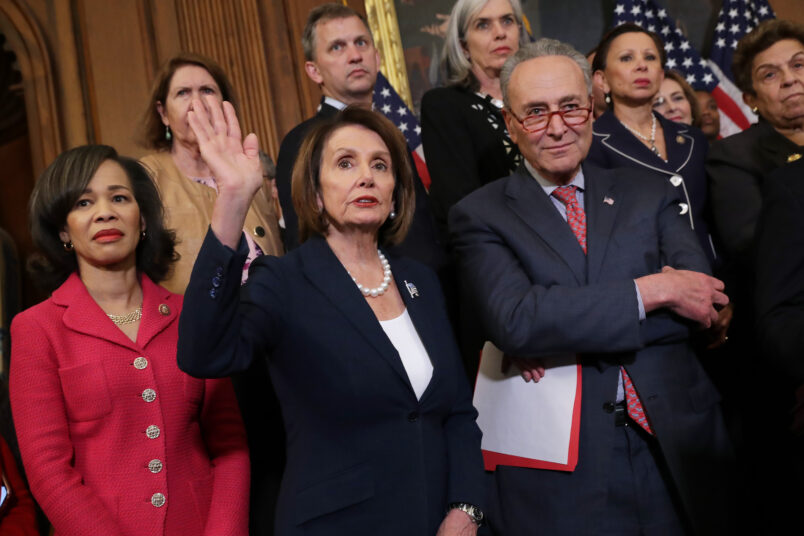
One thing is certain. Those Democratic dissenters are out of sync with what Americans — and not just Democratic voters — think.
The Democrats’ plan is very popular among Americans.
A Quinnipiac poll conducted July 27-Aug. 2 asked, “Do you support or oppose a $3.5 trillion spending bill on social programs such as child care, education, family tax breaks and expanding Medicare for seniors?” and found 62% support, 32% opposition.
Support is even higher for some key provisions of the plan. For example, over two-thirds of voters (69%) support raising taxes on the wealthy and corporations. A whopping 84 percent of likely voters (including 74 percent of Republicans) support paid family leave programs. According to recent polls, 84% of voters want to expand Medicare coverage to include dental, vision and hearing; 88% want Medicare to negotiate with pharmaceutical companies to reduced prescription drug prices. Data for Progress polling earlier this year found that nearly two thirds of likely voters support government action moving the country away from fossil fuels to a fully clean energy grid by 2035, including 86% of Democrats, 60% of independents, and 40% of Republicans.
So why are those two Democratic senators and 10 Democratic House members trying to subvert legislation that most Americans and 96% of their own colleagues support?
Most of the 10 House Democrats who are still waffling over the Biden plan are from swing congressional districts that they won by small margins, although other Democrats from battleground districts are on board with the plan. But in each of their districts, the Build Back Better plan would significantly improve the lives of their constituents as well as lower their taxes.
The opposition of the handful of Democrats can be explained in part by their close ties to big business and wealthy donors. They are doing the bidding of corporate America, which wants the physical infrastructure projects that is part of the separate $1 trillion bill, but doesn’t want the higher taxes or stiffer regulations to reign in corporate greed that is part of the $3.5 trillion safety net and clean energy bill.
For example, Rep. Scott Peters of California is leading the opposition to the drug pricing provisions. Last month, he voted to block it from advancing out of the Energy and Commerce Committee. Since he was elected from his San Diego area district in 2012, the pharmaceutical industry has showered him with $860,465 in campaign donations. So far this year alone, he’s received $88,550 from the drug lobby — the most of any member of Congress, according to the Center for Responsive Politics, which tracks political spending on the website OpenSecrets.org.
Manchin and Sinema insist that their stances reflect the concerns of voters in their home states. Last November, 68 percent of West Virginians voted for Trump, though Arizona narrowly went to Biden by a 49.4% to 49.1% margin.
But both West Virginia and Arizona are states with high levels of poverty and poorly funded schools and health centers, so there’s no question that their residents would benefit from the plan’s key provisions regarding health care, education, and other programs — indeed, more than residents of most other states. Manchin’s insistence that the bill incorporate means tests and eligibility caps, and Sinema’s fierce opposition to allowing Medicare to negotiate with drug companies to lower the price of medicine, will only hurt their constituents.
Manchin also has opposed many of the plan’s provisions to deal with the climate crisis — provisions that could hurt both his political fundraising and his pocketbook. He’s pocketed more contributions from coal, oil, and gas companies this campaign cycle than any senator, according to OpenSecrets. And his ties run deeper than the campaign donations he’s received from these corporate interests. Last year, Manchin made half a million dollars in stock dividends from a coal company that is now controlled by his son, according to the New York Times. The Intercept reported that since joining the Senate, he has earned more than $4.5 million from that coal company and another, both of which he founded in the 1980s.
For her part, Sinema promised to push to lower prescription drug prices when she ran for the Senate in 2018. Now she’s changed her tune, having taken in over $750, 000 from the pharmaceutical and medical device lobbies since then. In late September, Sinema held a fund-raiser with five business lobby groups that oppose the Biden bill.
Since Biden took office, America’s corporations have significantly ramped up their campaign donations and lobbying efforts. According to OpenSecrets, corporations have deployed more than 4,000 lobbyists to scuttle core provisions of the Biden bill. During the first six months of this year, business groups spent $1.5 billion lobbying Congress, much of it directed at undermining the Build Back Better legislation. In addition, business lobby groups have significantly increased their campaign contributions to key members of Congress, including Manchin and Sinema.
The U.S. Chamber of Commerce, the Business Roundtable, the National Association of Manufacturers, and other business lobby groups are investing big bucks to kill the proposed tax increases on big corporations and the rich. The oil and coal companies don’t want to wean the country off fossil fuels and are working overtime to kill Biden’s clean energy provisions. During just one week last month, oil giant Exxon Mobil spent $275,000 on Facebook ads against the Biden plan.
Prescription drug prices in the U.S. are about three times higher than in other affluent democratic countries, according to a RAND Corporation study. But the pharmaceutical companies don’t want to negotiate with Medicare to lower drug prices and are swarming Congress with big donations and lobbying efforts. The industry spent $171 million and deployed almost 1,500 lobbyists through the first half of the year, more than any other industry. Even the American Dental Association is mobilizing its 162,000 members to fight a proposal to include dental coverage for all Medicare recipients
On behalf of their corporate benefactors, Manchin and Sinema may be sabotaging the potential success of Biden’s presidency and the odds that the Democrats will have legislation to tout as they seek to maintain even their slim hold on Congress in next year’s midterm elections. They may also be undermining the last best chance to address America’s most pressing problems.
Democrats’ support for the Biden plan is — pick your adjective — overwhelming or near unanimous.
If Biden’s bill doesn’t make it through Congress, don’t blame “the Democrats.” Blame every Republican, and the tiny faction of Democrats, who have put their personal ambitions over the public good.
Peter Dreier is professor of politics at Occidental College and author of “The 100 Greatest Americans of the 20th Century: A Social Justice Hall of Fame.”
A Haunting Must-Read
It’s hard to describe just what’s in this article. Have you read the book or seen the movie Holes? It’s like a real life version of that – a tucked away county in Tennessee where a judge who’s barely even a lawyer presides over a kingdom of juvenile imprisonment.