

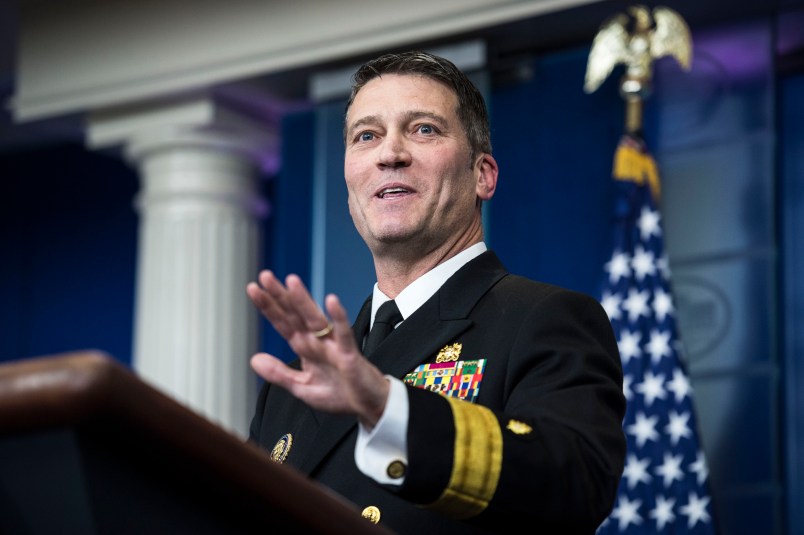
WASHINGTON (AP) — Rear Adm. Ronny Jackson was tending to grievously injured military personnel in Iraq when he was summoned to Washington to interview for a job he barely knew existed. He didn’t see a way to get there.
“I thought this was it — this is where the road stops,” he told the Lubbock Avalanche-Journal this month.
Instead, Jackson managed to catch a ride on a transport plane that steered the Levelland, Texas, native toward some of the loftiest corridors of power.
Jackson’s journey has wound through the White House and across the globe, treating the blisters, stomach ailments and more of the past three presidents and their retinues. This coming week, Jackson is back on the interview circuit and heading toward the Senate for a hearing Wednesday on his nomination to be President Donald Trump’s next secretary of the Department of Veterans Affairs.
“This will be the challenge of his life,” said Robert Darling, a former White House physician who still dines occasionally with Jackson at the Army Navy Country Club.
Now it’s time for Washington to examine Jackson, universally described as a reassuring presence in the most pressurized of atmospheres. But the 50-year-old apolitical Navy man has no experience leading a massive bureaucracy.
“He’s got a great bedside manner you feel comfortable with,” Sen. Sherrod Brown, D-Ohio, told The Associated Press. “But it doesn’t mean he will be a good leader of the VA.”
Some White House veterans privately say they’re mystified at why Jackson is willing to move from practicing medicine to the insult-laden world of Trump-era politics at the head of scandal-plagued agency. Jackson did not respond to requests for comment from the AP.
But, in an interview with the Lubbock newspaper, Jackson defended his qualifications for the VA job. “I’ve been in leadership school for 23 years now. … I’ve been confronted on a day-to-day basis with life and death decisions.”
Trump abruptly named him to succeed David Shulkin, an Obama-era holdover fired under an ethical cloud and something of a staff rebellion. The president was delighted with Jackson’s comprehensive and buoyant — some said fawning — briefing to reporters in January on Trump’s “excellent” health and mental acuity.
Jackson has been an unknown on policy and it’s not even clear he voted in the 2016 presidential election. The Hockley County Board of Elections in Texas shows he voted in 2015.
The only inkling of where he stands came when a few of the Democratic senators who met Jackson this past week reported that the nominee is promising not to privatize the VA. Shulkin’s resistance to partial privatization, through expansion of a program letting veterans choose private care at public expense, compounded his lapses in travel spending and may have been the driving force in his dismissal. Where Jackson stands on enlarging the VA Choice program has yet to be teased out.
His path to this point is a winding one that did not start off pointing to medical school, emergency surgery or service to presidents.
In fact, in high school, Jackson went through “an ornery stage” that featured him cutting classes and ending up in the assistant principal’s office at the business end of a wooden paddle.
“He got quite a few swats from me,” recalls former Levelland High School assistant principal Kelly Baggett, a longtime family friend who now counts himself one of Jackson’s biggest fans. “He took it like a man and shook my hand when it was over,” Baggett said in a telephone interview. “Just a great kid, the kind you always want to visit with.”
Jackson at first wanted to be a marine biologist, not a doctor. His direction changed after he took a job at the University of Texas Medical School as an autopsy assistant and found it interesting, according to an interview in the Lubbock newspaper. He graduated from Texas A&M University with a degree in marine biology in 1991.
He didn’t plan on entering the Navy, either. But Jackson needed money for medical school, and he learned of a program in which he could be a Navy diver and a doctor, according to that published account.
Jackson got his medical degree in 1995 from the University of Texas and began active duty naval service that year at the Portsmouth Naval Medical Center in Virginia, his Navy biography says. Jackson graduated from the Navy’s Undersea Medical Officer Program in Groton, Connecticut. He completed his residency back in Portsmouth and deployed as the emergency medicine physician in charge of resuscitative medicine for a forward deployed Surgical Shock Trauma Platoon in Taqaddum, Iraq.
The White House was another unplanned destination.
Jackson said he “got an email out of nowhere” saying he’d been nominated for a job at the White House. He then sped to Washington. Since President George W. Bush hired him in 2006, Jackson has cut a widely admired path among some of the nation’s fiercest partisans — on intimate terms. Everyone who’s recently worked in a president’s inner circle, it seems, has a Ronny Jackson story.
Somewhere along the Pacific Rim in 2015, he treated the severely blistered toe of Obama’s National Security Council spokesman, recalled the patient, Ned Price.
“Treatment consisted of bandages and tape, and it worked like a charm,” said Price, who said he had been suffering from wearing new shoes for 20 hours straight. He like others described Jackson as a cool-headed and pleasant presence, “the guy you always want to be around.”
“At no point was he down or stressed out,” said Jen Psaki, who was Obama’s communications director. She recalled Jackson reassuring her when she was pregnant that “if anything happens, we’re good” whether on medically equipped Air Force One or in back in Washington. “I remember telling my husband that there’s no safer place I could be than the White House.”
It was Obama who elevated Jackson to director of the White House medical team and made him his physician.
Liz Allen, who served as Obama’s deputy communications chief, said Jackson monitored her blood pressure for years and routinely would ask, even in passing, how she was doing.
“He is just so genuine,” she said. “He treated people well. He always made you feel like you were the priority even when there were competing priorities.”
Jackson is known for maintaining relationships. His connection to fellow Texan Bush, for example, survived the Bush presidency. In photos, the former president wears a reddish cap on a 2013 trip to Zambia, emblazoned with the name of Jackson’s hometown, Levelland. Freddy Ford, a Bush family spokesman, said the hat had been given to Bush by Jackson’s father, Waymon.
___
Associated Press writers Calvin Woodard, Hope Yen and Stephen Braun in Washington, Jake Pearson in New York, AP researcher Monika Mathur in Washington and AP investigative research Randy Herschaft in New York contributed to this report.





As a former G.M. and Company Prez, I can’t see him succeeding even if he has a stellar medical record. It’s critically important, the larger the organization (and this one is YUGE!). to have a long history of moving up over time to even larger personnel handling and policy making positions. The hardest part is keeping focus on personal goals while at the same time taking counsel from superiors (A Board or Owner) and subordinates,
Steering a large organization, especially one in need of major reforms, can be a daunting task even for highly experienced senior managers. I’d even venture the position would be better filled by a non-doctor type who does have the requisite large organization managerial success. Why? At the top of this pyramid, it’s all about management, direction setting, goal achievement and more. Less is the actual provision of medical assistance at the patient level. Less in that it’s the doctors, nurses, specialists who do this hard work, not the guy at the top!
I guess I don’t really understand what treating the blistered toe of a senior White House aide has to do with managing a bureaucracy of the magnitude of the VA system?
On top of that, anyone who willingly chooses to associate their career with the Trump rolling disaster is foolish at best, blindingly naive at worst. Their judgement, and/or their politics, needs to be questioned thoroughly.
If he is not on board with privatizing veterans’ care, he won’t last long; if it were me, I don’t think I would risk damaging my own career in order to become a convenient punching bag for the president.
I get that he thinks he can rise to the occasion, but I think the path is littered with the dead bodies and broken souls of many who believed the same thing. He should look around a bit before he tries to convince himself that having leadership training is a substitute for experience he’s never had.
Spanky opened door #3 and Jackson saw glory and riches, the likes of which he never dared dream. He got suckered.
I get what you’re saying, but the measure of success in providing good medical care to veterans will be evaluated at the patient level. There are many well-organized VA hospitals – and then there are the few that make the bad news, usually reported from the perspective of the patients themselves.
As with government in general, the approach should be service-oriented and at the individual level, performed by people who personally buy into the concept of what the country should be providing its citizenry. Competent management of individual hospitals (and not an overarching plan, like privatization) is the path to improve the actual service. The care of veterans and the opinions of their families about that care will drive public opinion on how effectively the VA is handling its mission.
How Jackson fits into this I don’t know and won’t predict. But trump could only appoint an effective director by accident, as in blind squirrel/nut.