

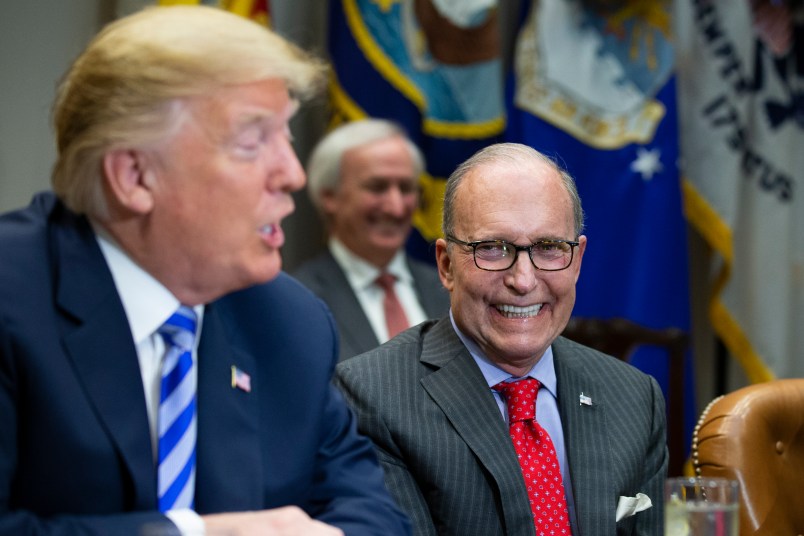
WASHINGTON (AP) — Defying fears of a global trade war, U.S. businesses have made it abundantly clear that they see no reason to stop hiring.
Employers added a robust 233,000 jobs in May, up from 159,000 in April, the government said Friday, and helped drive the nation’s unemployment rate to an 18-year low of 3.8 percent.
In the midst of all that hiring, the Trump administration has slapped tariffs on steel and aluminum from Europe, Mexico and Canada. The White House is also threatening China with separate duties. And Europe, Mexico, Canada and China have vowed to hit back at U.S. goods.
Yet so far, the trade disputes have done nothing to knock the nearly 9-year-old economic expansion — the second-longest on record — off track. Hiring has actually picked up this year compared with 2017.
“The May jobs report revealed impressive strength and breadth in U.S. job creation that blew away most economists’ expectations,” said Scott Anderson, chief economist at Bank of the West.
Some economists do remain concerned that the Trump administration’s aggressive actions on trade could eventually hamper growth. The direct impact of the tariffs on the nearly $20 billion U.S. economy will likely be scant. But persistent uncertainty about which trading partners might be hit next — and which U.S. products might be penalized in retaliatory moves — could disrupt some companies’ expansion plans.
“Risks are brewing … with the latest round of tariffs on aluminum and steel,” said Joseph Song, an economist at Bank of America Merrill Lynch. “However, the concerns so far remain on the periphery.”
Should the trade fights worsen, they would most likely affect some of the same industries that have ramped up hiring and lifted the economy. Manufacturers, for example, have added 259,000 jobs in the past year, a 2.1 percent increase. That’s the biggest percentage gain in factory jobs since 1995.
Exports have been a big driver of that hiring. In 2017, simultaneous growth in Europe, China, Japan, and some developing countries were a key reason that factory output rose. Now, European officials are threatening to raise tariffs on Harley-Davidson motorcycles and on Levi’s jeans.
Roughly an hour before the May employment data was released Friday morning, President Donald Trump appeared to hint on Twitter that a strong jobs report was coming.
“Looking forward to seeing the employment numbers at 8:30 this morning,” he tweeted.
The president is normally briefed on the monthly jobs report the day before it is released, and he and other administration officials are not supposed to comment on it beforehand.
Larry Kudlow, the president’s top economic adviser, downplayed Trump’s tweet.
“He didn’t give any numbers,” Kudlow said. “No one revealed the numbers to the public.”
Investors cheered the jobs data. The Dow Jones industrial average finished up 219 points. Other stock indexes also rose.
The healthy employment figures make it more likely that the Federal Reserve will keep raising interest rates this year — two and possibly three more times, after doing so in March.
Unemployment dropped from 3.9 percent in April. When rounded to one decimal, as the Labor Department typically does, the official jobless rate is now the lowest since April 2000. For women, unemployment has fallen to 3.6 percent, the lowest since 1953.
But the unrounded figure is 3.75 percent, the lowest since December 1969, when it was 3.5 percent. Unemployment remained below 4 percent for nearly four straight years in the late 1960s before reaching 6.1 percent during a mild recession in 1970. It didn’t fall below 4 percent again until the dot-com-fueled boom of the late 1990s.
With the unemployment rate so low, businesses have complained for months that they are struggling to find enough qualified workers. But Friday’s jobs report suggests that they are taking chances with pockets of the unemployed and underemployed whom they had previously ignored.
Unemployment among high school graduates fell sharply to 3.9 percent, a 17-year low. For black Americans, it hit a record low of 5.9 percent.
And the number of part-time workers who would prefer full-time jobs is down 6 percent from a year ago. That means businesses are converting some part-timers to full-time work.
Companies are also hiring the long-term unemployed — those who have been out of work for six months or longer. Their ranks have fallen by nearly one-third in the past year.
That’s important because economists worry that people who are out of work for long periods can see their skills erode.
Those trends suggest that companies, for all their complaints, are still able to hire without significantly boosting wages. Average hourly pay rose 2.7 percent in May from a year earlier, below the 3.5 percent to 4 percent pace that occurred the last time unemployment was this low.
And there may be more of those workers available. The number of involuntary part-time workers is still higher than it was before the 2008-09 recession.
Martha Gimbel, director of economic research at Indeed, the job-listing site, said some of the fastest-growing search terms on the site this year are “full-time” and “9-to-5 jobs,” evidence that many people want more work hours.
“That suggests there is still this pool of workers that employers can tap without raising wages,” Gimbel said.
Debbie Thomas, owner of Thomas Hill Organics, a restaurant in Paso Robles, California, said that finding qualified people to hire is her biggest challenge. She has raised pay by about a dollar an hour in the past year for cooks and dishwashers but is reluctant to go much higher.
“You don’t want to price yourself out of the market,” Thomas said.
The report comes amid other signs that the economy is picking up. Consumer spending rose in April at its fastest pace in five months. And companies are also stepping up spending, buying more industrial machinery, computers and software — signs that they’re optimistic enough to expand. A measure of business investment rose in the first quarter by the most in 3½ years.
Macroeconomic Advisers, a forecasting firm, said it now foresees the economy expanding at a robust 4.1 percent annual pace in the April-June quarter, which would be the fastest in nearly four years. The economy expanded just 2.2 percent in the first quarter.



Same ol story. Dems fix the economy, GOP reaps the rewards (and fucks it all up again).
Lots of glowing reports about this jobs report. However, that report coincides with data on higher interest rates, higher health insurance rates, higher gas prices, higher commodity/food prices, a drop in housing purchases, and more corporate profit taking. We are heading into the summer/fall where Americans’ disposable income will get squeezed.
If this job report had been say off by 40 thousand to 193k, the report would not nearly be as glowing. It wouldn’t have been terrible mind you, but I think you’d see a much higher number of skeptical commentary pieces. Adjustments like that happen all the time, just as the Q1 growth rate was revised substantially downward. Even this report says that the spur in hiring is being driven by export markets, the very markets that Trump is now threatening. In short, this glowing commentary is perhaps unwarranted and it fails to note that there are other trends which would appear to persist long after this jobs report. We’re as likely to get a June jobs report where 140,000 jobs are created, and the 3 month moving average would be far lower than 2017/16 (it already actually is lower because the April numbers were a bit modest). This selective, arbitrary praise over a jobs report doesn’t align with larger trends now shaping the economy in a Trump administration.
It’s quite possible that this past month represented one of the last big punches of the Obama recovery, ironically driven by export demand (not domestic demand) from markets which Obama himself stabilized and sought to promote. Given the data on housing, interest rates, gas prices and other factors affecting disposable income, domestic demand and growth may be insufficient to buoy a high level of job creation. So when we do get a jobs report in June, July or August of around 140,000, 160,000 or 120,000, you’ll see more talk about factors that are currently in place today and are affecting American families and employers.
Nancy Pelosi is right to ignore the report and focus on the danger signs and the unequal distribution of wealth.
Interesting article
America’s poor becoming more destitute under Trump: U.N. expert
The nation’s unemployment rate is at an 18-year low of 3.8 percent, businesses are struggling to find enough qualified workers, yet employers are not raising wages. This seems to indicate that the GOP economic dogma built around the infallible law of free market supply and demand is, shall we say, fallible.
Like most economic data, unemployment can be a noisy data series so a single report is not significant but in this case, the downward trend has been firmly in place for ten years so no surprise either; e.g., http://ritholtz.com/wp-content/uploads/2018/06/U3Unrate.png
Ditto for economic expansion: a single quarter is not significant and, even if it does touch above 4% it is not likely to stay there. Regardless the trend is and has been in place for over a decade: if it can stay close to 3% I will be surprised and delighted but a real trade war (not the current performance art type) will bring that down fairly quickly.
Better news is the increase in pay rate and inroads into the ranks of previously underemployed or unemployed workers: that’s real progress particularly since wages tend to be ‘sticky;’ it’s hard to reduce them later. Amplifying this trend is my current favorite unintended consequence: anti-immigration policies are hindering business from hiring foreign labor thus increasing the leverage of homegrown labor. Republicans imagining Benedict Donald would be good for the bottom line of their businesses will have more painful lessons coming soon…
NB: The Obama recovery was slow but is holding up and a good economy generally bodes better for the incumbent party. The big corporate tax giveaway has stolen some future expansion to give it to the present thus reducing the chance 3% plus growth is sustainable but the Republicans may have reason to hope come November that they can survive the blue wave in the Senate at least. My bet though is that the Mango Maniac cannot control himself well enough to leave any of this alone; It’s not just incompetence or panic over criminal prosecution (although those too) as unable to control the impulse to smash. JMO
“Character is destiny” —Heraclitus of Ephesus