

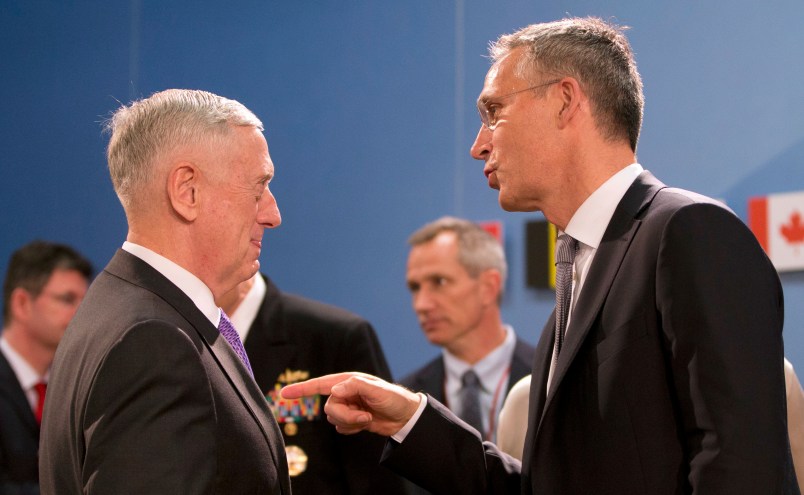
BRUSSELS (AP) — More than 16 years into the Afghanistan war, the United States and its NATO allies wrangled anew on Thursday over how to meet the need for more troops to counter a resurgent Taliban and help Afghan forces break a stalemate in the fight.
At a meeting in Brussels, NATO agreed to send more forces in response to commanders’ requests for as many as 3,000 troops to train and work alongside Afghan security forces. That number does not include an expected contribution of almost 4,000 American forces, divided between the NATO mission and America’s counterterrorism operations against Taliban, al-Qaida and Islamic State militants in Afghanistan.
NATO Secretary-General Jens Stoltenberg said 15 countries “have already pledged additional contributions.” He expected more commitments to come, but confusion about America’s plans may have held back some countries.
U.S. Defense Secretary Jim Mattis said at a news conference after the meeting that he was pleased by allies’ willingness to contribute more.
“We still have a few gaps and nations are stepping up,” Mattis said. “We’ve filled 70 percent of those gaps right now and I’m very, very optimistic that based on what I heard here we’ll be filling the rest.”
Mattis added that upon returning to Washington, he will consult with U.S. Gen. Joseph Dunford, chairman of the Joint Chiefs of Staff, and then will submit a recommended new Afghanistan strategy to President Donald Trump. “We will refine U.S. troop numbers at that time, within that framework,” he said.
Asked how much longer the war is likely to last, Mattis said it is not sensible to predict.
“I don’t put timelines on wars. It’s that simple,” he said. “War is a fundamentally unpredictable phenomenon. Every effort to try to create a pat answer to something like that is probably going to fail.”
He added: It’s not like you can declare a war over or want it over or say I’m going to quit, and you’re not going to pay a price for it. The most important answer to that is, ‘What is the price of not fighting this war?’ And in that case we’re not willing to pay that price.”
Considering that Britain said it would contribute a bit less than 100 troops in a noncombat role, it’s unclear how NATO will muster several thousand new forces. To hit that mark, the other allies would need to average more than 100 troops each. Britain is the alliance’s most powerful member aside from the U.S., though Germany contributes the second most forces.
“We’re in it for the long haul. It’s a democracy,” British Defense Secretary Michael Fallon said, referring to Afghanistan. He said the Afghans “asked for our help and it’s important that Europe responds,” and said extremist groups there a threat to Western Europe.
Mohammad Radmanish, an Afghan defense spokesman, welcomed NATO’s decision to send more troop trainers. He said Afghan troops were in need of “expert” training, heavy artillery and a quality air force.
“We are on the front line in the fight against terrorism,” Radmanish said in a telephone interview with The Associated Press in Kabul, the Afghan capital.
But Afghan lawmaker Mohammad Zekria Sawda was skeptical. He called NATO’s offer a “show,” noting the alliance and the U.S. were unable to bring peace to Afghanistan when they had many more soldiers deployed against Taliban insurgents.
“Every day we are feeling more worry,” he said. “If they were really determined to bring peace they could do it.”
European nations and Canada had been waiting to hear what Mattis would offer or seek from them. U.S. leaders haven’t publicly discussed troop numbers yet as they complete a broader, updated military and diplomatic strategy for the war.
Stoltenberg said what happens on the battlefield will affect the diplomatic strategy, adding that as long as the Taliban believe they can win, they will not negotiate.
On Thursday, details on the still-forming war strategy appeared murky.
“It’s for the Americans to decide the exact numbers that they are putting in and where they’re going, whether they’re to plug holes, if you like, in Resolute Support and ensure that the spokes of the wheel don’t collapse, or whether they’re putting additional direct effort into counter-terrorism,” Fallon said. “It’s for them to decide. But we’re clear. We’ve got to stay the course in Afghanistan.”
Norwegian Defense Minister Ine Eriksen Soreide said she expects allies will “come around” and make additional troop commitments. She didn’t expect the new U.S. strategy to come out until next month.
Dunford, the U.S. Joint Chiefs chairman, was in Afghanistan this week, meeting with commanders.
The expected deployment of more Americans is intended to bolster Afghan forces so they eventually can assume greater control of security.
Stoltenberg said the NATO increase does not mean the alliance will once again engage in combat operations against the Taliban and extremist groups.
There are now about 8,400 U.S. troops based in Afghanistan, with an additional 2,000 or so on temporary deployment. Some 6,600 troops from NATO and partner forces also are there.




What a totally screwed up country.
When it comes to funding healthcare for our citizens…it is a big friggin NO from Trump and the Republicans.
When it comes to funding expensive and senseless wars, there is not discussion about how to pay for it. In fact, the last time, Bush gave the rich TWO giant tax cuts which even spineless Obama extended!
Republicans…we’ll fund all these expensive wars and occupations by cutting taxes for the rich…which means by definition the poor and the needy will pay. We already have millions of homeless and starving Americans!
What on earth has happened to our country!
It will be a long haul, indeed, if you insist on it being a democracy. There is no military solution to the problem you claim to be trying to solve.
Indeed. I don’t understand what our goal is. To create a vibrant, healthy democracy? What, in the entire history of Afghanistan, would make anyone think that was possible? To crush the Taliban? Great. How’s that been working out so far? Doesn’t it seem fairly obvious that the more aggressive we become, the stronger the Taliban gets? (Wasn’t there a Star Trek TNG episode about something like that, with the Enterprise trapped in an asteroid field?)
When your policy is bankrupt, a Chapter 11 reorganization isn’t going to help. It’s well past time for a Chapter 7 liquidation. Time to get out, completely. No troops, no advisors.
And what are they going to try with those 3000 extra men that has not been tried in 16 years? There have been winners in Afghanistan, the soldiers and contractors really love their combat pay, the military suppliers love the afghan war. And of course the thieves in Kabul want as much time as they can get. When the americans leave, they will go with them.
Well it will certainly help that Trump has done so much to create a close relationship with NATO members and to foster such a sense of trust and mutual respect.
Ha, ha, ha.