

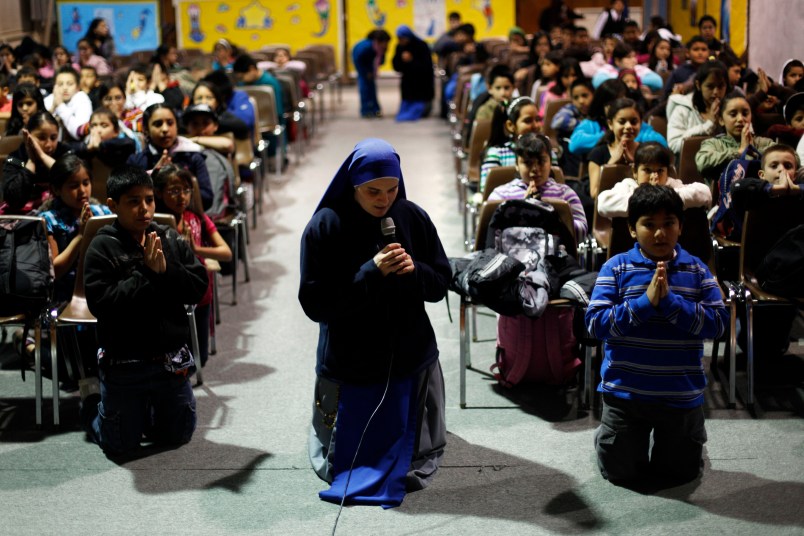
NEW YORK (AP) — Latinos in the United States are abandoning the Roman Catholicism of their childhood in increasing numbers to become evangelical Protestants or leave organized religion altogether, according to a new survey released Wednesday.
Only 55 percent of the nation’s Latinos consider themselves Catholic, a 12 percentage point drop since 2010. Of those who remain in the church, slightly more said they could imagine leaving than they have in previous years. At the same time, the share of Hispanic evangelicals rose from 12 percent to 16 percent, while Latinos with no religious affiliation increased from 10 percent to 18 percent.
The Pew Research Center report, “The Shifting Religious Identity of Latinos in the United States,” is based on a 2013 survey of more than 5,100 adults and points to the challenges ahead for the U.S. church, whose fortunes are inextricably linked to the growth of the Hispanic population.
The Catholic Church remains the country’s largest denomination by far, with more than 66 million members, but has been steadily losing non-immigrant parishioners. In a previous analysis, Pew found former U.S. Catholics collectively would be the third-largest faith group behind Catholics and Baptists.
Hispanics are still expected to become a majority within the U.S. church in the coming years given the overall increase in the general Latino population. Already, one-third of U.S. Catholic adults are Latino, Pew researchers said. But Catholic leaders have been struggling to hold onto new immigrants given the shortage of priests and the competitive religious marketplace in the U.S. Nearly every American faith tradition has intensified its outreach to Latinos in recent decades.
Pew found no single reason for the changing Latino religious landscape.
Respondents most commonly said they gradually drifted away from the faith of their childhood or stopped believing the teachings. About 30 percent said they found another congregation that helps its members more. Others said they had a personal spiritual crisis or left for family reasons. While a large percentage of Latinos overall said the church should do more to address the clergy sex abuse scandal, only a tiny percentage cited the crisis as a reason they left.
The changes partly reflect religious trends in Latin America, which has also seen a steady decline in Catholics as the ranks of evangelicals and nonbelievers have grown. Concern about the region’s losses is believed to have been a factor in the election of Pope Francis, an Argentine and the first pontiff from the Southern Hemisphere. Pew found about half of U.S. Latinos who left Catholicism did so before they arrived in this country.
However, U.S. religious life has also been an influence. The share of Americans overall who say they have no religion, or “nones,” has increased to about 20 percent in recent years. The trend is more pronounced among young people. Pew researchers found similar patterns among U.S. Latinos. Most of those ages 18 to 29 who left Catholicism now say they belong to no particular religious group. Hispanics ages 30 to 49 moved toward both evangelical Protestantism and no religion.
Some Latinos who became Protestants have joined mainline churches in the U.S., but most Hispanic Protestants are evangelical. Of those born-again Christians, most belong to Pentecostal groups, known for their spirit-filled worship and belief in divine healing. Overall, 22 percent of U.S. Latinos are Protestant.
Regarding political affiliation, Latinos overall favor Democrats over Republicans, but support for Republicans is higher among evangelicals. Three in 10 evangelical Hispanics lean toward the GOP, compared to 21 percent of Hispanic Catholics and 16 percent of the religiously unaffiliated.
Mark M. Gray, with the Center for Applied Research in the Apostolate at Georgetown University, said the decline is a concern, but the movement of Latinos among religious groups is more complex and less alarming to Catholics than it appears.
Amid all the religious switching by Americans, the Catholic Church overall has a higher retention rate than any single Protestant denomination, he said. He also pointed out that Catholic losses are so much higher than other U.S. faith groups because the denomination is so much bigger than any other. Gray noted, however, that the U.S. Latino population has grown the most in areas where the church has fewer resources, in the South and West, instead of the older Catholic population centers of the Northeast and Midwest.
“More investment needs to be made toward Hispanic ministry,” Gray said. “But the church doesn’t really always recognize population growth where it’s occurring very quickly and it’s difficult to respond to it.”
The Pew survey was conducted from May24-July 28 of last year and has a margin of error of plus or minus 2.1 percentage points.
____
Link to Pew report: http://goo.gl/noJSMp
Copyright 2014 The Associated Press. All rights reserved. This material may not be published, broadcast, rewritten or redistributed.




I used to be a Dodger fan, stretching back to before they left Brooklyn. I no longer am, because of their stupid religious proselytizing, I’m sure aimed at helping convert Roman Catholic Latinos to evangelical stupidity. I’m no longer a fan, I refuse to allow their religious posturing to be seen in my house. Go Giants. Fuck you dodgers
I think the real story is why so many have left organized religion.
Leaving church does not mean losing your faith. It can mean
finding a deeper faith. A living faith that is concerned with justice for
the sick, the poor, those that need real help. The church offers charity,
but rarely takes a stand on injustice, something Jesus did over and over.
Charity changes little. Justice requires courage.Perhaps there
is a Jesus movement that is outside of organized religion, because
the church has dropped the ball on what the message of Christ
was all about. I have read that there is a trend of people that have
left churches that meet on Sundays in homes and coffee shops and
conduct there own form of church that concentrates on living the
faith and not just being pew warmers. I think that is a positive
trend both personally and socially.
I read through this a couple of times, and I don’t understand where the “More Polarized” bit from the headline comes from. In what way are they more polarized?