

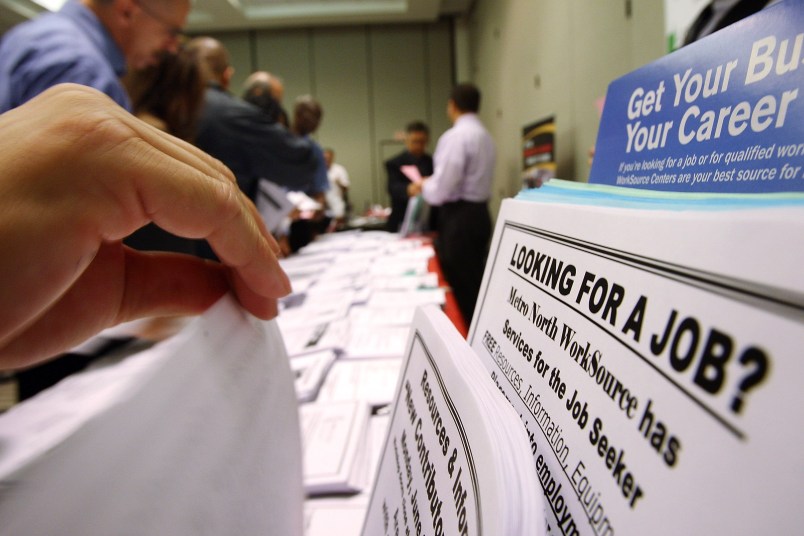
WASHINGTON (AP) — Hiring picked up in August as U.S. employers added a strong 201,000 jobs, a sign of confidence that consumers and businesses will keep spending despite the Trump administration’s conflicts with U.S. trading partners.
The Labor Department said Friday that the unemployment rate remained 3.9 percent, near an 18-year low.
Americans’ paychecks grew at a faster pace in August. Average hourly wages rose last month and are now 2.9 percent higher than they were a year earlier, the fastest year-over-year gain in eight years. Still, after adjusting for inflation, pay has been flat for the past year.
The economy is expanding steadily, fueled by tax cuts, confident consumers, greater business investment in equipment and more government spending. Growth reached 4.2 percent at an annual rate in the April-June quarter, the fastest pace in four years.
Most analysts have forecast that the economy will expand at an annual pace of at least 3 percent in the current July-September quarter. For the full year, the economy is on track to grow 3 percent for the first time since 2005.
Consumer confidence rose in August to its highest level in nearly 18 years. Most Americans feel that jobs are widely available and expect the economy to remain healthy in the coming months, according to the Conference Board’s consumer confidence survey.
The buoyant mood is lifting spending on everything from cars to restaurant meals to clothes. Consumers’ enthusiasm is even boosting such brick-and-mortar store chains as Target, Walmart and Best Buy, which have posted strong sales gains despite intensifying competition from online retailers.
In August, factories expanded at their quickest pace in 14 years, according to a survey of purchasing managers. A manufacturing index compiled by a trade group reached its highest point since 2004. Measures of new orders and production surged, and factories added jobs at a faster pace than in July.
Not all the economic news has been positive. Higher mortgage rates and years of rapid price increases are slowing the housing market. Sales of existing homes dropped in July for a fourth straight month.
And wages are still rising only modestly, even after more than nine years of economic expansion and an ultra-low unemployment rate.
Many economists also worry that President Donald Trump will soon follow through on a threat to impose tariffs of up to 25 percent on $200 billion of imports from China. That would be in addition to $50 billion in duties already imposed. That move could shave as much as a quarter-point off growth over the next year, Mark Zandi, chief economist at Moody’s Analytics, has estimated.
For now, there’s little sign that companies are worried enough about a trade war to slow hiring. Businesses are increasingly reluctant to even lay off workers, in part because it would be difficult to replace them at a time when qualified job applicants have become harder to find.
On Thursday, the government said the number of people seeking unemployment benefits — a proxy for layoffs — amounted to just 203,000 last week, the fewest total in 49 years.





This is a meh report overall. Jobs reports for the prior two months were adjusted downward by 50k, so if you net it all out it’s at 151k, which I think most would consider as ‘meh’. It’s not bad, but it’s not a sign of a booming economy either.
We have a possible slowdown in manufacturing developing which is driven in no small part by Trump’s tariffs. Contrary to the write-up, consumer confidence dipped in August because of higher costs for goods and services.
We have rising costs which are hitting both businesses and consumers, modest to decent hiring but insufficient to keep up with growth needs, and higher debt. The US economy could be on the verge of overheating, and people will start to cut back on purchases as costs for essentials go up. Interest rates will continue to go up.
The tariffs are like a ticking time bomb, it will take a while to feel all the effects. Canada and Mexico are ordering equipment to mold their own finished steel and aluminum products. In a couple years or so, the factories will open and those jobs will never come back to the US. Short video explains what will happen:
This is a number, but like China’s consistent GDP growth numbers, increasingly irrelevant as a measure of what is actually happening in the economy. Bangladesh also has about 4% unemployment and great job creation, but quality of life for most, well, that’s another issue. US housing is now unaffordable in many major urban areas. But strong corporate profits. Falling living standards, shorter life spans and higher infant mortality rates, but Dow is at record highs. An unprecedented 330% debt-to-GDP ratio, but strong dollar. It’s a number, but I wouldn’t get too excited. It’s like looking at your odometer and deciding you are getting great mileage without noticing that the low oil warning light has been on for the past 4 weeks.
I guess I’m confused, still. All I hear is about how Trump’s policies, in particular the tariffs, are going to destroy jobs and increase unemployment.
And then we get this.
My confusion goes back months and, clearly, continues. Folks, this is how the GOP keeps the midterms. The GOP can point to these jobs reports and insist that the Dems want to take this away from the American people. This is a strong message, as it resonates with middle America - they just want a job that keeps a roof over their heads.
Yes, wages aren’t keeping up, but they still have a job and that’s better than none.
Someone help me understand how this doesn’t truly impact the possibility of a Blue Tsunami in two months.
Timing. There is always a lag in the effect of fiscal policy. For a more immediate assessment, check the stock market. Emerging markets are in a deep nosedive now, because of the Dotard’s threats and tariffs. By this afternoon, when the new tariffs on Chinese goods are announced, not much will look the same as it does right now.