

This story was originally published by Grist. Sign up for Grist’s weekly newsletter here.
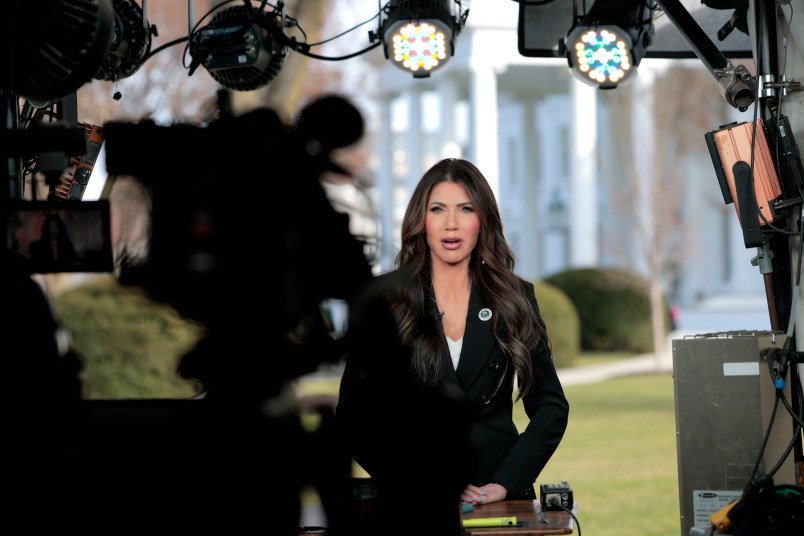
Kristi Noem faces intensifying public scrutiny over her leadership of the Department of Homeland Security. Criticism of the former South Dakota governor has focused on her handling of the killing of Alex Pretti by a federal immigration agent and her oversight of the Federal Emergency Management Agency, or FEMA. The controversies have prompted calls from Democratic lawmakers — and a small but noteworthy group of Republicans — for her resignation or impeachment.
The immediate flashpoint has been the January 24 killing of Pretti, which occurred during ongoing protests in Minneapolis. Noem initially described Pretti, a 37-year-old nurse, as a “domestic terrorist,” a narrative repeated by others in the Trump administration. Her account was almost immediately contradicted by numerous videos that showed Pretti was unarmed and restrained when federal agents shot him repeatedly.
“She should be out of a job,” Senator Thom Tillis, Republican of North Carolina, said after the videos emerged. While President Donald Trump has publicly said Noem’s position is secure, a number of potential successors have reportedly emerged,including Virginia governor Glenn Youngkin and Lee Zeldin, who leads the Environmental Protection Agency.
Noem’s handling of the killing — which came two weeks after an immigration agent in Minneapolis fatally shot protestor Renee Good — follows sustained criticism of her management of FEMA. Lawmakers, disaster response experts, and disaster survivors say her policies have slowed emergency response and delayed recovery funding. Long before the crisis in Minnesota, concerns were building over her approach to FEMA preparedness and spending and its response to calamities like last year’s devastating floods in the Texas Hill Country.
“It’s a policy of chaotic austerity,” said Sarah Labowitz, a senior fellow at the Carnegie Endowment for International Peace who studies disasters and adaptation. “It’s magic wand policymaking, where you need a crisis in order for something to happen.”
FEMA helps coordinate the response to major disasters like the Los Angeles wildfires, but the agency more often acts like a bank, reimbursing states and cities for their disaster preparedness and recovery spending. When Noem took office, she throttled that spending by, among other things, requiring her personal signoff on all expenses over $100,000. The pace of disbursements has since slowed to a trickle.
Those restrictions reportedly hindered the agency’s response to emergencies like July’s floods in Texas because officials could not pre-position search and rescue teams. The acting head of FEMA at the time, David Richardson, was reportedly unreachable for several hours, and the agency did not answer two-thirds of calls to its hotline. More than 130 people died in the floods.
On Thursday, a coalition of disaster survivors released a “report card” that gave Noem’s leadership an “F.” Brandy Gerstner, a member of that coalition, lost her home and belongings in the Texas flood. She and her family live in the rural community of Sandy Creek and spent three days without power or water waiting for federal assistance.
“Official help was scarce,” she said. “Despite that, Kristi Noem and Texas Governor [Greg] Abbott have described the response as exceptional, a lie that insults the memory of those lost in the floods.”
Beyond floods in Texas and fires in Southern California, the United States experienced relatively few major disasters last year. Even so, Noem’s restrictions on FEMA spending has also slowed payments to local governments still recovering from past catastrophes. The reimbursement backlog has reached $17 billion, according to the New York Times — more than the agency spends on such things in a typical year.
Delays have also affected FEMA’ efforts to reduce the impact of future catastrophes. A Grist analysis found that the agency’s net spending on resilience grants declined over the past three quarters, even as climate-driven disasters intensified nationwide. The nonprofit news outlet NOTUS identified a $1.3 billion backlog of such allocations, the primary source of federal funding for states and cities seeking to harden infrastructure. FEMA terminated another climate resilience program last year, though a court has ordered it to reinstate that program.
Former FEMA chief of staff Michael Coen, Jr., said Noem’s departure could ease the logjam.
“I don’t see another secretary coming in that is going to want to review every single grant,” said Coen, who served in the Obama and Biden administrations. “I would think that most executive leaders…are gonna find that that is micromanagement.”
Beyond Noem’s leadership lie other questions about the agency’s direction. The Trump administration has yet to nominate a permanent administrator, leaving Karen Evans, a former cybersecurity official, in charge since Richardson departed in November. Agency leaders have suggested firing more than 11,000 employees, many of them contract workers involved in local response and recovery efforts.
The Trump administration’s touted “review council” was to produce a report on FEMA’s future, but Noem reportedly pared the council’s final report to a fraction of its original length. The panel abruptly cancelled its plans to present the findings in December, and its deadline has been pushed to March.
“I think whether she stays or goes, there are huge issues that have been created in the last year at FEMA that have to be resolved quickly ahead of hurricane season,” Labowitz, said, referring to the season to come.
Noem appeared to soften her approach last week. The agency paused its planned terminations, and Noem hosted her first in-person briefing with agency employees, whom she attempted to rally ahead of Winter Storm Fern. She also appeared to respond to mounting criticism on Thursday when she announced the release of $2.2 billion in disaster response funds. The money will reimburse states and local governments for repair costs associated with events like Hurricane Helene, the 2023 floods in Vermont, and coastal erosion in Louisiana. A press release frames the allocation as “additional” recovery money, but recipients told Grist that FEMA is merely following standard procedure in granting reimbursements.
“We were all quite surprised yesterday when we were informed that the payment was coming as quickly as it came,” said Joe Flynn, the secretary of the Vermont Agency of Transportation. FEMA told his agency that it would provide $22 million to help rebuild a fleet garage destroyed in the 2023 floods. “There’s plenty of towns in Vermont that would still say they’re waiting.”
The offer was less than the state had requested, but Flynn accepted it given uncertainty about future funding. “With everything going on in the federal government, an adequately granted award is a bird in the hand,” he said.
The press release appeared to have been composed in haste. It contained multiple typos, including a misspelling of Louisiana as “Louisianna.” The director of the Greeneville Water Commission, after confirming that FEMA will reimburse the cost of rebuilding infrastructure lost to Helene, noted that her own town’s name was spelled wrong as well.
“By the way,” said commission director Laura White, “they spelled Greeneville wrong!”




Now Mississippi, Alabama, Tennessee and the rest of the southern states are complaining about the lack of FEMA support after the snow and ice. Should have voted for The Black Woman. Then you would have had FEMA support.
Removing Noem would be an unmitigated disaster for certain hair/make-up artists, wardrobe mistresses, set designers and film crews.
Kristi Noem and Sarah Palin: Separated at Birth??
Disbursing reconstruction money and funding disaster planning is just really boring when you could be cutting Instagram videos wearing a big cowboy hat.
In 2001 while I was still working for the federal Government, I handled a termination claim on a contract for maintaining and repairing levees that were protecting New Orleans.
A termination claim is where the Government decides something it has purchased is no longer needed and terminates the contract for convenience which “in the bis” is refereed to as a T for C. Basically, the Government pays for any completed work and the cost of any work in process.
Now I should not have to recount what would happen a few years later with unmaintained and unrepaired levees protecting New Orleans. But what I do need to mention, and why this is happening again, is that Democrats decided to “be forward looking” and not make Republicans pay a price to “doge” programs put into place by Democrats and terminated by Republicans to give tax reductions and subsidies to billionaires.
SO HERE WE ARE.
I do not know what harm will come with the criminal looting of our treasury and shear incompetence and lack of understanding what Government does by the Trump administration but note in hind sight it is very obvious the harm the Jr. Bush did.
Assuming we still have a democracy and Democrats get back into power, will they give, as Obama did for Bush and his crooked and incompetent gang, a free pass or will Republicans pay a political price. Currently, Republicans are loyal to Trump and backing all his crimes and shear stupidity because they are more afraid of what Trump then they are Democrats and history.
I don’t blame them.