

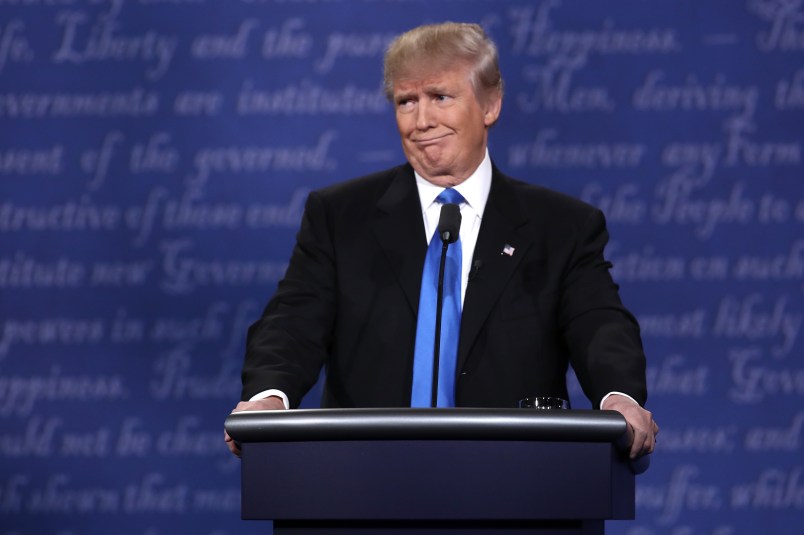
WASHINGTON (AP) — The speech was written. A cast of relatable Americans with emotional stories was standing by to reinforce the message. But President Donald Trump was in no mood to play along.
“The hell with it,” Trump said, recounting the scene with his aides to a West Virginia crowd last week, Trump tossed the staff-prepared remarks on tax cuts in the air and ducked as the paper fluttered to the floor. “I said, ‘This is boring, come on.’ Tell it like it is.”
This president has never been one to stick to a script, but that abandoned speech illustrates a new phase in Trump’s presidency. He is increasingly at odds with his staff — and growing wise to their tactics.
One favored staff strategy: Guide the president to the right decision by making the conventional choice seem like the only realistic option. Except now, 14 months into his administration, Trump is on to them, and he’s making clear he won’t be boxed in.
That was the message that an irritated Trump delivered to his national security team last week in a classified meeting about U.S. involvement in Syria.
Trump’s advisers, among them Defense Secretary Jim Mattis and the chairman of the Joint Chiefs of Staff, Gen. Joseph Dunford, were advocating for an ongoing U.S. military presence to provide stability. They aimed to rely on the same playbook they used last year in persuading Trump to keep U.S. troops in Afghanistan indefinitely. They would paint a dire picture of a pullout, of regional chaos benefiting Russia and Iran, and the potential resurgence of the Islamic State group.
But even before they could begin their pitch in that meeting Tuesday, Trump headed them off, saying he wanted to remove U.S. troops immediately. The ensuing heated argument put new distance between the president and his team and left the military with a mandate, if not a formal order, to remove U.S. troops from Syria within six months.
The episode stood in sharp contrast to the earlier meeting on Afghanistan, when Trump went along with his advisers despite his instincts to pull out completely.
More than 10 current and former White House officials and outside advisers spoke to AP on condition of anonymity to describe such internal discussions.
The shift has as much to do with changes in personnel as changes in the president’s attitude. Former White House staff secretary Rob Porter, for one, was viewed as a person Trump could trust to be an honest broker and make sure that all options were being faithfully presented to him.
During the Afghanistan meeting, aides went out of their way to make it appear that they were considering Trump’s perspective with an even hand. But with Syria, aides said, Trump felt he was being steamrolled and lashed out.
Managing a boss who despises being managed is a difficult game. And those who have succeeded have proceeded carefully. Some aides, convinced that Trump puts more stock in what he sees on TV than in his own aides’ advice, regularly phone prominent commentators and news hosts to provide talking points on everything from tax policy to Syria in hopes of influencing Trump. Similar strategies have also been embraced by foreign governments and outside groups trying to sway the president’s thinking.
Stall tactics were favored by Trump’s first chief of staff, Reince Priebus. He often told Trump that staffers needed more time to work on a proposal or that it would be better put off until the next week, hoping Trump would change his mind or forget.
Indeed, as Trump considered the impact of tariffs on steel and aluminum imports and on some imports from China, his free-trade-supporting aides hoped they could wait him out.
But Trump, fed up with aides who were pleading for more time on tariffs, blew up.
In the chaotic aftermath of Porter’s departure, Commerce Secretary Wilbur Ross and hawkish trade adviser Peter Navarro encouraged Trump to take protectionist action. Aides including Treasury Steve Mnuchin and then-National Economic Council Director Gary Cohn, whose actions some aides compared to “hiding the ball,” were suddenly left scrambling to devise a rear-guard action. Cohn resigned days later when it became clear that tariffs were imminent.
Of course Trump isn’t the only president whom aides have tried to roll, particularly when it comes to national security. The Pentagon has a history of presenting a range of options, some extreme, and trying to steer a president to its preferred policy.
In 2009, a new president, Barack Obama, wrestled for months with competing advice from his national security team on how to turn around the stalemated war in Afghanistan before deciding on a compromise plan to send 30,000 more troops in an escalate-to-exit strategy. Obama suspected the military of leaking details of National Security Council deliberations to press him into accepting a bigger troop surge. The internal acrimony over troop increases reached a point, Robert Gates wrote in his memoir, “Duty,” that he came closer to resigning than at any other time in his tenure as Obama’s defense secretary.
Some aides insist that Trump has long been aware of his staff’s management strategies, and was merely playing along with their schemes. But the recent changes in how Trump interacts with his staff have also been driven by a shake-up in White House personnel that includes the weakening of the chief of staff, John Kelly.
Over the last six weeks, the decision-making process overseen by Porter has largely broken down, giving Trump’s outside confidants a new opening.
Some of those outsiders were once insiders. Now gone, they’ve seized the opportunity to influence Trump once again.




This is the way banana republics are run. Decisions are made based on the whims of the president, not based on the careful deliberations of departments with professionals with a breadth and depth of knowledge.
You want to make a nuclear deal with N. Korea? You need to know N. Korean politics, Kim Jong Un’s personality, Korean customs of courtesy and a fair amount of technical knowledge of nukes. None of this is the slightest use when trying to negotiate trade policy with China. That’s why the State department exists.
This isolation resulting in tRump being tRump (as an extension of Fox news) with a trigger happy shitstain duke-nukem-Bolton is like my biggest fear. These shit-for-brains (with apologies to excrement everywhere) could totally destroy us physically and economically.
Is Mattis the one who will hold the line against bloody-nose strikes in NK for example, and if he has to say no to military action then are we totally in cray-town likely cheering for a military coup to keep us alive? Oh, and Iran. FFS, Iran. These bird brains are jonesing to bomb the living daylights out of Iran I’m guessing.
I’m switching to bourbon instead of morning coffee.
Re: Fox News
Managing a boss who despises being managed is a difficult game. And those who have succeeded have proceeded carefully. Some aides, convinced that Trump puts more stock in what he sees on TV than in his own aides’ advice, regularly phone prominent commentators and news hosts to provide talking points on everything from tax policy to Syria in hopes of influencing Trump. Similar strategies have also been embraced by foreign governments and outside groups trying to sway the president’s thinking.
This is some dysfunctional leadership.
Would Russia want us to stay in Afghanistan? Quite possibly.
Would they want us involved in Syria, knowing that most likely means opposing Assad? Hell no.
The thing about Syria is, trying to find an anti-Assad anti-ISIS ally to work with is not all that east, even more so if you don’t want them to be just as bad. No easy answers.
He’s a goddamn child.
We’re all gonna die.