


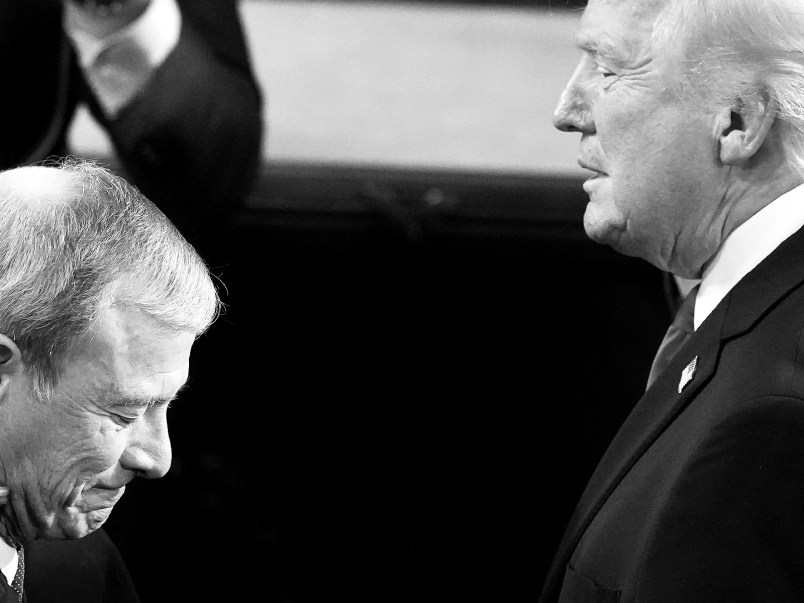
The Supreme Court preserved one of the most important tenets of the Constitution Tuesday, upholding birthright citizenship despite the Trump administration’s unprecedented attempt to shred it.
Chief Justice John Roberts wrote for the majority, joined by Justice Amy Coney Barrett and the liberals. Justice Brett Kavanaugh concurred in part and dissented in part. Justice Ketanji Brown Jackson wrote a concurrence, joined partially by Justice Sonia Sotomayor. Justices Samuel Alito, Neil Gorsuch and Clarence Thomas all filed dissenting opinions, with Gorsuch also signing on to Thomas’.
“Arguments for limiting birthright citizenship to those domiciled in the United States fail,” wrote Roberts. “These arguments err in their definition of ‘allegiance,’ contending that natural allegiance was no longer sufficient for citizenship and that some greater quantum of allegiance (based on domicile) was required. There is scant evidence for this dramatically revisionist view…”
The Trump administration had argued that the Citizenship Clause only applied to people “domiciled” in the United States, who have allegiance to no other country. Even at oral argument, Solicitor General John Sauer struggled with logistical questions about how to determine when someone is sufficiently “domiciled.”
Roberts also pointed out the more uncomfortable ramifications of that argument, echoed in Thomas’, and to a lesser extent, Alito’s dissent: If the test for citizenship is whether a person is “loyal” to the laws of two governments at once, every child of foreign parents does not qualify. Roberts observed that even Thomas “cannot stomach” such a result, and that Alito tried to craft an “ad hoc exception” for parents who have tried hard to become Americans.
Most legal experts thought that this Trump order to take birthright citizenship away from undocumented immigrants was too radical for even this Court. But the margin was ultimately very thin. Kavanaugh concurred with the judgment only insofar as he thinks the executive order violates a law (that Congress could change). He wrote that the order did not violate the 14th Amendment. So the split in terms of the finding that curtailing birthright citizenship violates the Constitution is a bare 5-4.
Kavanaugh wrote that the Constitution is an “enduring document” and that new exceptions to the Citizenship Clause can be added, an argument pushed by the Trump administration.
“Here, that interpretive principle would support additional exceptions for children born to foreign citizens unlawfully or temporarily in the country,” he wrote.
Thomas, always occupying the Court’s rightmost flank, argued that the Citizenship Clause was meant to apply narrowly to Black Americans and not to immigrants. He wrote that Tuesday’s ruling “adds to the sad history of the Fourteenth Amendment, which was designed and understood to secure equal rights for the freed blacks but has instead been repurposed for political projects that the Reconstruction Congress did not support.”
Jackson’s concurrence squarely rebutted Thomas’ myopic reading. She traced the history of advocacy leading to the Reconstruction Amendments as “an anticaste, antisubordination reset for the Nation, not a mere spot treatment for the dark stain of slavery.”
Freed Blacks, she wrote, did not “seek to advance their own position relative to, or at the expense and exclusion of, other marginalized groups,” but saw commonality with other minorities whose status as Americans was questioned and fought.
“Of course, the ultimate irony is that for all the talk about the detestable Dred Scott decision, the Government and the principal dissent propose a return to its core tenet,” she wrote. “Their bottom line is that, for certain people, being born on American soil will not suffice to confer citizenship.”
Alito, the Court’s most reliable repository of right-wing conspiracy theories, arrived at laments about “birth tourism” in the second sentence of his dissent, a ginned up moral panic about an alternate reality in which millions of pregnant immigrants travel to the United States to give birth, then depart.
And, later, on Texas’ valiant efforts to keep immigrants out with razor wire, Alito wrote: “Then, from the comfort of chambers more than 1,000 miles from the southern border, this Court sided with the Federal Government, allowing immigrants to pour into the State.”
The Trump administration ultimately did not get its biggest ask from the Court, which was not prepared to upend U.S. society. But the celebration must be somewhat muted; only two Republican appointees agreed that birthright citizenship given to all born on American soil is a constitutional guarantee.
Read the ruling here:


Kavanaugh dissents too. He says the 14th does not mean what it says, and Congress has the right to take away birthright citizenship. So it’s 5-4 on the plain text, the 130-year-old precedent, the universal understanding, and the Congressional legislative reliance on all of the above.
This Court is insane. It needs to be chucked into the nearest well.
Agree, but a win is a win.
All I can say is, after the violation of Article 2 yesterday and the upholding of the 14th today, judicially, we’ve just been through some epic whiplash.
Hurray. Tenets, though, I think.
I’m glad I get to keep my citizenship having been born in Santa Monica, CALIFORNIA USA