

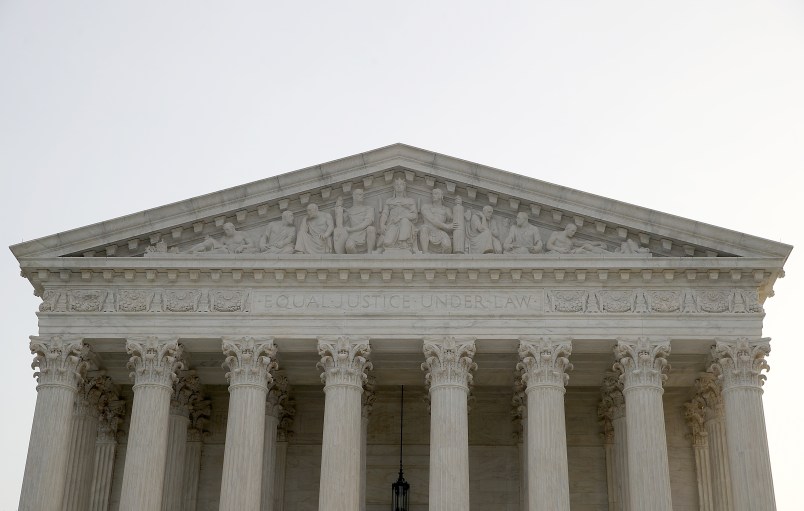
WASHINGTON (AP) — The Supreme Court says police generally need a search warrant if they want to track criminal suspects’ movements by collecting information about where they’ve used their cellphones.
The justices’ 5-4 decision Friday is a victory for privacy in the digital age. Police collection of cellphone tower information has become an important tool in criminal investigations.
The outcome marks a big change in how police can obtain phone records. Authorities can go to the phone company and obtain information about the numbers dialed from a home telephone without presenting a warrant.
Chief Justice John Roberts wrote the majority opinion, joined by the court’s four liberals.
Roberts said the court’s decision is limited to cellphone tracking information and does not affect other business records, including those held by banks.
He also wrote that police still can respond to an emergency and obtain records without a warrant.
Justices Anthony Kennedy, Samuel Alito, Clarence Thomas and Neil Gorsuch dissented. Kennedy wrote that the court’s “new and uncharted course will inhibit law enforcement” and “keep defendants and judges guessing for years to come.”
The court ruled in the case of Timothy Carpenter, who was sentenced to 116 years in prison for his role in a string of robberies of Radio Shack and T-Mobile stores in Michigan and Ohio. Cell tower records that investigators got without a warrant bolstered the case against Carpenter.
Investigators obtained the cell tower records with a court order that requires a lower standard than the “probable cause” needed to obtain a warrant. “Probable cause” requires strong evidence that a person has committed a crime.
The judge at Carpenter’s trial refused to suppress the records, finding no warrant was needed, and a federal appeals court agreed. The Trump administration said the lower court decisions should be upheld.
The American Civil Liberties Union, representing Carpenter, said a warrant would provide protection against unjustified government snooping.
The administration relied in part on a 1979 Supreme Court decision that treated phone records differently than the conversation in a phone call, for which a warrant generally is required.
In a case involving a single home telephone, the court said then that people had no expectation of privacy in the records of calls made and kept by the phone company.
That case came to the court before the digital age, and the law on which prosecutors relied to obtain an order for Carpenter’s records dates from 1986, when few people had cellphones.
The Supreme Court in recent years has acknowledged technology’s effects on privacy. In 2014, the court held unanimously that police must generally get a warrant to search the cellphones of people they arrest. Other items people carry with them may be looked at without a warrant, after an arrest.






And this is where Kennedy always leaves me hanging. I don’t get him very often.
Good for Roberts. I’m not sure how the other four thought their dissent was the logical approach.
Good.
Law enforcement still has to do some legwork to get probable cause to investigate crimes committed.
Apple, Samsung, Verizon and T-Mobile aren’t going to do it all. And innocent people - hopefully - won’t be tracked.
Not in the Matrix - yet.
That is an affront to the memory of Justice Scalia who correctly noted that “The Constitution that I interpret and apply is not living but dead, or as I prefer to call it, enduring. It means today not what current society, much less the court, thinks it ought to mean, but what it meant when it was adopted.”
It is indisputable that “The right of the people to be secure in their persons, houses, papers, and effects, against unreasonable searches and seizures,” did not apply to cell phone towers when the Fourth Amendment was ratified on December 15, 1791.
And that’s a bad thing because? The “originalist” argument is completely wrong, inasmuch as the Founding Fathers deliberately included a process for amending the Constitution. If it was so infallible and unchangeable, why include that part? It’s just more conservative/fascist propaganda.
I haven’t read it, but it seems odd. A person can be physically followed without a warrant. Police can get a pen register record of phone calls made without a warrant (not the content, but the numbers). Why should location data be subject to a higher standard? They can follow me around all day if they want and see exactly where I go, no warrant needed. It just seems inconsistent to require a warrant to get the same data from my phone. I don’t know whether it is a good or bad decision, it just seems off.