


UPDATE 3: June 29, 2015, 10:37 AM EDT
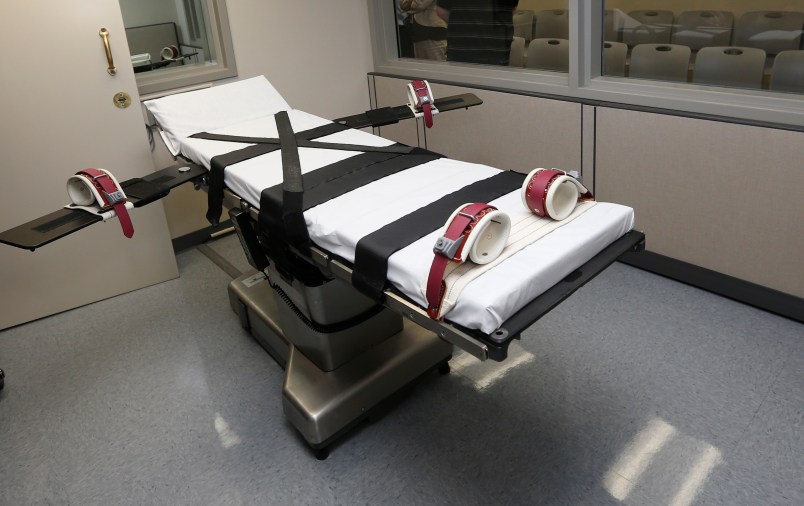
WASHINGTON (AP) — The Supreme Court upheld the use of a controversial drug in lethal injection executions Monday, as two dissenting justices said for the first time that they think it’s “highly likely” that the death penalty itself is unconstitutional.
The justices voted 5-4 in a case from Oklahoma that the sedative midazolam can be used in executions without violating the Eighth Amendment prohibition on cruel and unusual punishment.
The drug was used in executions in Arizona, Ohio and Oklahoma in 2014 that took longer than usual and raised concerns that it did not perform its intended task of putting inmates into a coma-like sleep.
Justice Samuel Alito said for a conservative majority that arguments the drug could not be used effectively as a sedative in executions is speculative.
In dissent, Justice Sonia Sotomayor said, “Under the court’s new rule, it would not matter whether the state intended to use midazolam, or instead to have petitioners drawn and quartered, slowly tortured to death, or actually burned at the stake.”
Alito responded, saying “the dissent’s resort to this outlandish rhetoric reveals the weakness of its legal arguments.”
In a separate dissent, Justice Stephen Breyer said the time has come for the court to debate whether the death penalty itself is constitutional. Justice Ruth Bader Ginsburg joined Breyer’s opinion.
The Supreme Court’s involvement in the case began in January with an unusually public disagreement among the justices over executions.
Then, the court refused to block Oklahoma inmate Charles Warner’s execution over the objection of the four liberal justices. In a strongly worded dissent for the four, Justice Sonia Sotomayor said, “The questions before us are especially important now, given states’ increasing reliance on new and scientifically untested methods of execution.”
Eight days later, the justices agreed to hear the case of three other Oklahoma death-row prisoners. It takes just four votes among the nine justices to agree to hear a case, but five votes to place a hold on an execution.
When the case was argued in late April, the justices engaged in unusually combative exchanges about the Oklahoma case and impassioned debate about capital punishment more generally.
Among the conservatives, Justice Samuel Alito said death penalty opponents are waging a “guerrilla war” against executions by working to limit the supply of more effective drugs. On the other side, liberal Justice Elena Kagan contended that the way states carry out most executions amounts to having prisoners “burned alive from the inside.”
In 2008, the court upheld Kentucky’s use of a three-drug execution method that employed a barbiturate as the first drug, intended to render the inmate unconscious.
But because of problems obtaining drugs, no state uses the precise combination at issue in that earlierSupreme Court case.
Four states have used midazolam in executions: Arizona, Florida, Ohio and Oklahoma. Also, Alabama, Arkansas, Louisiana and Virginia allow for midazolam, but they have not used it in executions.
Last April’s execution of Clayton Lockett was the first time Oklahoma used midazolam. Lockett writhed on the gurney, moaned and clenched his teeth for several minutes before prison officials tried to halt the process. Lockett died after 43 minutes.
Executions in Arizona and Ohio that used midazolam also went on for longer than expected as the inmates gasped and made other noises before dying.
Meanwhile, the court challenge has prompted Oklahoma to approve nitrogen gas as an alternative death penalty method if lethal injections aren’t possible, either because of a court ruling or a drug shortage.
Copyright 2015 The Associated Press. All rights reserved. This material may not be published, broadcast, rewritten or redistributed.





In case you had any doubts about what sort of a person “Justice” Kennedy actually is.
It’s funny how the paleo-Catholics who might be expected to follow long standing Church doctrine on this choose death. Popes, liberal and conservative have opposed capital punishment as have Bishops of various sptripes. I guess this is the kind of “church-state” separation we’re stuck with.
So a drug that has shown to be unreliable & slow to work & certainly appears to be gruesome is OK? … so what would cross the line of Cruel & unusual Punishment? put a convict in a cage, douse them with gasoline & light them up? - or would the swiftness of the death make that OK?
Disgusting decision. Alito cares more about the “intent” of using a bad drug, than the bad drug itself and its ineffective and harmful results for the purposes of execution. It is not “speculative” when there is proof that the drug did not perform as intended. It was clearly an inappropriate choice as a stand-in drug, that was used when other drugs were unavailable to the executioners. The man woke up after being given the drug! How is that not cruel and unusual punishment?
Alito has always been junior league at this Supreme Court stuff. He’s really one of the midget-minds on the court, not to mention he appears totally incompetent. Alito doesn’t seem to read beyond the first paragraph of filed legal briefs he receives without having already made up his mind. There’s a lot of that kind of shit on this court still, regardless of the decisions reached last week.
No surprise here. Republicans hate government, unless it’s promoting the killing of citizens. For some reason, they can’t get enough of that. No one on the court is more supportive of State-sponsored killing than the “pro-life” Antonin Scalia.