

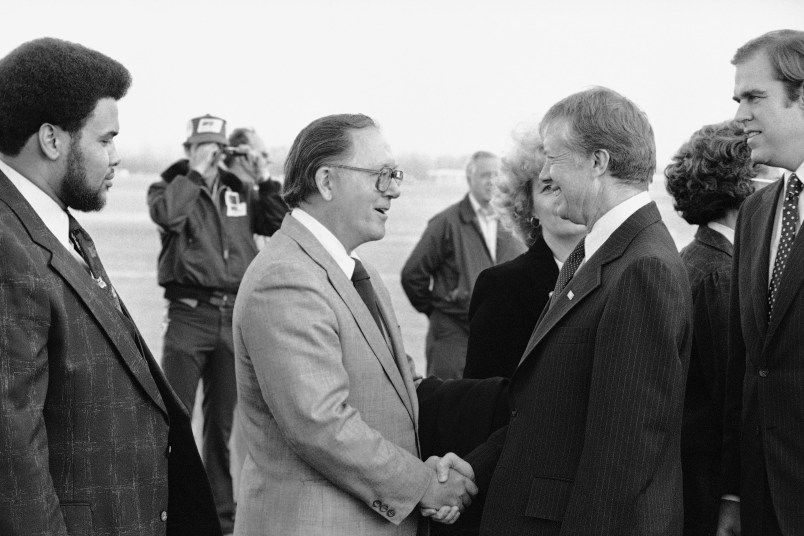
DETROIT (AP) — Former U.S. Sen. Robert Griffin, a Michigan Republican whose withdrawal of support hastened President Richard Nixon’s resignation during the Watergate scandal, has died at age 91.
Griffin was defeated in 1978 but landed a new career in 1987 as a Michigan Supreme Court justice — a job he described as his “highest calling” as a public servant. He died Thursday, according to a family statement released Friday.
Griffin was appointed to the Senate in 1966, following the death of Patrick McNamara, and went on to serve 12 years in the chamber. He was a staunch Republican who initially backed Nixon during the Watergate scandal before joining other influential senators in calling for the president’s resignation in August 1974.
“It’s not just his enemies who feel that way,” Griffin said at the time. “Many of his best friends — and I regard myself as one of those — believe now that this would be the most appropriate course.”
Griffin’s family said President Gerald Ford, another Michigan Republican, had pledged to nominate him to the U.S. Supreme Court but backed off in fear that senators would see it as an act of cronyism.
Griffin helped orchestrate a four-day filibuster in 1968 that squelched President Lyndon Johnson’s nomination of Abe Fortas, a Supreme Court justice, for chief justice. Critics raised ethical questions about Fortas and described him as too liberal.
U.S. Rep. Debbie Dingell, D-Mich., said Griffin was her first boss.
“He taught me the importance of integrity in the political process, keeping your word and working with members on both sides of the aisle,” she said.
Griffin was born Nov. 6, 1923, in Detroit and served in the U.S. Army from 1943 to 1946. The next year, he received an undergraduate degree from Central Michigan University, which in an effort to spur renewed interest in government later established the Robert and Marjorie Griffin Endowed Chair in American Government.
He earned a law degree at the University of Michigan in 1950, and practiced law in Traverse City until 1956, when he was elected to the U.S. House.
Griffin served eight years on the Michigan Supreme Court through 1994.
“I have enjoyed the honor of earlier government service in other capacities,” he said. “However, I can say without hesitation that I have never worked harder, nor have I met a higher calling, than as a member of this court.”
The Grand Traverse County courthouse in Traverse City was named for Griffin in 2006.
Survivors include his wife of 67 years, Marjorie. A son, Richard Griffin, is a judge on the 6th U.S. Circuit Court of Appeals in Cincinnati.
___
Follow Ed White at http://twitter.com/edwhiteap
Copyright 2015 The Associated Press. All rights reserved. This material may not be published, broadcast, rewritten or redistributed.






Griffin is among the very last of a quickly dying breed: a conservative Republican who wasn’t a complete and utter lunatic. If he’d been faced with the likes of Louie Gohmert, Michele Bachmann, Carson, Santorum, and Cruz, he’d have recognized them for what they in fact are: the ideological descendants of the John Birch Society. At the time Griffin was in office, Birchers were regarded by most mainstream Republicans with distaste and disdain. I never would have voted for Griffin, but one of his Republican contemporaries was former Michigan governor William G. Milliken, who I voted for twice. Milliken was unapologetically pro-choice and socially moderate on a wide range of policy issues, and was one of the more decent people I’ve ever known in politics. Today, Milliken would be reviled by the GOP base as a horrible liberal, and Griffin would be regarded as insufficiently conservative.