

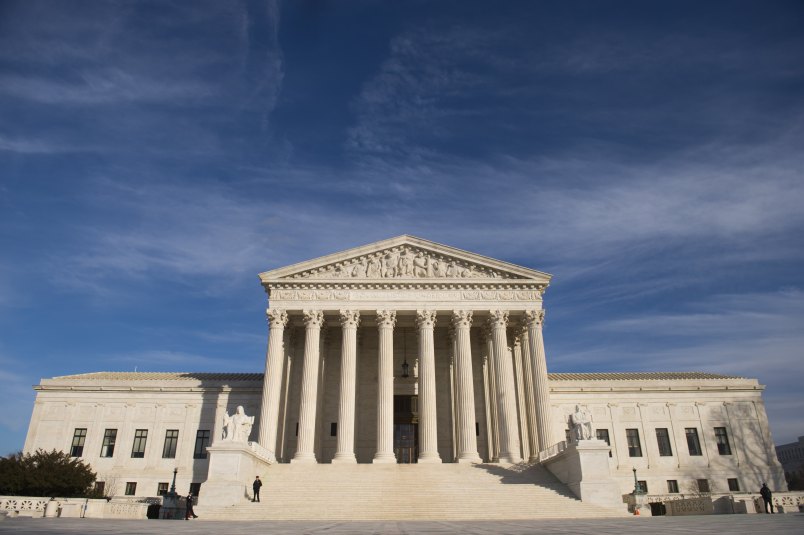
WASHINGTON (AP) — The Supreme Court is hearing arguments in a case that could deal a painful financial blow to organized labor.
All eyes will be on Justice Neil Gorsuch Monday when the court takes up a challenge to an Illinois law that allows unions representing government employees to collect fees from workers who choose not to join. The unions say the outcome could affect more than 5 million government workers in 24 states and the District of Columbia.
The court split 4-4 the last time it considered the issue in 2016. Gorsuch joined the court in April and has yet to weigh in on union fees. Organized labor is a big supporter of Democratic candidates and interests. Unions strongly opposed Gorsuch’s nomination by President Donald Trump.
Illinois government employee Mark Janus says he has a constitutional right not to contribute anything to a union with which he disagrees. Janus and the conservative interests that back him contend that everything unions representing public employees do is political, including contract negotiations.
The Trump administration is supporting Janus in his effort to persuade the court to overturn its 1977 ruling allowing states to require fair share fees for government employees.
The unions argue that so-called fair share fees pay for collective bargaining and other work the union does on behalf of all employees, not just its members. People can’t be compelled to contribute to unions’ political activities.
The American Civil Liberties Union is on the unions’ side against an individual’s free speech claims. ACLU Legal Director David Cole said fair share fees do not violate nonunion workers’ rights.
Labor leaders fear that not only would workers who don’t belong to a union stop paying fees, but that some union members might decide to stop paying dues if they could in essence get the union’s representation for free.
“This is the place, sisters and brothers, where we make a stand today,” said Lee Saunders, president of American Federation of State, County and Municipal Employees, at a rally Saturday in New York City. A union local is the defendant in the case.
___
AP Radio Correspondent Julie Walker contributed to this report.



A death knell for unions.
Ending minimum wage and child labor laws (for the children Rethugliklans and their NRA masters choose to let live) will be next.
We’ll be back to the Gilded Age before you know it.
I am not hopeful about this.
Workers in America have no sense of history, and indicate forcefully time and time again their willingness to work like animals for peanuts. I do not understand how the vast millions of underpaid workers at Walmart and Amazon don’t just stand up and demand a decent living wage, or simply walk out! There is no longer any tradition in America of labor flexing their muscle even with the huge power they have in their numbers and their labor. Remarkable.
There have been protests at Walmart and fast food places, as for Amazon they contract out most of their warehouse workers. The problem for most retail workers is that the companies cut hours. B&N just cut workers and hours of workers, middle management is constricting so they aren’t firing as many people but when those people in middle management leave they won’t be replaced.
As for Janus ( name of Roman god with two faces, seems apropos) he’s not following the Right To Work mantra of if you don’t like the conditions of your job leave and get one that you like.
The case only applies to unions representing state government employees. The answer to an adverse decision is blindingly obvious. States could easily change their laws so that public employee unions only bargain on behalf of their members. Right now, they must also bargain on behalf of all employees, whether or not they are union members. So, today, a government employee (most often a teacher or police officer or fire fighter) gets the benefit - whether or not they have joined the union - of the pay increase that a union got through a collective bargaining agreement with the government agency. If that were changed so that only dues paying union members got the benefit of a collective bargaining agreement, then government employees could make a rational decision about union membership. If you don’t want to pay dues, that’s your right. But you can’t both decide not to join the union and, at the same time, get the wages, hours and working conditions that the union has achieved through the collective bargaining process. My guess is that almost all employees would choose union membership, paying the dues and getting the benefits. For those who don’t want to, they don’t have to. But they don’t get to be free riders.
Union my whole life till retirement in construction.
Collective bargaining agreement
Trained workers
Safe working conditions
Decent wage
Decent pension
Super annuity
All things a republican despises.
By the way, the 911 clean up was all union workers in every category. Not something advertised very much. Private companies and slave labor could not even come close to getting the work accomplished.
I know because I was there, working