

Both were great generals. Both Virginians. Both came from slave-owning plantation families.
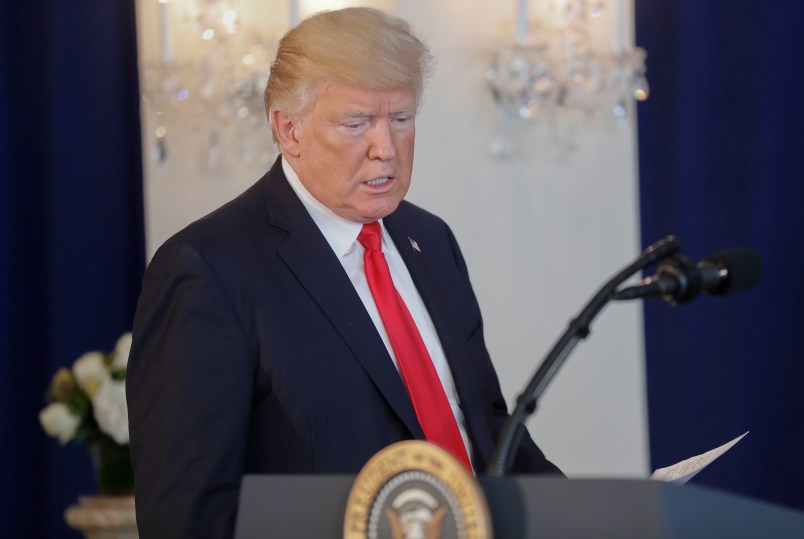
Is it really so far-fetched to put Robert E. Lee in the same category as George Washington, as President Donald Trump suggested Tuesday?
Many historians say yes.
“It’s a ridiculous conflation,” said Professor Alice Fahs of the University of California, Irvine. “He’s not a founding father, and it’s as though Trump thinks he is. It’s really astonishing. It’s amazing.”
Trump’s remarks on Tuesday came as he was defending those who have sought to preserve the statue of Lee in Charlottesville, Virginia, the focus of a violent weekend clash in which an anti-racist protester was killed. The president didn’t exactly equate the Confederate general with the nation’s founding fathers. But he noted a similarity sometimes glossed over — ownership of slaves by figures who nobly stand or sit astride horses on U.S. pedestals — and he asked: If you’re going to be pulling down statues, “where does it stop?”
“So, this week it’s Robert E. Lee,” he said. “I wonder, is it George Washington next week, and is it Thomas Jefferson the week after?”
There is no notable movement to tear down the Washington monument.
Most historians are in agreement that Washington and Jefferson’s ownership of slaves has tainted the positive legacy they left. And some monuments and memorials to both men attempt to address that part of their lives.
For some, monuments to those founding fathers “force us to contemplate the centrality of slavery to the making of the nation,” said Gregory Downs, a history professor at the University of California, Davis who studies the impact of the Civil War on the United States. But he also said the difference between the nation’s first president, George Washington, and then man who sought to secede from the nation, Robert E. Lee, isn’t complicated.
“It is obvious that traitors in arms to the nation are not equivalent to those who created it,” he said.
Adding to the complexity of the debate, many Lee memorials were erected long after the Civil War as part of an effort to rehabilitate Lee’s reputation and denigrate his victorious opponent Ulysses S. Grant, who fought to preserve the nation and later defended black civil rights as president.
In that sense the memorials “celebrated two historical crimes,” Downs said. “First, treasonous secession for the purpose of preserving and expanding slavery forever. Second, the violent and fraudulent creation of Jim Crow segregation.”
Associate Professor Michael Green of the University of Nevada Las Vegas added, “A lot of Southerners glorified Lee into something more than he was.”
Lee has been portrayed as kindly to slaves, which he was not, and conflicted about which side to fight for, which is inaccurate, Green said.
He concedes, however, that if “my ancestors had fought for the Confederacy, it’s possible I would feel a little differently. It’s important to look at historical figures so that we don’t look up at them or down on them, but from all angles.”
He said that historical consensus is very different now than when Trump learned it in school decades ago. People like Lee were presented as heroes and people like Frederick Douglass, about whom the president seemed to have little knowledge earlier this year, weren’t presented at all.
Lee and Washington in the same class? Said Downs: “Had the Confederacy won, a new nation founded on perpetuating slavery would have celebrated Robert E. Lee as its George Washington. Luckily for us, that effort failed.”
___
Andrew Dalton reported from Los Angeles.






I’ve gone completely to the other side in this argument. I once sympathized with my neighbors here in Kentucky, those who were arguing that these symbols and monuments were celebrating heritage. But in revisiting history, especially the history of these monuments, I’ve come full circle.
First, Kentucky was not part of the Confederacy; it was a border state, along with Maryland, who chose not to participate in the Civil War. So for Kentuckians to celebrate the Confederacy is rather ironic. Second, most of these monuments weren’t put up right after the Civil War, but right after the Supreme Court wrongfully defended segregation, and white nationalists attempted to “whitewash” their history. Lastly, it is laughable for people who cry about “taking their country back” are deciding that people who commit treason against the United States should be lumped in the same category as those who sought to preserve the Union.
There’s a difference between recognizing history versus memorializing it. I don’t have family members who fought for the Confederacy. One of my family members was an Army deserter during the Civil War. I acknowledge him and our history, but I don’t try to memorialize him or use him as an example of my family’s heritage. People who choose to memorialize the Confederacy need to understand that, while admirable that they want to recognize people from their past, that not all human efforts should be counted as noble, brave, or noteworthy.
Intellectual consistency is not a strength of either POTUS or the extreme right. Newt Gingrich has given cover to anyone who wants to revise history so that it supports their twisted views. We’ve seen this same impulse in science, and you can see it in those who want to force teachers to teach “both sides” of various controversies. Stand by for state legislators filing bills to force history teachers to teach the truth about Robert E. Lee, et al.
Trump goes afoul by breathing.
I agree with most of what you say, but this is problematic:
Kentucky, Maryland and Missouri, slave states that did not secede, were very much involved in the war. It is true that the Kentucky legislature tried to declare neutrality in 1861, but that was laughable. As I suspect you know, Kentucky was heavily fought-over early in the conflict, and contributed thousands of soldiers to both sides.
If Trump wants to compare Lee to Revolutionary War figures, I suggest Benedict Arnold would be more appropriate than Washington or Jefferson.