

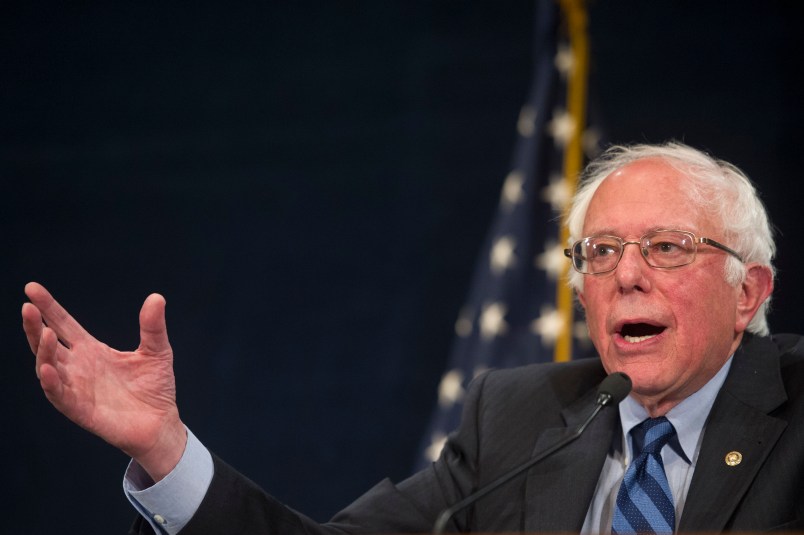
SAN FRANCISCO (AP) — Saying that consuming too much sugar is a serious health problem, U.S. Sen. Bernie Sanders told the soft drink industry to stop using his name in ads fighting proposed soda taxes in the San Francisco Bay Area.
The Vermont senator said in a statement Thursday that campaign commercials and mailers implying that he opposes soda tax measures on the Nov. 8 ballot in San Francisco and Oakland are false.
Neighboring Albany also has a penny-per-ounce tax measure on its ballot.
“I have not taken any position on those ballot items and I have asked the American Beverage Association to stop using my name in connection with this misleading advertising,” Sanders said.
His Senate campaign noted his objections in a cease-and-desist letter sent to the association on Oct. 10.
Soda tax opponents, funded largely by the beverage association, have gleefully touted Sanders in their campaign against the measures. Sanders opposed a soda tax in Philadelphia, calling it a regressive tax that would hurt poor consumers.
“The ad accurately speaks to the fact that these taxes are regressive – a point that Senator Sanders made not just once or twice, but emphasized multiple times in multiple forums during his presidential campaign – and that they disproportionately affect low- and middle-income Americans,” Joe Arellano, a spokesman for the opposition campaigns, said in a statement. “The ad accurately portrays his position.”
However, the statement added, “if Mr. Sanders wants to stay out of these local issues, we will respect that as well.”
Bay Area opponents say a tax would harm small grocers and customers, and that the money raised could be used for anything by city government.
Sanders’ news cheered tax proponents, who say the sugary drinks contribute to obesity, diabetes and tooth decay.
“I would call on the television stations that are currently running the misleading ads to stop doing so immediately,” said Dr. John Maa, secretary of the San Francisco Medical Society and tax proponent.
Sanders said the version of the tax he opposed in Philadelphia was three times higher than those being considered in the Bay Area.
“Excessive sugar consumption is a serious health problem for children and all of us,” he said in his statement. “Every community in our country will determine how best to address this major health crisis.”
The tax on sugary drinks — including sweetened tea, soda, and energy drinks — is on distributors and is not paid by customers who buy the drinks. There is no tax proposed on diet drinks.
Copyright 2016 The Associated Press. All rights reserved. This material may not be published, broadcast, rewritten or redistributed.





This reminds me of a thread over on FARK from a couple of weeks ago where right-wing anti-every-tax-ever dipshits were agog at the idea of using taxes as incentives. I’m sure they don’t mind the mortgage deduction, child credit, or charity deduction on their 1040s, though…
Anywho, yeah the soda tax is probably somewhat regressive. If you assume that the average bottom-income-quintile person drinks about as much soda per year as the average top-quintile person, then it’s slightly regressive due to a larger share of the bottom-quintile person’s spendable cash going towards the tax (at $0.01/oz, we’re talking $43/year at one 12oz soda per day, or $117/yr for a 32oz Big Gulp per day). If you assume that the average bottom-quintile person drinks more soda than the average top-quintile person, then it’s more regressive.
But the thing is, not all regressive taxes are Bad Things. Nothing in economics is black-and-white anyhow, and tax incentives especially so. There are massive externalities (“costs we all pay for whether we like it or not” for you right-wing dipshits) associated with excess sugar consumption and, most importantly, there are easily available substitutes for sugary drinks.
The presumption of the beverage industry shills is that people will continue to drink just as much soda as always and therefore this regressive tax will “hurt poor people”. When in fact, since it is an incentive to purchase healthier and easily obtained alternatives, it will in the long run help poor people and everybody else as well.
Also, as a related aside, some RWNJs will say “I don’t want the gubmint telling me how to live my life!!!111one!” Well good because that’s not what is happening. You can live however you want. Drink four Super Gulps before breakfast for all we care. But you are going to help pay for the external effects of your poor choices. No more freeloading on the rest of us.
The tobacco industry fought cigarette taxes using the same rhetoric. They were wrong, and PepsiCocaColaCo are wrong as well.
The problem with using the “tax incentive to make healthy choices” argument is it ignores other societal problems that face low income populations.
The idea behind taxing junk food/sugary drinks makes perfect sense to suburban consumers who can go to Whole Foods or other upscale grocery stores that have an abundance of “cheap” fresh produce and other “alternatives”, but go to many urban and lower income neighborhoods and you may have to rely solely on what the local corner bodegas have to offer, and that is usually cheap off brand soda and processed foods. Also, when you’re trying to stretch a paycheck, stuff that spoils quickly like vegetables and such give way to more shelf stable items that last longer. The “easily available healthy choices” can ,and often are, several miles away from them. It’s basically the same counter argument to why voter ID laws are bullshit, some people do not have access to what you take for granted. The problem of obesity is not going to be solved by “tax incentives”, until the supply problem is solved.
I’ve been in the situation where I wanted to make more healthy choices with my groceries, but getting those healthy options was only possible if I drove 30 minutes down the interstate to the next town over.
And yes, the evidence shows the “bottom-quintile” consumes far more soda/sugary drinks than the top.
This is usually a good argument - yes, when people say, “Why are you eating processed food instead of fresh vegetables?”, it does indeed overlook that the poorest among us tend to live in food deserts and don’t always have fresh vegetables available (or the time/energy available to prepare them). But the alternative to soda is water. Regardless of income level, adults should be drinking water as their primary beverage, with anything else as an occasional treat. And outside of horrifying exceptions such as Flint, you can just get water from the tap.
Flint is an extreme case, but is not the only case of the local tap water being basically undrinkable in the nation (it’s not even the worst, just the one that has made the news). Heck, in places like NYC it can be on a building by building basis.
Long story short, “soda”/“junk food” taxes are borne by lower income earners, and are just as indefensible as “sales tax in place of income tax” and “voter ID is necessary because reasons”
[quote=“pandastirfry, post:3, topic:45584, full:true”]
The problem with using the “tax incentive to make healthy choices” argument is it ignores other societal problems that face low income populations. The idea behind taxing junk food/sugary drinks makes perfect sense to suburban consumers who can go to Whole Foods…The “easily available healthy choices” can ,and often are, several miles away from them.[/quote]
OK, well, I was not talking about junk food, only sugared sodas. I admit to not shopping often at the local corner bodega in lower-income neighborhoods, but I have yet to see a convenience store anywhere in my city - or anywhere I’ve lived or traveled, including some of the poorest areas of Mississipi - that does not have diet soda on the rack right next to the sugared variety. Or water. Or juice. Or tea. Etc. I said “easily available substitutes”, not “healthier” (though arguably the water or juice might be the healthiest choice).
I agree 100% with your comments regarding for example fresh produce vs. junk food. Not the topic, however.
??? You may have me confused with someone else. I am against voter ID laws, at least as every state has tried to implement them.
I’m genuinely interested in why you put scare quotes around “bottom-quintile”. This is an economic term of art, not an insult. In any case, my intuition was that soda consumption would be stronger among lower income individuals, but I didn’t do the research so I tried to cover all bases. I’ll take your word for the actual state of things.
FWIW I completely agree that sales taxes in lieu of income taxes is an indefensible proposition on the basis of its regressive nature. I see a large difference between that and a soda tax, however.
Perhaps a way forward in our discussion: are you in favor of repealing all cigarette taxes? Or if you are old enough, were you against levying them in the first place?