

WASHINGTON (AP) — The Americans imprisoned by Iran began their journey home Sunday, their friends and family awaiting emotional reunions, after delicate
diplomatic negotiations that played out quietly in the shadows of
international nuclear talks.
A charter plane left Tehran for Switzerland with the Americans — all four who had been detained, according to Iran state television, or only three, the U.S.
said — as part of a prisoner swap.
U.S. officials said Washington Post reporter Jason Rezaian, former U.S. Marine Amir Hekmati, and pastorSaeed Abedini were on the flight, but not Nosratollah
Khosravi-Roodsari. But Iran said he had taken off, too. The discrepancy
could not immediately be reconciled.
“Those who wished to depart Iran have left,” according to a senior U.S. official, speaking on condition of anonymity because of the sensitivity of the matter and
privacy concerns for the families.
The Post’s publisher, Frederick J. Ryan, Jr., said in a statement, “We are relieved that this 545-day nightmare for Jason and his family is finally over.
Hekmati’s family said “it is hard to put into words what our family feels right now.”
Iran celebrated the lifting of stiff economic penalties now that the Islamic
Republic has met a critical benchmark as part of the agreement to pull
back its nuclear program.
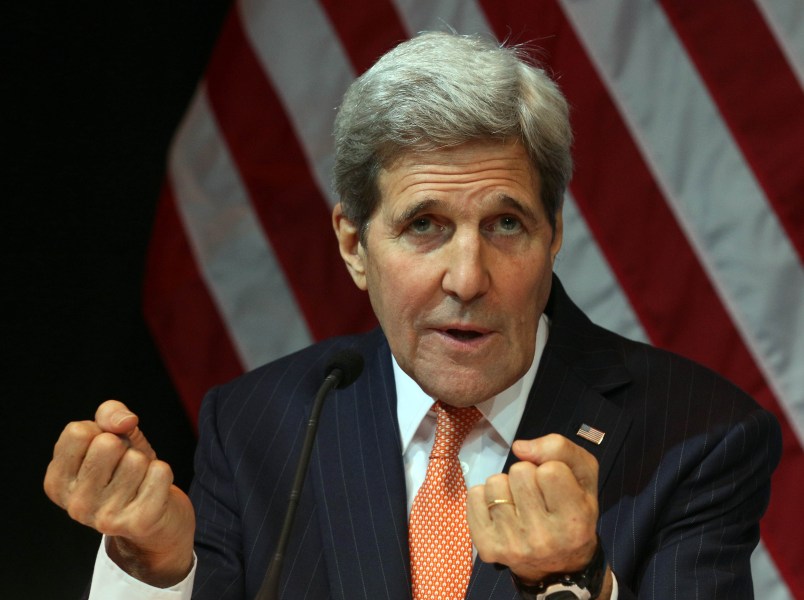
Secretary of State John Kerry said U.S. officials hashed out the prisoner exchange over 11 or 12 meetings with the Iranians. At times, the Americans thought a deal was set, only to get stuck on the details.
After almost constant conversation over the last few days, they finally did settle it.
Kerry said the nuclear agreement provided the key impetus.
Just before Iran’s foreign minister, Mohammad Javad Zarif, announced the
July 14 accord with his European Union counterpart, Kerry again raised
the issue of the detained Americans.
A photograph of him speaking with Zarif and Iranian President Hasan Rouhani’s brother, Hossein Fereydoun, captured the moment.
Things progressed significantly by a November meeting in Vienna on Syria’s
civil war, when, for the first time, Iran was included in the
discussions. Kerry and Zarif met on the sidelines of the talks to
discuss the prisoners.
“We actually shook hands thinking we had an agreement,” Kerry said. “I thought it was done.”
But the deal bogged down in Tehran and never went through. “So we went back to work,” Kerry said.
He described the negotiations as difficult, especially as the Iranians
made what he said were unacceptable demands. Kerry said the United
States made it clear that it would not release a hardened criminal such
as an accused murderer or someone with a narcotics record.
“For a long time, this didn’t move because of the people they were asking for,” Kerry recalled. “We said, ‘No, and no, and no.'”
“And believe me, it’s hard when somebody says to you, ‘Hey, you give us this
guy, we let them all out.’ And you have to say no. And you know you’re
keeping people in a not very nice place for the next whatever number of
months,” he said.
“But there have to be an enforcement of our principles and our standards here. And in the end, we came out in the right place on that.”
More progress was made by Kerry’s meeting with Zarif on Dec. 18 in New York. By then, American and Iranian teams in Geneva were working hard on the details of the swap.
The U.S. was prepared to release individuals who violated nuclear-related
sanctions on Iran, Kerry said. By Saturday night, those penalties were
no longer in effect.
“In the end, the president made the call,” he said.
Talking to reporters in his plane after landing Sunday morning at Andrews Air
Force Base, Kerry said he had hoped to meet the returning Americans in
Switzerland.
But after the nuclear talks moved to Vienna and dragged on, he decided to send the lead negotiator on the matter, Brett McGurk, and State Department aide Patrick Kennedy, to await the Americans’ arrival.
Kerry said one of the last hiccups that delayed the departure of the Americans was an Iranian military official’s misunderstanding about Washington Post reporter Jason Rezaian’s mother.
The deal specifically permitted her to accompany Rezaian on the flight. After Kerry spoke to Zarif, that problem was solved.
But the various administrative holdups meant that the Swiss crew set to fly
the plane ran into a mandatory crew rest. That set back takeoff several
hours.
Kerry said the prisoner swap and almost simultaneous implementation of the nuclear deal raise the prospects of increased U.S.-Iranian cooperation on other matters.
Zarif, Kerry said, made
it clear that if they got the two tasks done, “there are ways to try to
translate this and hopefully be constructive in other things. He
specifically said Syria and Yemen.”
“I put a big, ‘Who knows?'” on that, Kerry said, but expressed hope.
Kerry said he would remain at work on other Americans still being held in Iran.
The
exchange did not cover Siamak Namazi, an Iranian-American businessman
who advocated better ties between Iran and the U.S. and who reportedly
was arrested in October, or former FBI agent Robert Levinson, who
disappeared in Iran in 2007 on an unauthorized CIA mission.
Asked if Levinson was dead or alive, Kerry said, “We have no idea.”
The
exchange eases a leading irritant as the two countries gingerly explore
prospects for a smoother relationship after decades of hostility — even
as they remain sharply at odds on other fronts.
A fifth American, student Matthew Trevithick was released independently of the larger swap, and already had headed home.
In
turn, the U.S. was pardoning or dropping charges against seven Iranians
— six of whom are dual U.S.-Iranian citizens — accused or convicted of
violating U.S. sanctions.
Three were serving prison terms and
received a commutation or pardon. Three others were awaiting trial; the
last one made a plea agreement.
In addition, the U.S. was dropping
drop Interpol “red notices” — essentially arrest warrants — on 14
Iranian fugitives it has sought, officials said.
Copyright 2016 The Associated Press. All rights
reserved. This material may not be published, broadcast, rewritten or
redistributed.




This is great news indeed. Secretary deserves great credit - the energy it took to complete the Iran deal and then negotiate the release of prisoners had to be exhausting. I had read (not on Al Jazeera that he had established a good relationship with Javad Zarif was the key and that the two actually like each other.
It is interesting however, the way the media is spinning this
https://www.washingtonpost.com/world/iran-releases-post-correspondent-jason-rezaian-iranian-reports-say/2016/01/16/e8ee7858-ba38-11e5-829c-26ffb874a18d_story.html
But the agreement also contains significant political risk for a
White House that is staking its legacy on Iran’s willingness to
comply with unprecedented curbs and extensive monitoring of its
nuclear program. The pact — which has been repeatedly condemned by
the Israeli government as well as by members of Congress from both
parties — drew fresh attacks Saturday from Republican presidential
contenders, some of whom blasted the deal as a sellout to Iran’s
clerical rulers.
The nuclear pact calls on Iran to dismantle key nuclear equipment in
a deal designed to ensure that Iranian officials could never
accumulate enough fissile material to build a nuclear bomb. The
agreement also requires unprecedented inspections and monitoring
covering all aspects of Iran’s nuclear program, from uranium mining
to research facilities.
Iranian Foreign Minister Mohammad Javad Zarif echoed Kerry’s remarks,
saying on Twitter that “diplomacy requires patience, but we all know
that it sure beats the alternatives.” Implementation of the deal,
Zarif said, meant that “it’s now time for all — especially Muslim
nations — to join hands and rid the world of violent extremism. Iran
is ready.”
The release of prisoners had not been officially part of negotiations
between Iran and the six world powers: the United States, Russia,
China, Britain, France and Germany. But Kerry frequently raised the
plight of imprisoned U.S. citizens during last year’s nuclear talks.
The Obama administration had come under heavy criticism for
concluding the nuclear accord without winning the release of American
detainees, including Rezaian, 39, whose 544-day detention is the
longest ever by a Western journalist in Iran. White House officials
confirmed that the swap was clinched during months of secret talks
that gained momentum in the days before the nuclear pact was formally
implemented.
The president is about to speak this morning
I didn’t realize Robert Levinson was detained in Iran in March of 2007 under the esteemed administration of George W. Bush. I don’t remember, but you can be sure the republicans didn’t make a big deal out of that and what if anything did the Bush admin do to get him back?>
I am confident the Iranian government will comply. Of course, going forward there surely will be disagreements and differing interpretations of the requirements, but it is infinitely better to argue over these interpretations than to go to war.
Also, Iran would face the brunt of a full return of economic sanctions if they violate the terms of the agreement. They know the stakes are high, especially after their economy was decimated by years of sanctions.
They also face pressure from another source: the Iranian people, largely young, educated, and somewhat Westernized. They have been pushing for an end to the high unemployment, and economic and diplomatic isolation they have experienced as citizens of a pariah nation.
And they want the same opportunities – to get an education, study, travel, and enjoy a higher standard of living for themselves and their families – that citizens of many other countries enjoy.
As far as the media, they unfortunately tend to the shallow, trivial and dramatic, and too often only serve as a mouthpiece for the most unhinged opposition.
And since the election of President Obama, the Republicans are only motivated by hatred, resentment and phony outrage. To their shame and everlasting disgrace, not one of them has praised this administration for forcing Iran into compliance.
And it was a good statement he made.