


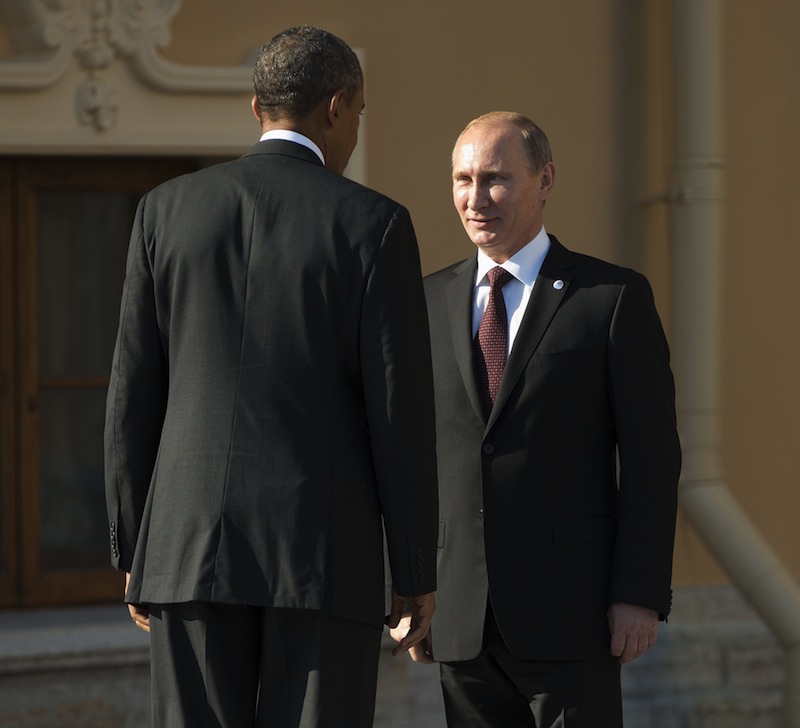
SEOUL, South Korea (AP) — The U.S. and Europe are laying the groundwork to sanction broad sections of Russia’s economy if Moscow invades eastern Ukraine, President Barack Obama said Friday, even as he acknowledged those sanctions may fail to deter Vladimir Putin.
So far, the U.S. has slapped sanctions on individuals but hasn’t targeted entire economic sectors, such as Russia’s critical energy sector. Obama’s comments affirmed that barring a full-on military incursion, Russia is unlikely to face those beefed-up sanctions, which could ricochet and harm U.S. allies in Europe that do business with Russia.
“We’ll continue to keep some arrows in our quiver in the event we see further deterioration,” Obama said during a news conference in South Korea, where the president was traveling.
Obama said he planned to call key European leaders on Friday evening to discuss what’s transpired since a deal was reached in Geneva last week to de-escalate the crisis. Echoing harsh comments from U.S. Secretary of State John Kerry, Obama said Russia has failed to uphold the deal by urging pro-Russian militias to give up buildings they’ve occupied in Ukrainian cities.
Seeking to convey strong unity among the U.S. and European nations, Obama said he was “deeply encouraged” by the consistent condemnation of Russia’s actions in Crimea that have emanated from capitals in Europe, North America and across the globe.
Still, Obama conceded that those statements of condemnation, as well as sanctions levied on Russia so far, have not persuaded Russia’s leaders to change course. But he insisted that Putin understands the economic hit Russia has already taken as a result of its actions, adding that the Russian president “is not stupid.”
As if to underscore those costs, credit agency Standard & Poor’s cut Russia’s credit rating Friday for the first time in more than five years.
The crisis in Ukraine has continually trailed Obama as he travels across Asia this week. As Obama opened a visit to South Korea on Friday, Russia’s foreign minister was accusing the West of plotting to control Ukraine. A day earlier, Russia announced new military exercises near its border with Ukraine in yet another sign that tensions have only increased.
With Moscow and Washington trading harsh words, the crisis has brought renewed attention to the testy relationship between Obama and Putin, who was asked during a news conference earlier in the week whether Obama would save him if he were drowning. Putin said he was sure that Obama would.
Asked to corroborate that claim on Friday, Obama joked that as a strong swimmer who grew up in Hawaii, he’d like to think he’d save anybody.
“I absolutely would save Mr. Putin if he were drowning,” Obama said.




Many are watching events unfold in the Ukraine with great concern. As the situation becomes increasingly real, there are real potential consequences facing Europe in the event that Russia uses its energy reserves as a weapon by withholding vital supplies or implementing drastic price increases, a prospect which could undermine Europe’s fragile economy and, by extension, our own.
In a similar vein, disarmament talks with Iran, while promising, face real obstacles, not the least of which is the wariness, skepticism and attitudes hardened by decades of mutual isolation and distrust.
Not completely unrelated to these issues are the sluggish economic recoveries facing the American and European populations.
In an effort to stave off European concerns over possible economic brinksmanship with Russia, and lessen the potential for destabilizing energy price hikes or sanctions to lead to another European economic slump, perhaps Iran, as well as Iraq, can be brought into the equation: Why don’t we – as part of an effort to provide an incentive to facilitate ongoing disarmament talks with Iran and to help Iraq recover from our disastrous and ruinous invasion – encourage Iran and Iraq to sell their oil, and Iraq to sell their oil and natural gas, to Europe? This could not only fill the gap in Europe’s energy supply in the event of an economic energy blockage by Russia, it might also effectively end the economic and diplomatic isolation of Iran and Iraq and foster greater economic ties between, and integration among, the two regions. In exchange, we can work out a security guarantee for Iran and agree to help them develop peaceful uses for nuclear energy.
Such an agreement could ease the security concerns of our ally Israel, and also in turn lead to great economic exchanges between the two nations.
This could also ease security concerns among Israelis in regards to a peace settlement and also serve as a model for a mutually beneficial economic cooperation between Israel and Palestine.
In addition, European concerns for a potential economic downturn caused by an energy shock from Russia could be alleviated by your proposed Europe-U.S. trade pact, which could fill the void caused by the economic shock resulting from a Russian oil embargo or price hike.
And while trade pacts have been painted as a “race to the bottom” since NAFTA, this must be presented as a different set of opportunities: whereas the perception that worker interests possibly were undermined by the lowering of trade barriers with a nation – Mexico – featuring low average wages, low levels of unionization, and lax governmental and environmental regulations, it must be emphasized that many European nations boast comparable or even higher average wages than enjoyed by many American workers, higher levels of unionization, comparable and even stricter governmental and environmental regulations.
Therefore, a Europe-U.S. trade pact could be presented, not as a race to the bottom that undercuts American workers and leaves them at a competitive disadvantage, but as a level playing field between two markets of comparable size, complexity and with shared cultural and political values.
This could be presented to a “stimulus-weary” conservative leadership and electorate under the rubric of national security and a strengthening of shared purpose with fellow democracies, just as Lend-Lease helped trigger the eventual onset of a full economic mobilization that accompanied our entry into World War II.
“I absolutely would save Mr. Putin if he were drowning”
The question is would Putin try to drown him?
Of course our POTUS would save Putin if drowning…he’s not a Republican…