

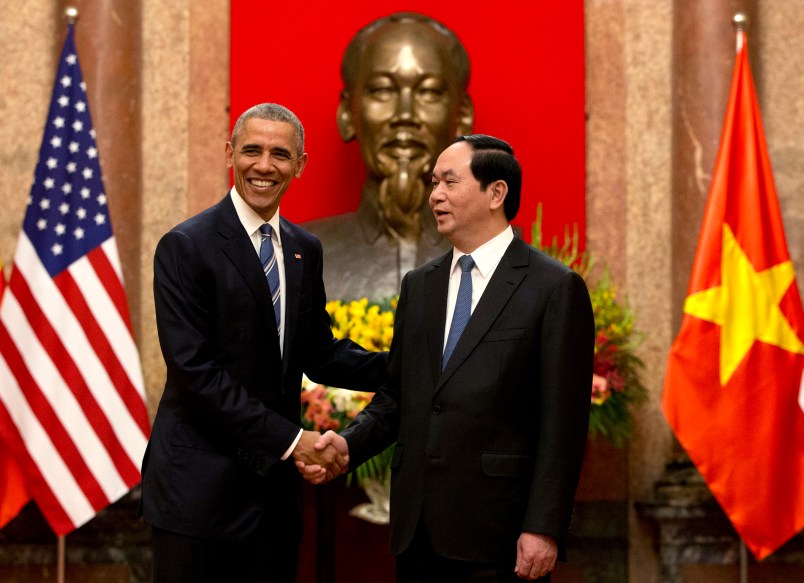
HANOI, Vietnam (AP) — U.S. President Barack Obama on Monday lifted a half-century-old ban on selling arms to Vietnam, looking to bolster a government seen as a crucial, though flawed partner in a region that he has tried to place at the center of his foreign policy legacy.
Obama announced the full removal of the embargo at a news conference where he vowed to leave behind the troubled history between the former war enemies and embrace a new era with a young, increasingly prosperous nation. Obama steered clear of harsh condemnation of what critics see as Vietnam’sabysmal treatment of dissidents, describing instead modest progress on rights in the one-party state. Activists said his decision to lift the embargo destroyed the best U.S. leverage for pushing Vietnam on abuse.
“At this stage, both sides have established a level of trust and cooperation, including between our militaries, that is reflective of common interests and mutual respect,” Obama said. “This change will ensure that Vietnam has access to the equipment it needs to defend itself and removes a lingering vestige of the Cold War.”
Obama also had more current motivations. His move was the latest step in a yearslong and uneven effort to counter China’s influence in Asia. Obama’s push to deepen defense ties with a neighbor was certain to be eyed with suspicion in Beijing, which has bristled at U.S. engagement in the region and warned officials not to take sides in the heated territorial disputes in the South China Sea.
Obama claimed the move had nothing to do with China, but made clear the U.S. was aligned with the smaller nations like Vietnam.
The United States and Vietnam had mutual concerns about maritime issues and the importance of maintaining freedom of navigation in the South China Sea, he said. While the Washington doesn’t take sides, he said, it does support a diplomatic resolution based on “international norms” and “not based on who’s the bigger party and can throw around their weight a little bit more,” a reference to China.
China outwardly lauded the lifting of a U.S. arms embargo, saying it hoped “normal and friendly” relations between the U.S. and Vietnam are conducive to regional stability. A spokeswoman for the Chinese Foreign Ministry said bans are a product of the Cold War and shouldn’t have existed.
China itself remains under a weapons embargo imposed by the U.S. and European Union following 1989’s bloody military crackdown on pro-democracy demonstrations centered on Beijing’s Tiananmen Square.
For Vietnam, lifting the arms embargo was a psychological boost for Vietnam’s leaders. The United States partially lifted the ban in 2014, but Vietnampushed for full access as it tries to deal with China’s land reclamation and military construction in nearby seas.
It was unclear whether striking the ban would quickly result in a boost in arms sales. Obama said that each deal would be reviewed case by case, evaluated based on the equipment’s potential use. But he said he no longer believe a ban based on “ideological division” was necessary.
“There’s been modest progress on some of the areas that we’ve identified as a concern,” Obama said, adding that the U.S. “will continue to speak out on behalf of human rights we believe are universal.”
Vietnamese President Tran Dai Quang embraced the chance to enter a new era in U.S-Vietnamese relations. He praised the expansion in security and trade ties between “former enemies turned friends” and, standing next to Obama before reporters, called for more U.S. investment.
Ahead of the visit, in what was seen as a goodwill gesture, Vietnam granted early release from prison to a prominent dissident Catholic priest.
Some U.S. lawmakers and activists had urged the president to press the communist leadership for greater freedoms before lifting the arms sale embargo.Vietnam holds about 100 political prisoners and there have been more detentions this year. In March, seven bloggers and activists were sentenced for “abusing democratic freedoms” and “spreading anti-state propaganda.” Hanoi says that only lawbreakers are punished.
“In one fell swoop, President Obama has jettisoned what remained of U.S. leverage to improve human rights in Vietnam — and (has) basically gotten nothing for it,” Phil Robertson, with Human Rights Watch, said.
Obama’s arrival in Hanoi late Sunday made him the third sitting president to visit the country since the end of the war. The trip comes four decades after the fall of Saigon, now called Ho Chi Minh City, and two decades after President Bill Clinton restored relations with the nation.
Obama also made the case stronger commercial and economic ties, including approval of the 12-nation Trans-Pacific Partnership trade agreement that is stalled in Congress and facing strong opposition from the 2016 presidential candidates. The deal, which includes Vietnam, would tear down trade barriers and encourage investment between the countries that signed it.
Critics worry it would cost jobs by exposing American workers to low-wage competition from countries such as Vietnam.
Obama and Quang earlier attended a signing ceremony celebrating a series of new commercial deals between U.S. and Vietnamese companies valued at more than $16 billion. The deals included U.S. engine manufacturer Pratt & Whitney’s plans to sell 135 advanced engines to Vietnamese air carrier Vietjet, and Boeing’s plans to sell 100 aircraft to the airline.
___
AP writer Nancy Benac contributed to this story.
Copyright 2016 The Associated Press. All rights reserved. This material may not be published, broadcast, rewritten or redistributed.




Well, that’s going a little too far in “outwardly lauding” the lifting of the arms embargo, don’tcha think, Chinese spokeswoman? I think there were some pretty darn good reasons we put the embargo in place to begin with.
That said, I have mixed feelings about this move. Vietnam has been for a long time now a “friendly” nation to the U.S. However, there are some troubling aspects here, primarily the human rights situation, their laws on freedom of speech, being a single-party nation. I know the Obama administration is under the gun with regards to the TPP trade agreement and with China breathing down our necks with regards to trade and militarily. China’s increasing aggression in the South China Sea is more than just a bit troubling. There are many pieces to this puzzle. As usual, rarely are there many easy or clear answers.
I wonder if anyone can provide a concrete example of a U.S. embargo that actually succeeded in causing another nation to make fundamental changes in its human rights performance. I can’t think of any, offhand.
Embargoes tend to make repressive regimes even more repressive, it would seem. They feed their paranoia.
Here’s hoping raising a ban and actually selling them some don’t go hand in hand.
As a Vietnam vet I say it is about F’ing time…I have no qualms at all.
You have a very unique and qualified understanding of the situation. It helps (me) to hear from folks such as yourself. Thank you.