


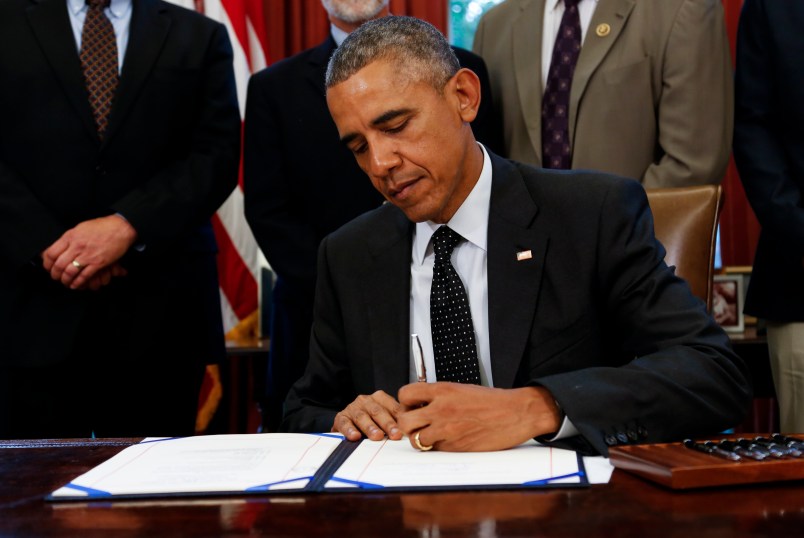
WASHINGTON (AP) — Showing solidarity with workers on Labor Day, President Barack Obama will sign an executive order Monday requiring paid sick leave for employees of federal contractors, including 300,000 who currently receive none.
The White House wouldn’t specify the cost to federal contractors to implement the executive order, which Obamawas to address at a major union rally and breakfast in Boston. The Labor Department said any costs would be offset by savings that contractors would see as a result of lower attrition rates and increased worker loyalty, but produced nothing to back that up.
Under the executive order, employees working on federal contracts gain the right to a minimum of one hour of paid leave for every 30 hours they work. Stretched out over 12 months, that’s up to seven days per year. The order will allow employees to use the leave to care for sick relatives as well, and will affect contracts starting in 2017 — just as Obama leaves office.
The Obama administration has been working on the executive order for months, and chose Labor Day to announce it as Obama works to enact what policies he can before his presidency ends despite resistance in Congress to laws he’s proposed to improve workplace conditions. That push has reverberated in the 2016 campaign, where Democratic candidates are seeking to draw a distinction with Republicans on who’s most supportive of the middle class.
“There are certain Republicans that said we can’t afford to do this,” said Labor Secretary Thomas Perez. He lamented how paid leave is seen as a partisan issue in the U.S. despite broad support in Europe. “The Republican Party is out of step with similar conservative governments around the world,” he said.
Roughly 44 million private sector workers don’t get paid sick leave — about 40 percent of the private-sector workforce, the White House said. In his speech to the Greater Boston Labor Council’s breakfast, Obama was also to renew his call for Congress to expand the requirement beyond contract workers to all but the smallest U.S. businesses, an idea that has gained little traction on Capitol Hill.
The Labor Day gathering in Boston was attracting other bold-named politicians, Sen. Elizabeth Warren, D-Mass., and Boston Mayor Marty Walsh among them. Union leaders like American Federation of Teachers President and Service Employees International Union President Mary Kay Henry hitched a ride on Air Force One for the flight to Boston. And Vice President Joe Biden, who is considering entering the Democratic presidential primary, was to echo the labor rights theme in a march with AFL-CIO President Richard Trumka on Monday at a Labor Day parade in Pittsburgh.
Unable to push much of his agenda through a Republican-controlled Congress, Obama has in recent years used executive orders with frequency to apply policies to federal contractors that he lacks the authority to enact nationwide. His aim is to lay the groundwork for those policies to be expanded to all Americans. Earlier executive orders have barred federal contractors from discriminating against workers based on their sexual orientation or gender identity, raised the minimum wage for contractors and expanded the number of contract workers eligible for overtime.
Although labor groups have hailed those moves, they remain deeply skeptical of Obama’s push to secure sweeping new trade deals with the Asia-Pacific region and with Europe. Many unions have warned that the deals could lead to the widespread elimination of certain types of U.S. jobs.
The White House said it couldn’t estimate how many federal contractors don’t offer paid leave now, citing a maze of state and local laws that make crunching the numbers difficult. Officials also declined to put a dollar figure on how much contractors would face in added compensation costs.
Cecilia Muniz, director of the White House’s Domestic Policy Council, said the administration has an obligation to get the most out of every federal tax dollar. She said the change to the government’s contracting rules would not increase federal spending.
___
Reach Josh Lederman on Twitter at http://twitter.com/joshledermanAP
Copyright 2015 The Associated Press. All rights reserved. This material may not be published, broadcast, rewritten or redistributed.






In his recent weekly address, President Obama urged the Congress to pass a budget that reflects the ideals we celebrate on Labor Day: investments in education, middle class jobs, renewable energy, and military readiness.
He also threatened to veto any budget that denied those ideals and continued the mindless cuts exemplified by the sequester, and warned Republicans of the dangers of once again shutting down the government and squandering the momentum of our recovering economy.
It is said that America is a place that allows for second chances. Let’s examine a few areas of focus and explore their centrality not only to the ongoing American recovery, but to the character of American life and the place of the United States among the community of nations.
After decades of stability in the finance sector, the economy suffered from a series of deregulations, first with credit card interest rates in the late 1970s, then with savings and loans in the 1980s, the failure to regulate derivatives in the 1990s, the 1999 repeal of the Depression-era Glass-Steagall Act – which had created a firewall between commercial banks and investment banking – to the rise of unregulated payday loan and other short-term loan and check-cashing firms that prey on the poor and marginalized.
Likewise, President Franklin Roosevelt’s vision for a United Nations, as part of an attempt to champion diplomacy and the rule of law over colonialism and the rule of might, could not prevent the world’s descent into a terrifying Cold War, which saw an erstwhile ally, the Soviet Union, become a nuclear-armed foe capable of unimaginable destruction, and the world locked in a Manichean, apocalyptic struggle between Soviet satellites and client states of the Western powers.
Also soon after World War II, representatives of powerful multinational firms and Wall Street interests epitomized by the Dulles brothers came to dominate our foreign policy and foreign intelligence service, and the US, which had so recently led the fight against fascism and totalitarianism, would all too often act as the ‘muscle’ behind a new global colonialism driven by moneyed interests loyal to no country’s flag and willing to target non-aligned nations and populist movements as pro-communist.
And all too often the U.S. would become involved in political intrigues and moral atrocities including overthrowing legitimate governments, backing authoritarian regimes, and interfering with national elections in Iran, Southeast Asia, Central and South America as part of an effort to advance corporate interests but under the banner of ‘fighting communism.’
Part of this postwar corporate neo-colonialism involved co-opting authoritarian oil-rich Middle East governments to service a fuel-hungry American Empire that lacked the political will to achieve energy independence.
President Jimmy Carter’s goal of achieving energy independence from an unstable Middle East – signaled when he ordered solar panels installed on the White House roof – was undermined when his successor Ronald Reagan ordered the solar panels down, a move that presaged the events of that decade: a return to large, gas-guzzling American cars, the growing popularity of even more fuel-thirsty trucks, continued intrigue in Middle East politics, and a popular culture transfixed by the exploits of Wall Street corporate raiders and the scheming oil oligarchs of the TV drama Dallas.
The abuses in the energy sector reached a corrupt climax with Enron, whose securitization of the California energy markets foreshadowed and mirrored what would occur in the housing and finance sectors.
After the dot-com bubble burst in 2000, investors worldwide withdrew from the stock market and were directed to investments backed by American real estate. Soon, unsound sub-prime mortgages were packaged into securities, marked triple-AAA by corrupt ratings agencies, and sold to an unsuspecting global market.
Living in South Florida – Ground Zero of the housing bubble – I saw the lending, legal and land development sectors working hand-in-glove to feed this market:
Growth management laws and lending procedures were relaxed, and real estate development became a means to move money and securitize financial instruments that would then be offered to an eager global market.
The captured media promoted the myth of endlessly rising property values and ignored warnings of overexposure until it was too late – they were too dependent on real estate and banking ad revenue to look closely and impartially at what was actually occurring.
Reckless speculative investment by some of the largest players in the financial sector – and by investors with little margin for risk but who were encouraged to buy on margin – led to huge exposure to unregulated markets in exotic financial instruments such as derivatives, mortgage backed securities and reverse swaps.
Another type of investment involved betting on investors and homeowners defaulting on their obligations.
It was truly a house of cards.
When the overheated housing market began to cool from double-digit annualized growth rates, investor confidence flagged and the developing crisis of confidence led to the Crash of 2008 and its aftermath:
The mania for short-term gains has eroded our ability to maintain long-term value, and a symptom of this unwillingness to maintain long-term value of our public assets is Republican opposition to healthcare and finance reform, fiscal stimulus, renewable energy, and President Obama’s American Jobs Act, which would create millions of jobs repairing and upgrading our nation’s infrastructure – once the envy of the world but, after decades of disinvestment, now reduced in some cities to unpaved dirt roads.
Another symptom is the eagerness of state officials in Michigan and elsewhere to exploit a manufactured economic crisis by privatizing, at fire-sale prices, vital infrastructure projects such as water systems – which represent a massive public investment and commitment to the general welfare, and massive revenue streams – to politically well-connected special interests.
This is part of a larger problem: the financialization of the economy, which enriches only a very few at the very top at the expense of the many.
There was a similar financialization in the healthcare sector, which began with the Health Maintenance Organization Act of 1973 that fueled the rise of HMOs. Whereas healthcare providers who saw patients as revenue centers were once in the driver’s seat in terms of healthcare decision-making, newly-empowered third-party payers such as HMOs instead increasingly saw subscribers of their services as cost centers, and did everything short of medical malpractice to limit costs by denying them timely and appropriate health care.
On the provider front, huge investor-owned firms began to consolidate and acquire hospitals across the country – and immediately began to shut down almost as many – to achieve “corporate efficiency” which reversed the gains in community healthcare access achieved in previous decades.
The Affordable Care Act has already expanded healthcare access tremendously, slowed medical inflation, and significantly extended the actuarial life of Medicare.
On the energy front, President Barack Obama’s efforts to reverse the most reckless and short-sighted policies of the past are also bearing fruit. Domestic oil and natural gas production are reaching record levels, American automakers have agreed to voluntarily double the fuel mileage of cars and trucks in the next decade, and solar and wind energy is booming.
The Department of Defense, the nation’s largest energy consumer, has become the largest renewable-energy laboratory and demonstration project, conducting large-scale experiments with the potential for widespread commercial application and greater energy independence.
A recently concluded agreement to limit Iran’s nuclear program in exchange for lifting economic sanctions has the potential to ease Middle East tensions and free up Iranian oil and gas for the European market, which could undercut Russia’s ability to use its own oil and gas as a geopolitical weapon to counter economic sanctions imposed by America and an energy-dependent Europe in response to Russia’s incursions into Ukraine.
Free trade agreements under negotiation with European and Asia-Pacific powers promise to establish enforceable worker and environmental protections and blunt the Empire’s efforts to exploit We the People everywhere.
And Wall Street reform has had an impact: Systemically large (“too big to fail”) financial entities are facing greater scrutiny, banks must meet higher reserve ratios, pass stress tests, and make out ‘living wills’ in the event of their failure, the Volcker Rule limits proprietary trading by banks, and a consumer financial protection bureau roots out fraud and abuse.
Healthcare, finance, housing and energy: all represent functions vital to a thriving, dynamic society – We the People – and all were hijacked by the Empire of the investor classes in their greed for short-term profits that benefit only a very few at the expense of the many.
And all have been given a second chance to return to their original vital function.
Similarly, I believe in giving We the People a second chance by providing an opportunity to train, learn new skills, advance in or change careers, and gain the dignity of becoming self-sufficient.
I also believe in giving our nation a second chance after it has squandered so many opportunities to tap into American innovation, enterprise and genius in an effort to become energy independent and sustainable.
In addition, I believe in giving our national economy a second chance to rebuild upon a strong basis of local prosperity, cultural optimism, personal self-worth and productive achievement while rejecting the illusory pursuit of speculative gains and short-term profits that benefit only a very few at the expense of the many.
To that end, I believe we must reject the illusory goal of an American Empire and strive to re-power and fulfill the promise of an American Century.
On behalf of We the People, let’s give America a second chance.
Thanks Randy. Our President is surely someone to be proud of.
Agree, Chammy. Happy Labor Day.
The things this man has accomplished even in the last few months is astounding. He gets such little credit. This Iran deal is one BFD. Lame duck my arse!!! Not this guy,
Happy Labor Day to you too and everyone here.
I agree that, with his willingness to take on major challenges, President Obama was the man for our time and keenly aware of this historic moment he was given.
He knows he doesn’t have a minute to spare, and I think he will produce yet another game-changer in his term.
I also get frustrated at how he has been treated and misunderstood, but then I take heart: he has inspired millions around the world to take responsibility, and he also is preparing a new generation of leadership.