

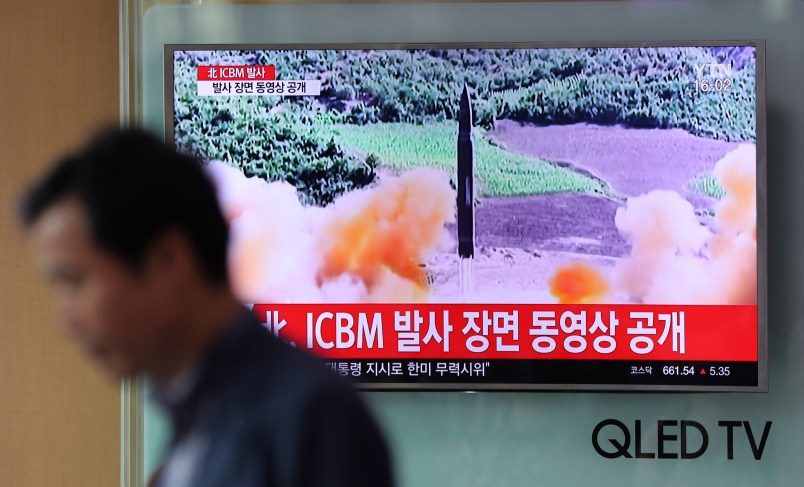
WASHINGTON (AP) — North Korea’s newly demonstrated missile muscle puts Alaska within range of potential attack and stresses the Pentagon’s missile defenses like never before. Even more worrisome, it may be only a matter of time before North Korea mates an even longer-range ICBM with a nuclear warhead, putting all of the United States at risk.
The Pentagon has spent tens of billions to develop what it calls a limited defense against missiles capable of reaching U.S. soil. The system has never faced combat or been fully tested. The system succeeded May 30 in its first attempted intercept of a mock ICBM, but it hasn’t faced more realistic conditions.
Although Russia and China have long been capable of targeting the U.S. with a nuclear weapon, North Korea is seen as the bigger, more troubling threat. Its opaque, unpredictable government often confounds U.S. intelligence assessments. And North Korea’s leader, Kim Jong Un, has openly threatened to strike the U.S., while showing no interest in nuclear or missile negotiations.
“We should be worried,” said Philip E. Coyle III, a former head of the Pentagon’s test and evaluation office. North Korea’s latest success, he said, “shows that time is not on our side.”
U.S. officials believe North Korea is still short of being able to miniaturize a nuclear warhead to fit atop an intercontinental missile. And it’s unclear whether it has developed the technology and expertise to sufficiently shield such a warhead from the extreme heat experienced when it re-enters Earth’s atmosphere en route to a target.
A Pentagon spokesman, Navy Capt. Jeff Davis, said Wednesday, “We’ve still not seen a number of things that would indicate a full-up threat,” including a demonstrated ability to mate a nuclear warhead to an ICBM. “But clearly they are working on it. Clearly they seek to do it. This is an aggressive research and development program on their part.”
Davis said the U.S. defensive system is limited but effective.
“We do have confidence in it,” he said. “That’s why we’ve developed it.”
The Trump administration, like its recent predecessors, has put its money on finding a diplomatic path to halting and reversing North Korea’s nuclear program. While the Pentagon has highly developed plans if military force is ordered, the approach is seen as untenable because it would put millions of South Korean civilians at risk.
But diplomacy has failed so far. That’s why U.S. missile defenses may soon come into play.
The Pentagon has a total of 36 missile interceptors in underground silos on military bases in Alaska and California, due to increase to 44 by year’s end. These interceptors can be launched upon notice of a missile headed toward the United States. An interceptor soars toward its target based on tracking data from radars and other electronic sensors, and is supposed to destroy the target by sheer force of impact outside the Earth’s atmosphere. Sometimes likened to hitting a bullet with a bullet, the collision is meant to incinerate the targeted warhead, neutralizing its nuclear explosive power.
This so-called hit-to-kill technology has been in development for decades. For all its advances, the Pentagon is not satisfied that the current defensive system is adequate for North Korea’s accelerating missile advances.
“The pace of the threat is advancing faster than I think was considered when we did the first ballistic missile defense review back in 2010,” Rob Soofer, who is helping review missile defenses, told a Senate Armed Service subcommittee last month. Beyond what U.S. officials have said publicly about the North Korean nuclear threat, he said the classified picture “is even more dire.” Soofer didn’t provide details.
The escalating danger has led the administration to consider alternative concepts for missile defense, including what is known as “boost phase” defense. This approach involves destroying a hostile missile shortly after its launch, before the warhead separates from the missile body and decoys can be deployed. One proposed tactic would be to develop a drone capable of long-endurance flight and armed with a solid-state laser to destroy or disable a missile in flight.
These and other possible new approaches would add to budget strains already felt in the missile defense program.
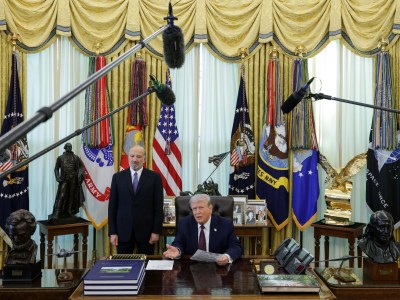
President Donald Trump’s proposed 2018 budget would cut $340 million from missile defense programs intended to deter a potential strike by North Korea, Iran or other countries. The Republican-led Congress has taken the first steps in rejecting the reduction. Rep. Mac Thornberry, R-Texas, the House Armed Services Committee chairman, declared last month that he was “astonished” Trump would propose trimming missile defense.
Thornberry’s committee voted last week to provide about $12.5 billion for missile defense in the 2018 fiscal year that begins in October, nearly $2.5 billion more than Trump’s request. The Senate Armed Services Committee also called for millions more than Trump requested. The full House and Senate are expected to consider the committees’ legislation, and the boost in missile defense money, later this month.






Translation. “Give us even more boatloads of cash.”
“The Trump administration, like its recent predecessors, has put its money on finding a diplomatic path to halting and reversing North Korea’s nuclear program.”
LOLOLOL!!
Ok, first off, Trump NEVER puts HIS money on anything. But since its metaphorically referencing US Tax dollars, I guess I’ll let that one slide. But only because of the bigger, bold face lie here.
Diplomatic paths are nonexistent when you don’t have a diplomatic corps. Or a State department. And every action Trump has taken regarding North Korea is saber rattling, and falsely threatening them with Chinese action, that China has absolutely no interest in taking.
The really cool thing about nuclear weapons is they make war impossible, in terms of survival and yes Punkytrump, winning. Sociopathic great leaders and their psycophant supporters stubbornly plunge further into MADness. The sure truth is we will never reach the stars if we fail to achieve peace on this planet.
Every time I read an article about US missile defense, I’m left with the impression that this program is in it’s infancy. In fact, the missile defense program was started by Ronald Reagan (then called ‘Star Wars’) and is more than 30 years old. Of course, the program has changed and been renamed many times in those 30 years giving the impression of always being new. This is handy to ice over decades of failure. In the wake of 9/11, the Bushies ramped up spending (again) forcing the deployment of interceptors which at that point had never successfully worked.
An interesting article for someone at TPM would be to trace the spending and history of the missile defense program since Ronald Reagan. Spending must have topped $100B by now.