


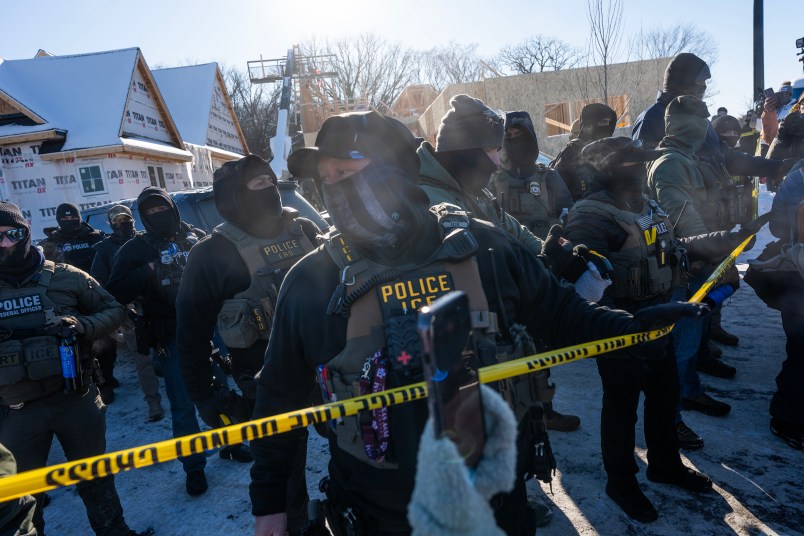
Minnesota state prosecutors charged a second ICE agent on Monday with assault over incidents that took place during the Trump administration’s winter occupation of the city.
Prosecutors brought four counts of second degree assault and one count of falsely reporting a crime against Christian Castro, who allegedly shot a man of Venezuelan origin. The man, who had legal status to be in the United States, told law enforcement that he had helped a housemate escape an ICE officer and was inside his home at the time that Castro allegedly shot him.
The charges set up what’s likely to be a battle between Minnesota and the federal government over how far the state can go in holding officials who, state officials say, committed crimes while stationed in Minneapolis over the winter. It will likely play out in a test over a key question, state officials and legal experts said: whether Castro, and other agents, were acting so far outside the bounds of their duties that they can be prosecuted.
“His federal badge does not make him immune from state charges for his criminal conduct in Minnesota,” Hennepin County Attorney Mary Moriarty said at a press conference, adding that there’s “no such thing as absolute immunity for federal officers who commit crimes in this state or another.”
ICE called the charges “nothing more than a political stunt” in a statement to TPM. But in a marked change of tone from the Noem era, it then said that federal prosecutors were investigating the officers involved for lying under oath, saying that they “may face disciplinary action, including termination of employment, as well as potential criminal prosecution.”
The Trump administration hasn’t responded yet to the announcement. DHS didn’t return TPM’s request for comment. Minnesota officials charged another ICE agent, Gregory Morgan Jr., with second-degree assault last month over an incident in which he allegedly brandished a gun at other vehicles while driving.
In both cases, state prosecutors issued national arrest warrants. Morgan has not yet been apprehended, Moriarty said at the press conference.
The events that led to Castro’s charging flew under the radar as federal agents surged into Minneapolis over the winter. That ended after federal officers shot and killed two protestors — Renee Good and Alex Pretti. The administration changed tactics: It removed theCBP officer in charge of the operation, Greg Bovino, who retired; Tom Homan, a longtime federal immigration enforcement official, took over.
Castro allegedly began to pursue a Venezuelan Doordash driver on Jan. 14, a week after Good was shot. As he arrived at his home, his housemate, Julio Sosa-Celis, exited the house and pulled him off an ICE agent who was attempting to arrest him, per a charging document. The two entered the home, at which point Castro allegedly fired through his front door, striking the Sosa-Celis once in the thigh.
Federal officials have stonewalled investigations into the Pretti and Good killings, as well as the Sosa-Celis shooting. The state is suing to obtain records; Moriarty said that Minnesota officials were able to identify Castro because they heard FBI agents mention his name at the scene of the shooting before Trump officials directed federal agents to stop cooperating with local law enforcement.
After then-DHS Secretary Kristi Noem accused Sosa-Celis and his housemate of “attempted murder,” federal prosecutors filed charges against the two of them, alleging a lengthy attack on federal agents by shovel. But like many other cases brought across the country against people who ran afoul of aggressive interior enforcement operations, it collapsed on contact with the court system. Video released by state officials and obtained by the Star-Tribune showed no shovel attack; the charges were later dropped.
State prosecutors likely face a complicated legal battle ahead. The federal government is expected to remove the case to federal court, where a judge will have to decide whether the officer’s alleged criminal conduct was a “necessary and proper” part of their duties, per one analysis. That’s gone multiple ways in the past: During the Civil Rights movement, Mississippi officials tried to prosecute a federal official over using tear gas to suppress rioting over the integration of the University of Mississippi. That case was dismissed.
Moriarty, the Hennepin County prosecutor, mentioned pardons twice at the press conference.
“Should it result in a conviction, Mr. Castro will be ineligible for a presidential pardon,” she said.
This story initially misstated which person involved in the incident was working for Doordash. It was Sosa-Celis’ housemate.



I’d like to think that Minnesota’s prosecution would succeed, but with the Roberts MAGAt brigade standing in the way I have serious doubts.
Ukko wants to ensure that everyone knows he’s available.
Best of luck, Minnesota. If successful this could quickly become a crashing house of cards for these criminal federal curs.
But is Ukko an intact male? Ukko will need those balls to stand up to Roberts, Alito, and Thomas.
Gee those are the same qualifications for joining ICE, in fact they are the only ones.