


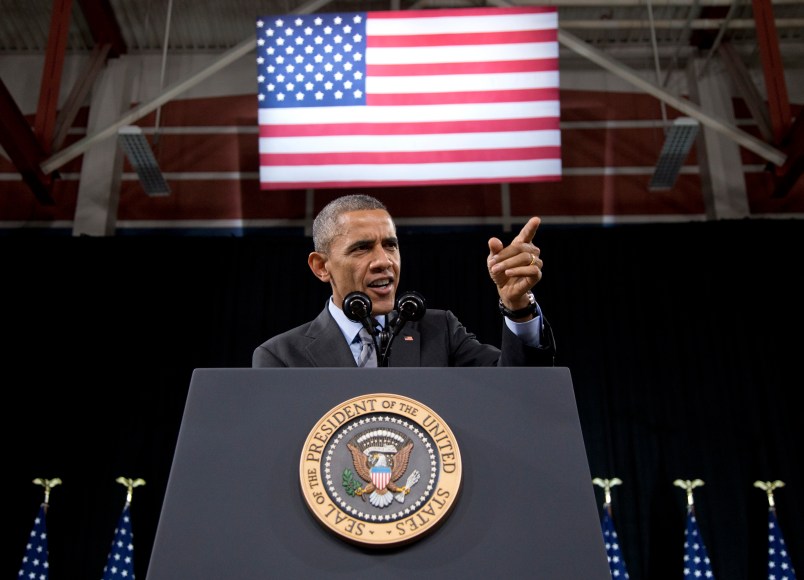
NEW ORLEANS (AP) — A federal appeals court has ruled against President Barack Obama’s plan to protect an estimated 5 million people living in the United States illegally from deportation.
In a 2-1 decision Monday, the 5th U.S. Circuit Court of Appeals upheld a Texas-based federal judge’s injunction blocking the administration’s immigration initiative.
Republicans had criticized the plan as an illegal executive overreach when Obama announced it last November. Twenty-six states challenged the plan in court.
The administration argued that the executive branch was within its rights in deciding to defer deportation of selected groups of immigrants, including children who were brought to the U.S. illegally.
Texas Gov. Greg Abbott praised the ruling.
“President Obama should abandon his lawless executive amnesty program and start enforcing the law today,” Abbott said in a news release.
“We strongly disagree with the 5th Circuit’s decision,” the White House said in a statement. “The Supreme Court and Congress have made clear that the federal government can set priorities in enforcing our immigration laws.”
The ruling further dims prospects of implementation of the executive action before Obama leaves office in 2017. Appeals over the injunction could take months and, depending on how the case unfolds, it could go back to the Texas federal court for more proceedings.
The administration could ask for a re-hearing by the full 5th Circuit but the National Immigration Law Center, and advocacy group, urged an immediate Supreme Court appeal.
Justice Department spokesman Patrick Rodenbush said in a statement they were reviewing the opinion to determine how best to proceed.
“The department is committed to taking steps that will resolve the immigration litigation as quickly as possible in order to allow DHS (Department of Homeland Security) to bring greater accountability to our immigration system by prioritizing the removal of the worst offenders, not people who have long ties to the United States and who are raising American children,” he said.
Part of the initiative included expansion of a program called Deferred Action for Childhood Arrivals, protecting youngimmigrants from deportation if they were brought to the U.S. illegally as children. The other major part, Deferred Action for Parents of Americans, would extend deportation protections to parents of U.S. citizens and permanent residents who have been in the country for years.
The 70-page majority opinion by Judge Jerry Smith, joined by Jennifer Walker Elrod, rejected administration arguments that the district judge abused his discretion with a nationwide order and that the states lacked standing to challenge Obama’s executive orders.
They acknowledged an argument that an adverse ruling would discourage potential beneficiaries of the plan from cooperating with law enforcement authorities or paying taxes. “But those are burdens that Congress knowingly created, and it is not our place to second-guess those decisions,” Smith wrote.
In a 53-page dissent, Judge Carolyn Dineen King said the administration was within the law, casting the decision to defer action on some deportations as “quintessential exercises of prosecutorial discretion,” and noting that the Department of Homeland Security has limited resources.
“Although there are approximately 11.3 million removable aliens in this country today, for the last several years Congress has provided the Department of Homeland Security with only enough resources to remove approximately 400,000 of those aliens per year,” King wrote.
Copyright 2015 The Associated Press. All rights reserved. This material may not be published, broadcast, rewritten or redistributed.







I have a feeling the SCOTUS will side with the administration on this one. Or if they don’t, they are going to make it a very narrowly defined decision.
I don’t see SCOTUS deciding to reel in Executive Orders in a big way, not ahead of an election. And politically, giving Obama a win on this actually helps the GOP more. It will give them something else to gnash their teeth about and go into full spittle flicked rage.
Smacking down the guy who isn’t going to be running ever again isn’t nearly as apocalyptic.
It seems an extraordinary notion that the Executive cannot, in its discretion, decide that it would rather devote its limited budget to something other than the deportation of illegal immigrants. Simply makes no sense. This has to be overturned.
But of course, let’s go back to the Supreme Court, which has (mostly) been the answer to all the GOP’s problems since 2000.
What a surprise:
“Judge Jerry E. Smith, who was appointed by former President Ronald Reagan, and Judge Jennifer Elrod, who was appointed by former President George W. Bush, voted to deny the request. Judge Carolyn Dineen King, appointed by former President Jimmy Carter, cast the dissenting vote.” http://www.texastribune.org/2015/11/09/fifth-court-strikes-down-immigration-program/
The Fifth Circuit only covers three states, Texas, Louisiana, and Mississippi. As a general matter, a Circuit Court’s decision is not applicable outside that Circuit. In this case, the Federal District Judge in Texas issued a nationwide injunction, attempting to apply his decision way beyond the Fifth Circuit. One of the key issues on appeal was whether he could do so. The three judge panel was split on this, with the two Republican judges saying Yes, the one dissenting Democrat judge saying No. I point this out because it leads to another potential Administration strategy; it could simply say that it does not accept the Fifth Circuit’s decision to attempt to apply its decision outside its boundaries. This would be very aggressive, but clearly within the Administration’s authority. It might even apply for an Order to that effect in the Ninth Circuit (California and the West), carefully selecting its judge and thereby dramatically limiting the impact of the Fifth Circuit. As I said, this would be a very aggressive action, but it would be an appropriate jurisprudential FU to the Fifth Circuit’s Republican judges and would keep the issue in play through the 2016 elections, forcing the Republican presidential candidate to take a hostile anti-immigrant position.