

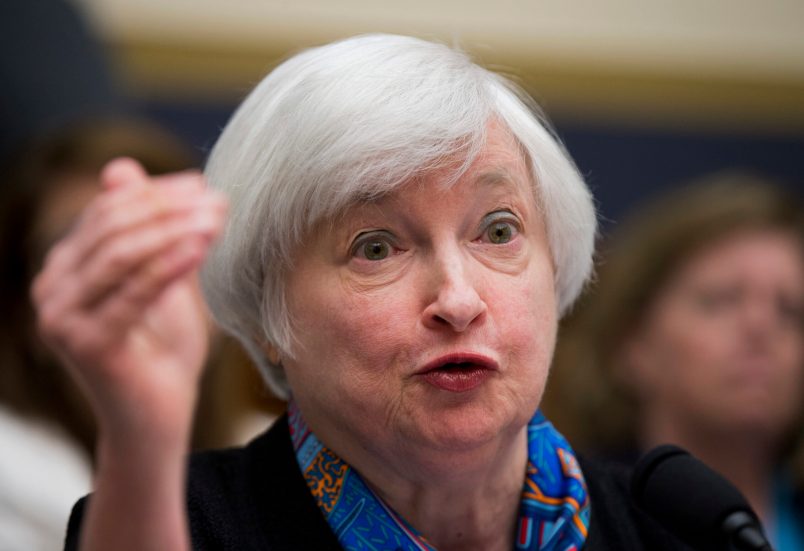
The central bank chose to raise rates again despite an economic slowdown at the start of 2017, which it predicts will prove temporary. It foresees one additional rate hike this year, unchanged from its previous forecast. It gave no hint of when that might occur.
The latest Fed rate hike, announced in a statement after a policy meeting, comes as the U.S. economy is growing only sluggishly. Even so, many of the barometers the Fed monitors most closely have given it the confidence to keep gradually lifting still-low borrowing rates toward their historic norms.
Though it assesses the overall economy, the Fed’s mandates are to maximize employment and stabilize prices. And hiring in the United States remains solid if slowing, with employment at a 16-year-low of 4.3 percent — even below the level that the Fed associates with full employment.
Inflation has been more problematic, having long stayed below the central bank’s 2 percent target rate. Recent data have suggested that inflation may even be slowing further. But Fed officials have said they think inflation will soon pick up along with the economy.
That said, no one expects the Fed’s rate hikes to turn aggressive. If nothing else, the chronically low inflation and the political fights and uncertainty in Washington — over investigations into Russia’s ties to President Donald Trump’s campaign, health care legislation, tax-cut plans and about whether Congress will raise the nation’s borrowing limit and pass a new budget — could lead the Fed to raise rates more slowly than it otherwise would.
Uncertainty also surrounds the membership of the Fed’s own policy committee. Trump is expected soon to fill three vacancies on the Fed’s influential board, and those new members, depending on who they are, could alter its rate-setting policy.
Fed officials have concluded that the economy, now entering its ninth year of expansion, no longer needs the ultra-low borrowing rates they supplied beginning in the Great Recession.
The central bank kept its benchmark rate at a record low near zero starting in late 2008 to try to boost consumer and business borrowing and lift the country out of the worst downturn since the 1930s. It finally raised the rate modestly in December 2015, then waited a year do so again. It acted again in March.
At the depths of the recession, the Fed began buying Treasury and mortgage bonds to try to depress long-term loan rates. That effort resulted in a five-fold increase in its portfolio to $4.5 trillion. The Fed said Wednesday that it would eventually allow a small amount of bonds to mature without being replaced — an amount that would gradually rise as markets adjusted to the process.
Some news reports have mentioned leading candidates to fill the three vacancies on the Fed’s seven-member board. They include Randal Quarles, a top Treasury official in two past Republican administrations, for the vice chairman’s job of overseeing bank regulation. Marvin Goodfriend, an economist at Carnegie Mellon University, has been mentioned for another board spot, and Robert Jones, chief executive of Old National Bancorp in Indiana, reportedly is a candidate for a board seat designated for a community banker.
The betting is that the administration will choose officials who will tilt the Fed toward a more “hawkish” stance. Hawks tend to worry that rates kept too low for too long could escalate inflation or fuel asset bubbles. By contrast, “doves” favor the direction taken under Chair Janet Yellen, favoring relatively low rates to maximize employment.
Yellen, the first woman to lead the Fed, is serving a term that will end in February. So far, Trump has sent conflicting signals about whether he plans to nominate her for a second term.



I can’t wait to hear Turmeric the Terrible crow about a rise in interest rates.
And then immediately turn around and trash Yellen, bragging that he could fire her at any time.
I like this news. I’ve been waiting and waiting for them to raise the rates so that the money I have in savings could earn a little money.
I have not seen any incentive for lenders to lend money at 1/2 %. I think it discourages lenders, even though it makes more people consider borrowing. Why should lenders lend money out that they are barely making anything on?
Hope you have your money in a credit union. They are, hands down, the best.
No - and I don’t have much left either, after '08. I just still have a couple of CDs.
I think this is a minor mistake, but reversible if needed. There are no signs of an overheating economy, so why apply the brakes? Good for banks, bad for consumers.
Do banks turn away borrowers because the bank isn’t making enough? I did not know this was a thing that happened. They add their 2-3% (for prime borrowers) to the fed rate and are always making that margin. Even more for sub-prime borrowers. Are banks better off just sitting on the cash, somehow?
I confess to not researching this idea, so maybe banks are getting out of the lending business (or sitting on the sideline) with the low rates of the last 8 years? Are you suggesting that, with higher rates, banks will now take on more (presumably riskier) loans? I say “presumably riskier” because I just got a mortgage within the last 60 days and there were many dozens of choices of lender. I’m a pretty low-risk borrower, though; maybe it’s very difficult for sub-prime borrowers to find lenders and higher rates will help with that.