


This story was originally reported by Amanda Becker of The 19th. Meet Amanda and read more of their reporting on gender, politics and policy.
How many women does your employer have in management positions compared to industry peers? Are a retail chain’s Black workers as likely to be in public-facing roles as its White workers? Did a trucking company hire qualified women at the same rate it hired qualified men?
It will be much more difficult to answer these and other questions related to gender, race and ethnicity in workplaces once President Donald Trump’s U.S. Equal Employment Opportunity Commission (EEOC) enacts a key Project 2025 recommendation and scraps its 60-year practice of collecting workforce demographic data from employers.
The EEOC’s Republican majority voted 2-to-1 earlier this summer to approve a rule ending the collection of this data, pending a public-comment period that has since closed. Though thousands of comments were submitted, the civil rights agency could finalize the proposal as soon as the end of this month. Few substantive changes are expected.
When that happens, the agency will, for the first time in its history, stop collecting the annual data from employers. It’s a significant change since the data has allowed EEOC investigators and attorneys to identify the type of systemic discrimination that has resulted in some of the agency’s largest settlements, benefiting thousands of workers.
Chai Feldblum, a Democratic former commissioner, said there will be a multi-year “chasm” in data availability until a new presidential administration installs EEOC leaders that restart data collection, “which is very likely under a Democratic administration, but given that employers see the utility of this data collection, it might even be under a Republican administration that is less ideological and cares more about what works and enforcing the law.”
Feldblum and other former EEOC leaders, including several who were fired by Trump last year, have formed a shadow organization that monitors their former agency’s work, and preserves details about past rulemakings and recommendations.
Here is what you need to know about the EEOC’s move to stop collecting demographics data from employers — and how the Trump administration could impact civil rights enforcement at work.
When was the EEOC created and why?
The EEOC was created by the 1964 Civil Rights Act to enforce civil rights laws in the workplace. Ever since, the agency has investigated and brought discrimination cases on behalf of aggrieved workers — at no cost to them, with a notably high success rate.
The Civil Rights Act mandated that employers keep records about workforce demographics and make them available to the EEOC. One of the agency’s first rules, published in 1966, created an annual reporting system. Employers with 100 or more employees file what’s known as an EEO-1 report that tracks gender, race and ethnicity across job categories. The agency does not publish individual employer reports but shares aggregate data drawn from them on its website. Many employers choose to publish their own data.
The workforce data helps the EEOC identify patterns of discrimination early on during investigations. It also allows investigators to analyze whether policies that are seemingly neutral have resulted in classes of workers being treated differently. These so-called disparate-impact cases are often associated with racial discrimination but can also be related to gender, disability and religion.
For example, the EEOC in 2018 secured a $3.2 million settlement in a gender-discrimination case against CSX Transportation. The agency used some of the data it collects to show that physical strength tests given to applicants unlawfully impacted women because the railroad operator had not shown the tests were necessary to prove an applicant was fit for the job.
Why is the Trump administration targeting the EEOC’s work?
Many of the Trump administration’s attacks on diversity, equity and inclusion (DEI) efforts are grounded in recommendations from Project 2025, the far-right, Christian nationalist blueprint for Trump’s second term created by the conservative Heritage Foundation.
It is the potential impact of disparate-impact cases that has made the EEOC a target. Project 2025 recommended the agency stop collecting demographics data because it “can then be used to support a charge of discrimination under a disparate impact theory,” which in turn may “lead to racial quotas.”
Though Trump tried to distance himself from the 900-page document when running for reelection — “NEVER READ IT, NEVER SAW IT,” he wrote on Truth Social — dozens of its authors had previously worked with the president during his first administration or campaigns.
What specific steps has Trump taken to undermine the EEOC?
Shortly after taking office, Trump fired the EEOC’s general counsel and two of three Democrats on its bipartisan, five-member commission before their terms ended — the first time in history a president has done so.
Trump also named the remaining Republican commissioner, Andrea Lucas, as the EEOC’s acting chair. Lucas has served on the commission since Trump’s first term and made clear during the Biden administration that she opposed many of the EEOC’s efforts to explain or enforce workforce protections related to pregnancy and LGBTQ+ people. Ahead of Lucas’ July Senate confirmation, former EEOC leaders told The 19th they expected her to lead a “real retreat from the historic mission of the agency.”
In April 2025, Trump issued an executive order on “restoring equality of opportunity and meritocracy” in workplaces, saying the EEOC would end its longtime practice of pursuing disparate-impact cases — the type of cases that often require the workforce demographics data the agency collects.
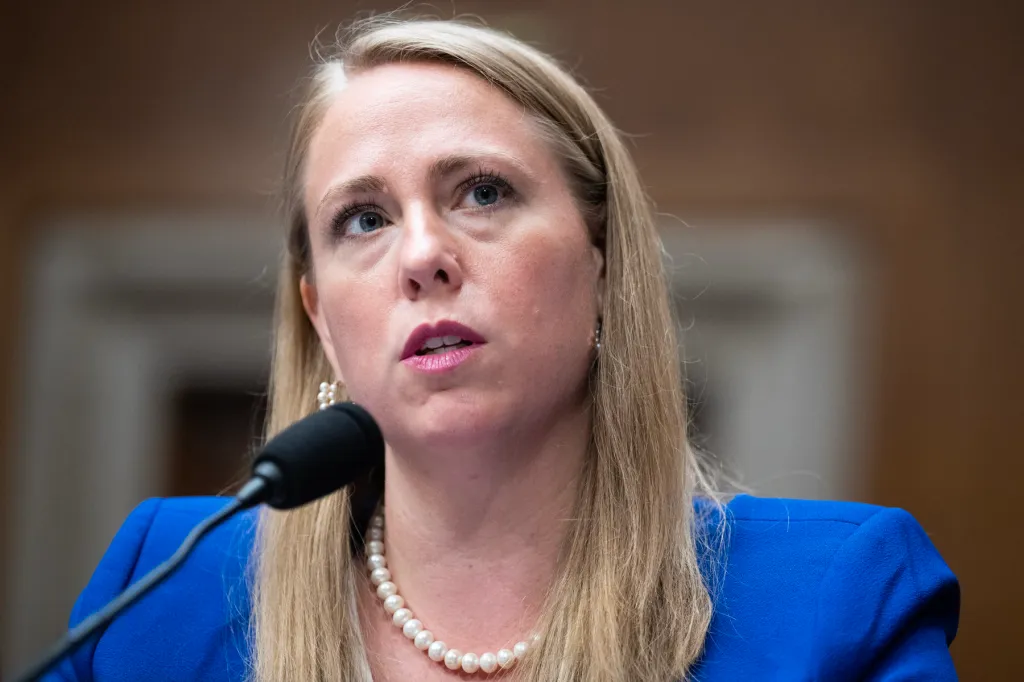
What is Lucas’ focus as the head of the EEOC?
Lucas has made clear that she believes White men are experiencing reverse discrimination in the workplace, often due to DEI initiatives, and that protecting trans workers comes at the expense of women. She made significant progress in redirecting the EEOC’s mission during the first year of Trump’s presidency.
The changes came quickly even though Lucas was not confirmed as the EEOC’s chair until July 2025 — and despite the agency not having the required three-comissioner quorum to conduct official business until fellow Republican Brittany Bull Panuccio was confirmed that October.
In January 2025, Lucas announced that one of her priorities would be “defending the biological binary reality of sex and related rights.” The EEOC then began withdrawing from cases brought by transgender workers who faced discrimination related to their gender identities.
Two months later, Lucas sent an unprecedented letter to 20 of the country’s largest law firms requesting information about their “DEI-related employment practices,” suggesting that they were unlawful because they could put White workers at a disadvantage. The letter broke with agency precedent by publicizing a threat of investigation before its conclusion. Nine of those firms have settled with the agency.
Then, in December 2025, Lucas clearly articulated the EEOC’s new focus on reverse discrimination against White men in a video she shared on the social media site X: “Are you a White male who has experienced discrimination at work based on your race or sex? You may have a claim to recover money under federal civil rights laws.” She urged White men to contact the agency as soon as possible.
This January, the EEOC’s Republican majority voted to rescind years-in-the-making 2024 guidance that applied historic civil rights laws to modern workplace harassment scenarios, providing 200 pages of examples. Lucas had said that she wanted to rescind the guidance because it protected LGBTQ+ people at the expense of women — but the agency first needed a quorum.
Past EEOC leaders and other experts told The 19th that while the impacts of the rescission would be most immediately felt by LGBTQ+ workers, it also had implications for workers experiencing harassment related to their gender, race and ethnicity as well.
When Lucas and Panuccio formalize the repeal of the data-collection rule in the coming weeks, it will be the agency’s largest victory yet in Trump’s broader anti-DEI effort — and deliver on a key priority of Project 2025.
Kalpana Kotagal, the EEOC’s only remaining Democratic commissioner, said the move would “kneecap the agency’s ability to investigate discrimination and protect workers” when she voted against the draft proposal earlier this summer.
Should I still go to the EEOC if I experience discrimination at work?
Yes. Even though the EEOC is dealing with staffing shortages and showing a definitive shift in enforcement priorities, filing a charge with an EEOC field office is likely still a worker’s best first step if they believe they have experienced discrimination. (The EEOC currently has about 1,700 staff, down roughly 600 from the Biden administration.)
The laws are still the laws, and the EEOC is still the agency Congress created to investigate and enforce civil rights violations in the workplace. Plus, most workers are legally required to file an EEOC charge before they can bring an employment discrimination case in court.
But, experts said, how thoroughly the EEOC will investigate a charge might depend on the type of complaint and its compatibility with the agency’s current enforcement priorities. White men who believe they have faced discrimination due to their race or gender will likely get the agency’s full attention; LGBTQ+ people and workers trying to determine whether discrimination against them is part of a broader pattern will be at a disadvantage.
Karla Gilbride, a Democratic former EEOC general counsel who now works on disability-rights issues for the American Civil Liberties Union (ACLU), explained that in the past, if a Black worker came to the agency charging that a retail chain did not hire them due to their race, “an investigator would pull the EEO-1 reports and say, ‘Oh, they’re not just not hiring Black workers at this store, but at a lot of stores’.”
Now, the investigator won’t have that data to review.
“I think what this is going to mean is that investigations will be smaller or more localized because they won’t have the basis for knowing to push for a broader investigation — because the data is what gives you that sense,” Gilbride said.
While the EEOC is highly unlikely to pursue cases on behalf of transgender workers, most will still need to file a charge before they can pursue a discrimination claim in civil court.
What if the EEOC won’t pursue my case?
If the EEOC decides not to move forward after a worker files a discrimination charge, the agency will issue a “Notice of Right to Sue” and the worker will have 90 days during which to file a discrimination lawsuit. The worker will be responsible for finding and paying for their own legal representation.
Will data be kept on workplace demographics if the EEOC isn’t collecting it?
Even if EEOC ends its annual reporting program, that does not override the Civil Rights Act provision mandating employers keep records about workforce demographics. The onus will now be on the agency to ask for the data.
“I want to be clear,” Kotagal wrote in a July 21 statement, “regardless of whether the Commission ultimately rescinds its EEO-1 regulations, employers are still required to collect demographic data under the law.”
Lawyers said they also expect that most employers would continue to internally track some or all of the data that they have previously sent annually to the EEOC. Shareholders of some of the country’s largest and most profitable public companies have rejected Trump’s anti-DEI push, so those employers will likely continue using that data to implement and track their own DEI efforts.
It is likely that some employers will stop publicizing workforce demographics data on public-facing websites and in annual reports due to fears it could be weaponized against them by the Trump administration or aligned conservative activist groups.
Will workers be able to get demographics data?
The data will exist, but it will likely be harder to get. Employers might not keep data in the same format as they previously submitted to the EEOC, so a request by the agency might yield more unwieldy data sets.
It will also be more challenging to compare companies within industries to detect patterns without the aggregate data. In the context of a private lawsuit, obtaining data from individual employers will likely require subpoenas.
“Now this is going to be a fight,” Gilbride said.






So much bullshit on one page. White men are being discriminated against? Cry me a river…try years of discrimination against women and people of color, et al. Project 2025 has become the worst thing to happen to the Federal government since Prohibition.
I don’t have any stats to throw in here, but anecdotally, one sees and hears of every damned type of discrimination with zero enforcement. We’re talking age, sex, race, sexual orientation, to name only 4.
Even when there was some modicum of enforcement, it is just so damned hard to prove. The employer always has a superficially valid reason. I’m betting one would have a helluva time getting any employment lawyer to take a discrimination case today. Employers can manufacture “evidence” so fast.
Recall how Clarence Thomas got nominated to SCOTUS?
Story is that it was Geo Bush Père’s reward for Thomas’s crippling of EEOC.
EEOC is a paper tiger. Has been for years.
This wouldn’t be a problem if there weren’t Republicans whose religion was money.
The GOP has been a cover for our worst bigots of every social/economic class for decades. It has been seen as the party that keeps people I hate out of my office and out of my neighborhood.