

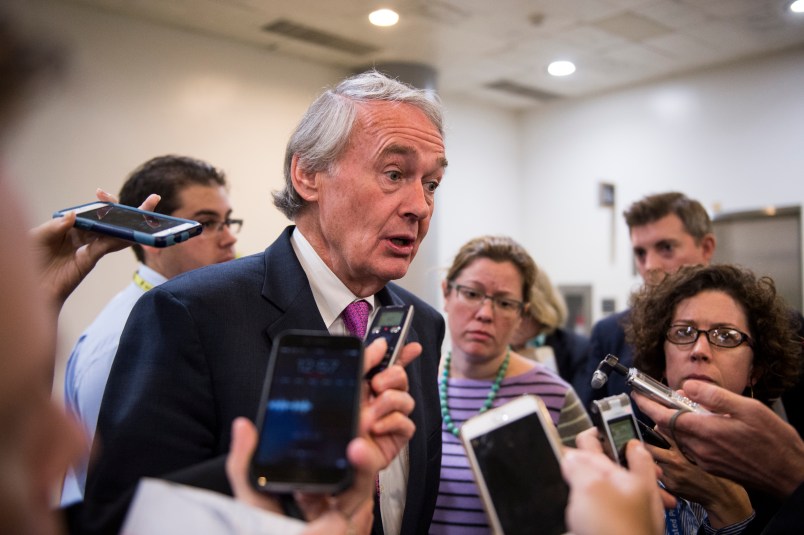
WASHINGTON (AP) — A Democratic senator said Monday he is blocking President Barack Obama’s nominee to head the Food and Drug Administration as he pressures the agency to be tougher on abuse of opioid painkillers.
Massachusetts Sen. Edward Markey said in a statement that he has put a hold on the nomination of Dr. Robert Califf, the No. 2 official at the agency, who was a prominent cardiologist and medical researcher at Duke University for more than 30 years.
“The FDA needs to commit to shift the way it approaches and evaluates addiction before I can support Dr. Califf’s nomination,” Markey said. “Until it does, we will continue to see this tsunami of opioid overdoses engulf family after family.”
Deaths linked to misuse and abuse of prescription painkillers climbed to 19,000 last year, the highest figure on record, according to the Centers for Disease Control and Prevention. By its estimation, deaths tied to these drugs have surged more than fourfold since 1999 amid increased prescribing by U.S. doctors.
Even though a Senate committee approved Califf’s nomination by voice vote earlier this month, Obama’s choice has faced opposition from several senators.
Sen. Lisa Murkowski, R-Alaska, has also placed a hold on the nomination. At the vote, she said she wanted reassurances that FDA will write rules for labeling genetically modified salmon. She has said the engineered salmon approved by the FDA last year could be harmful to her state’s wild salmon industry.
Democratic presidential candidate Sen. Bernie Sanders said the country needs an FDA commissioner who will stand up to the pharmaceutical industry and that Califf is “not that person.” The Vermont independent said he was considering a hold.
Some Democrats have raised concerns about Califf’s ties to industry. In 2006, Califf founded the Duke University Clinical Research Institute, a contract research group that has conducted studies for virtually all of the world’s largest drugmakers. Government disclosure forms show that Califf received more than $29,000 in consulting fees, travel, meals and other payments from drugmakers in 2014.
Califf has already recused himself from dealing with certain companies to avoid conflicts of interest.
Tennessee Sen. Lamar Alexander, the Republican chairman of the Health, Education, Labor and Pensions Committee, is supporting the nomination.
As head of the FDA, Califf would inherit a raft of projects and potential challenges, including unfinished tobacco regulations and food safety and labeling reforms.
Former FDA Commissioner Margaret Hamburg left the job early last year. The FDA’s chief scientist, Dr. Stephen Ostroff, is serving as acting head of the agency.
___
Follow Mary Clare Jalonick on Twitter at http://twitter.com/mcjalonick
Copyright 2016 The Associated Press. All rights reserved. This material may not be published, broadcast, rewritten or redistributed.





With friends like these…who needs enemas?
It sounds as if Dr. Califf might not be the right person for this position – but, as a life-long sufferer of chronic pain, I take issue with the idea that the FDA, DEA or any other organization need to step up their game with regards to the use of opiate painkillers, etc. Pain management is not close to being perfect and requires a very individual plan between a patient and his/her Primary Care Physician, surgeon, etc., and the Palliative Care Physician. After the last big crackdown (less than a decade ago), the state of Virginia came down very hard on pain management doctors, surgeons and the like – so much so that many stopped writing ANY scripts for narcotics and similar medicines. I have been fairly fortunate, myself, but I knw of others who haven’t fared so well and have been forced to endure agonizing physical pain.
This nation does need to re-think how we treat persons going through horrid, agonizing, wretched physical torture – and it is sometimes torture what I go through – and just what our goals are to be. Yes, it is true there will always be some who abuse their medications–and I fully understand the need to try and avoid such an outcome–but, at the same time, some of the policies that are forced upon the treating doctors and affected patient are too harsh and cause not only physical agony but mental agony as well. I would much rather we treat folks through their physicians who are trained for palliative care than having draconian policies that force many to abuse street drugs, risking them using/abusing substances that are not true pharmaceutical grade as well as forcing many others to just endure needlessly. Draconian policies lead to more deaths and severe agony than not.
The U.S.A. is better than this – we have the ability to be far more compassionate than we currently show ourselves to be. At minimum, would you rather force a small but still solid number of “abusers” onto the street where it’s very difficult to keep track of not only the pain sufferer but of what substance they’re using to treat themselves and the effects on their families and communities … or keeping most of them in some sort of system where it’s easier to track them and know what they’re ingesting, possibly being able to reach them mentally so as to be able to get them in recovery of some kind as well as actually properly treating those of us who need it now and likely will always need palliative care?
This issue is not cut and dry, black and white. There are so many shades in between, and so many elements involved that go to make up the patient and his/her situation. I can tell you from personal experience that I’d much rather have a more lax attitude (that doesn’t mean less-documented) and policy than the scary cop with a control attitude and the inevitable suffering. No matter what, you’ll always have a few who abuse anything – but that’s true of everything in life. I believe America currently gives the pain sufferer short shrift in attempt to crack down on the abusers.
Thank you.
Thoughtful people understand this. However, it is well documented that opioids are overprescribed in the U.S. with overdoses from them now equalling overdoses from heroin. And while it’s a given that a portion of the abuse is attributable to the “black market,” the lack of centralized record keeping for controlled substance prescription is equally at fault. Nothing very nuanced about that, especially as it’s the kind of thing that’s gone on for decades and really shouldn’t any longer with computer data bases. Think of elderly people seeing different doctors for different ailments and there being little or no communication between them and what they may be prescribing.
Meh…At least he has a legitimate issue he’s trying to force to be addressed.
And a perfect example of why these should be two different entities. If something ought to be combined it would be rolling the Food part into the Department of Agriculture.