

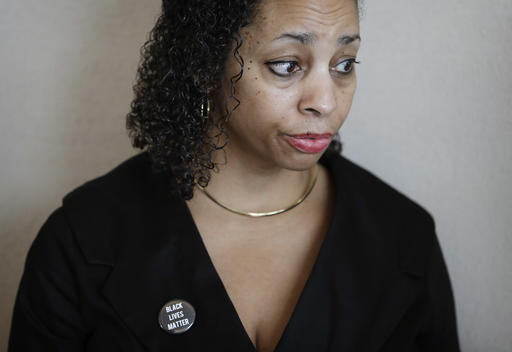
LAS VEGAS (AP) — A defense attorney touched off a protest about race and free expression in a Las Vegas courtroom when she refused to remove a “Black Lives Matter” button from her blouse despite a judge’s request not to demonstrate what he called “political speech.”
Clark County District Court Judge Douglas Herndon asked Erika Ballou, a deputy public defender who is black, to remove the button or leave the courtroom and turn the case she was handling over to another lawyer.
“I’m asking the same thing of defense attorneys that I ask of anybody else,” the judge said. “Please leave any kind of political or opinion protest statements outside the courtroom.”
Ballou, with Clark County Public Defender Phil Kohn standing at her side and about a dozen defense attorneys in the audience Tuesday to show their support, insisted that she had a First Amendment right to demonstrate her opinion. She also refused to remove herself from her client’s case, which the judge postponed to Thursday.
Several supporters wore a similar lapel button: Black, about the size of a silver dollar, with white letters. Attorney Jonathan MacArthur said he’ll wear it again to Herndon’s courtroom on Thursday.
“This is an issue about criminal justice,” Ballou told the judge.
She noted that some deputy district attorneys wear small office badge-type lapel pins, and that uniformed court officers are allowed to wear symbolic black bands on their badges to mourn police officers killed on duty.
“This is not political speech. It is not supporting a particular candidate,” she said of her pin. “I believe a courtroom is the proper place.”
Ballou, a public defender for 11 years, said outside court that she took her stand after the head of the Las Vegas police union sent a letter last week to the chief state district court judge, David Barker, complaining that what the union executive termed “‘Black Lives Matter’ propaganda” had no place in courtrooms.
“We are certain that the courts would not allow similar public displays from citizens who believe that killers should be sentenced to death or that sexual predators should be castrated,” Las Vegas Police Protective Association director Steve Grammas wrote. “While we embrace the First Amendment, we do not believe that such statements should be made in the halls of justice.”
Grammas said in a brief email that he raised the issue at the request of a union member, who was “satisfied to have the issue addressed.” Grammas didn’t immediately respond to follow-up questions.
Barker was in court hearings and unavailable to immediately respond to messages.
A court spokeswoman, Mary Ann Price, pointed to court rules of conduct making judges responsible for applying rules of decorum, proper attire and dignity.
Herndon, who earlier asked court spectators to cover T-shirts they’d worn to support victims in another case, told Ballou he tries to keep his courtroom free of outside influences.
The pin, the judge said, “is making a political statement, that, ‘I wear this in protest of how the court is treating minority defendants.'”
“Wear it in the hallway. Wear it in front of the courthouse,” Herndon added. “Demonstrate. Protest. Use your voice. But that’s not what dealing with justice on an individual case is about.”
Ballou, a self-described “middle-aged, middle-income” woman, said she feared for her life when she was surrounded by four Nevada Highway Patrol officers during a traffic stop for a driving infraction last July 4.
“People are getting killed in the streets every day. People who look like me,” she said. “Black Lives Matter is not a protest against police. It is a protest against police brutality.”
She said she was moved to wear the pin after hearing about the police union letter, amid a backdrop of high-profile police shootings of black men that have ignited protests and a national dialogue about race in America.
Ballou also invoked recent national anthem protests by San Francisco 49ers quarterback Colin Kaepernick over racial injustice, including comments he made to the media that “people don’t realize what’s really going on.”
In Las Vegas, race in criminal justice has been a controversial issue in recent years.
The Las Vegas Metropolitan Police Department drew scrutiny from the U.S. Justice Department’s office of Community Oriented Policing Services and began in 2013 to change a range of policies after a review of officer-involved shootings over several years.
The seven-month COPS review looked at 87 cases of police use of deadly force from 2007 to 2012. Of those, 10 involved unarmed people, including seven who were African-American.
Copyright 2016 The Associated Press. All rights reserved. This material may not be published, broadcast, rewritten or redistributed.



I have been practicing criminal defense law for almost 49 years, and I am with the judge on this one. I insist and judges oblige when I ask that opposing counsel be asked to remove political pins and jewelry whenever I am with a jury. The article does not make clear if a jury was involved. If there is not a jury there I stiill find bringing politics or current issues into court offensive, and if the rules are not uniformly enforced, there is no problem with asking the judges to order others to remove political symbols too. The only “exceptions” I make is something denoting past military service, because I figured they earned it, and law enforcement wearing the black bands on their badges to mourns a recent death, as it has never been an issue for my cases (and those guys in the courtrooms where I am protect everyone), but I could see asking for that under the right circumstances. The courtroom is no place for political expression unrelated to the issue and immediate facts at hand. The First Amendment’s protections and guarantees are always subject to time and place limitations.
What about a cross on a necklace? Is that also considered political jewelry?
if i don’t understand what’s really going on, how can i tell when somebody is trying to protect me from my own ignorance?
She didn’t earn the right to wear that pin by being black and thus under systemic assault in this country, but the military gets an exemption because military?
It sounds as if the judge in this courtroom has not been enforcing the rules evenhandedly. Which would be unfortunate. I’m also just a touch concerned about wanting to get rid of a BLM button. Would a button that said “Police Officers Must Obey the Law” be barred from a courtroom as well? Pretty soon the american flag goes right our as a political statement…