


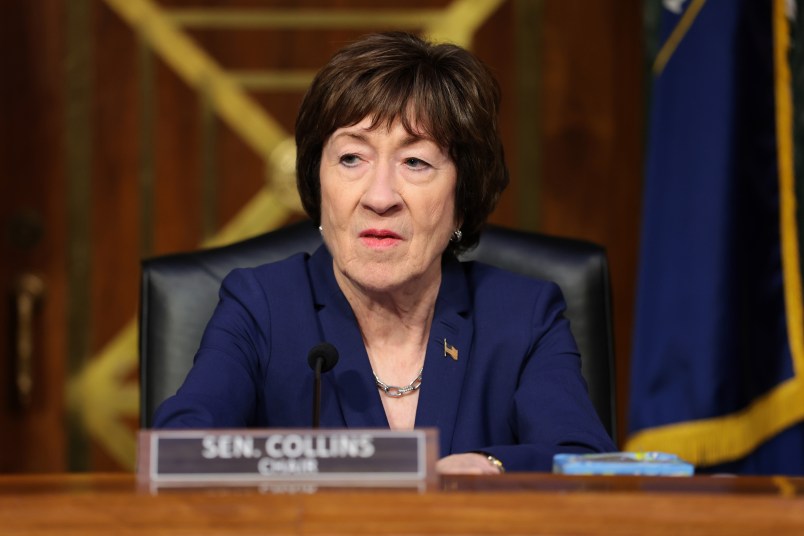
With the prospect of another government shutdown looming, the Senate Appropriations Committee released the text of a continuing resolution (CR) on Sunday that would keep the federal government funded until Dec. 11 and punt the government funding negotiations until after the midterms.
In that stopgap bill, Democrats and a couple of Republicans included a significant provision that would ban, for now, the Trump White House and its Office of Management and Budget (OMB) from finalizing a grantmaking rule change it proposed in May.
The proposal came as OMB has made a practice of illegally pausing and terminating federal funds that are distributed to states for everything from medical research to clean energy, money that has made the U.S. a powerhouse for innovation. Those actions have faced significant pushback in the courts, with some wins for parties that were affected by the Trump administration’s actions.
Seemingly in an attempt to formalize, standardize and create a legal framework for the way administration staff have been manipulating federal funds, on May 29, the OMB released a proposed rule that targets the federal grantmaking process. The proposed rule seeks to modify how grant award decisions are made, allowing them to be made by political appointees and based on political calculations. The rule change opens the process up to a great risk of abuse and corruption, experts told TPM.
“The proposed rule is one of the clearest articulations of the view of this administration that the government is meant to serve the president and his interests rather than the American people,” Devin O’Connor, senior fellow at Center on Budget and Policy Priorities’ federal fiscal policy team, told TPM.
“It codifies this view that grant making should serve to advance the president’s political and policy preferences, whether or not those align with congressional intent, the public good or merit, and that it should be wholly subject to the unreviewable and unaccountable whims of political actors in the executive branch.”
The rule would also create an extension of the executive branch’s ongoing efforts to impede Congress’ power of the purse.
“Congress says what the conditions are for receiving this money,” David Super, law professor at the Georgetown University Law School, told TPM.
Under the law, the administration “can’t give out the money without meeting all the congressional conditions,” he said. “But they also can’t withhold the money to people who meet the conditions by adding their own.”
O’Connor added that the rule would maximize the Trump White House’s coercive power over states, cities, researchers, and other grantees, “because it relies on unreviewable actions by political actors with minimal transparency, creating an open invitation for corruption and abuse.”
Top Republicans on the Senate Appropriations Committee — including Chairwoman Susan Collins (R-ME) and Sen. Lisa Murkowski (R-AK) — publicly voiced their support for temporarily banning the OMB from implementing the rule.
“I advocated for significant changes to the proposed rule in a July 6 letter to the agency, citing its potential to politicize grants and harm small, rural communities, families, and biomedical research,” Collins, who is facing a tough electoral challenge this fall, said in a Sunday statement addressing the CR.
The proposed rule change has already received significant pushback from congressional Democrats. The small group of Senate Republicans joining their colleagues across the aisle on the issue through the language they included in the CR gives the proposed, temporary block on the rule a greater chance of becoming law. Any CR that passes the Senate would then have to pass the House, likely in September, and be signed by Trump.
“The fact that the rule is being delayed on a bipartisan basis shows that Republicans recognize how potentially harmful this could be and how radical a set of changes it would create,” O’Connor said of the language included in the CR.
While the GOP support is significant, the Senate Appropriations Committee Ranking Member Patty Murray (D-WA) emphasized on Sunday that the CR is a time-limited, temporary solution. “Republicans rejected killing the proposed rule outright,” she said.
If adopted, the rule change would give the president and his political appointees the discretion to choose who the federal grants are awarded to based on grantees’ policy and political preferences — including preferences unrelated to the purpose of the grant itself. The rule effectively allows political officials to evaluate proposed grants set up by Congress for whether they carry out the president’s narrow and often-changing political objectives, Super said.
“The president changes his program frequently. I’m old enough to remember when the president was against forever wars,” Super said, sarcastically.
Instead of finding the “best person who’s going to deliver the most value for the federal dollar,” they will focus on, “Who is our friend? Who is our ally? Who is aligned with the way we see the world? And use that as the primary consideration for how federal grant making works,” O’Connor told TPM.
The rule change would also put the grantees under constant threat from the administration for penalties or grant terminations based on the ever changing whims of Trump and his political appointees instead of performance.
For example, if a grant is going to a project that would benefit states that voted predominantly Democrat, the administration could change the requirements of the grants to prioritize giving the money to states that align with Trump in their policies.
That provides an “enormous ability to coerce, harass, or target anyone the Trump administration perceives as their enemies” or “anyone who isn’t sufficiently supportive of the Trump administration across a range of policy priorities that may have nothing to do with the purpose of the grant,” O’Connor told TPM. It would create an environment where “grantees are living under constant threat, where their money could be taken away at any time if they somehow run afoul of the administration or say things the administration doesn’t like.”
As experts have pointed out to TPM, these proposed changes are all practices the Trump administration has been utilizing for more than a year and a half.
“In many ways, what’s sort of remarkable about this is that most of the things that the rule calls for are things that OMB has already been doing since January 2025,” Super told TPM. “They’re giving us a list, which actually gives me a little bit of hope that when this rule is finalized and litigated, the courts will not just say this rule is invalid, but say these practices are invalid.”



Oh, this is so cute. Let’s legislate a limitation on a guy who has never met a limitation he couldn’t violate.
So cute.
While this is true (in Tr*mp world laws and rules are for suckers) the Orange faced felon is also a coward with absolutely no scrote. He relies on the grantees to quit (usually because they can’t afford lawyers) rather then fight for the funding.
When ever a aggrieved Party chooses to fight back and sue the bast_rd the Courts almost always rule that the proposed denial of funds is indeed unconstitutional. His Adminstration promptly folds like a cheap table and releases the funding. Case in point:
Under the law, the administration “can’t give out the money without meeting all the congressional conditions,” he said. “But they also can’t withhold the money to people who meet the conditions by adding their own.”
O’Connor added that the rule would maximize the Trump White House’s coercive power over states, cities, researchers, and other grantees,
I don’t remember Donnie’s campaign ads promising he’d be a better dictator than Biden or Harris.
There was even this, no?
(Duckduckgo reply to prompt donald trump project 2025 )
they don’t need yet another distraction heading into the midterms.
THIS. 1000 times.
Susie Collins thinks the rubes will not notice. Ms. Concern never does anything that’s not a threadbare, incremental step yielding miniscule results. If I were running Troy Jackson’s campaign, I’d have him hammering her hard for this ploy as the perfect example of why she cannot be taken seriously as a defender of the People. He should do an ad, looking straight in to the camera and asking, "Hey Susan, why are you so afraid to do the right thing and make the law permanent? "