

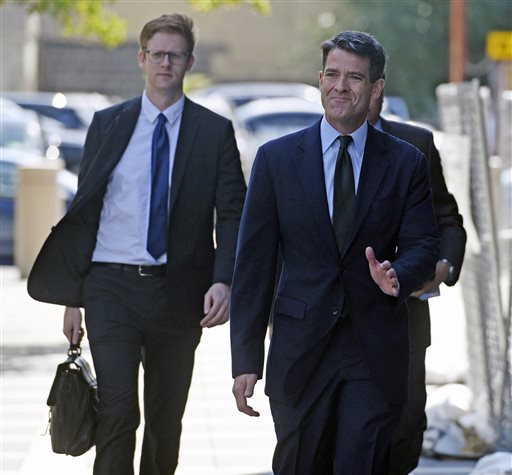
NEWARK, N.J. (AP) — Top officials in New Jersey government and the authority that runs the George Washington Bridge knew about or had a hand in what prosecutors contend was a false narrative that a lane realignment in 2013 was part of a traffic study rather than a scheme to punish a mayor, a defendant in the case testified Monday.
In his first public comments about the scandal since his indictment nearly 18 months ago, former Port Authority of New York and New Jersey executive Bill Baroni also contradicted the prosecution’s star witness by offering a third version of when, and how much, Republican Gov. Christie learned about the lane realignment and subsequent gridlock in Fort Lee, the town adjacent to the bridge.
Prosecutors say the lane closings created traffic jams intended to punish Mark Sokolich, the Democratic mayor of Fort Lee, for not endorsing Christie’s re-election.
Baroni and former Christie deputy chief of staff Bridget Kelly are charged with misusing Port Authority property, fraud and civil rights offenses. The bridge, considered the busiest in the country if not the world, connects New Jersey to New York over the Hudson River.
Above all, Baroni stressed during several hours of direct questioning and the beginnings of cross-examination by the government, that he was hoodwinked by Port Authority colleague David Wildstein, the self-styled architect of the scheme.
“I listened to David Wildstein,” Baroni said when asked why he didn’t return Sokolich’s calls and text messages during the four days of gridlock. “He said to me, ‘Let me handle it.’ I listened to him. I have regretted it ever since.”
Wildstein, a former high school classmate of Christie’s who has handed a $150,000-a-year job at the Port Authority created especially for him, has pleaded guilty and testified for the prosecution. He told jurors the plan was to ignore Sokolich once the traffic problems began.
Prosecutors focused during the end of their case last week on Baroni’s testimony to a state legislative committee in 2013 in which he said the gridlock was caused by a poorly communicated traffic study that sought to gauge the effect of freeing up two tollbooth lanes. That was an attempt to cover up the real motive, prosecutors say.
Baroni testified Monday that then-Port Authority Chairman David Samson, a Christie mentor who headed his transition team, was among those urging Baroni to put together a report explaining what happened. Among those involved in prepping Baroni for his testimony before the committee were Samson’s chief of staff, a Port Authority attorney and Charles McKenna, Christie’s chief counsel at the time.
Materials provided to him by Port Authority staffers “absolutely reinforced” his belief that it had been a legitimate traffic study, Baroni testified.
Baroni also contradicted Wildstein’s version of a meeting between the two men and Christie at the World Trade Center on Sept. 11, 2013. Wildstein testified earlier that Baroni told Christie about the traffic problems and about Sokolich’s calls going unanswered, to which Christie allegedly laughed and made a sarcastic joke about politics being involved.
But Baroni testified Monday it was Wildstein who told Christie and that no mention of Sokolich or political retaliation was made. Christie hasn’t been charged and has denied knowing about the alleged scheme while it was in progress.
On cross-examination, Assistant U.S. Attorney Lee Cortes peppered Baroni with questions about why he didn’t respond to Sokolich, someone with whom Baroni had developed a close relationship. On the first morning of the traffic jams, Baroni said, he was participating in a panel discussion when he got the first message.
“You could have called the mayor. But you didn’t, did you?” Cortes asked. Baroni replied that he passed Sokolich’s message to Wildstein, who directed him: “Radio silence.”
He said Wildstein told him about the lane realignment plan on Sept. 8, the day before it was put into effect. He said Wildstein told him if he answered Sokolich’s pleas for help it would mean he was “wimping out” and would ruin the traffic study.
Copyright 2016 The Associated Press. All rights reserved. This material may not be published, broadcast, rewritten or redistributed.


I’m missing something here:
Baroni is testifying that Wildstein told him - advised, informed, whatever - about the “plan” to shut down the lanes one day BEFORE the “plan” or any of the lane shutting happened.
Bear in mind that at that moment, when Baroni’s being told that, Baroni is the Deputy Executive Directory of the Port Authority - not the New Jersey end of the PA, of the whole combined New Jersey-New York Authority.
And at the same moment, Wildstein is in a LESSER position with the Authority, a position what never had existed before Gov. Christie appointed Wildstein (his former high school classmate and long time political operative), titled “Director of Interstate Capital Projects” - which, even for anyone on the outside not familiar with the politicization of the Port Authority and Wildstein’s background, would be an office that involves things like financing and budgets, things that are more tangentially connected to day to day operations than Baroni’s job with the PA, and INFERIOR to the office of Deputy Executive Director.
Plus Baroni was in fact an insider, knew Wildstein, knew who had arranged to appoint Wildstein to the PA, and knew that Wildstein’s role with the PA was as a pollitcal officer reporting to Gov. Christie.
So what possible basis does Baroni have for accepting that the information he’s receiving from Wildstein the day BEFORE the lane closing has anything at all to do with the OPERATIONS of the PA or PA planning, budget, or financing issues?
If Baroni didn’t know who Wildstein was, how Wildstein got his job, who got the job, why, Wildstein’s role and function, and who Wildstein actually reported to, this would seem to constitute incompetence on the part of Baroni.
If Baroni DID know all that - and it seems clear that he was aware of all that - then that means Baroni realized on the day BEFORE the lane closings that this plan and the lane closings were part of some political election op. That, and that alone, would explain why Baroni would accept the “radio silience” direction from Wildstein, again, his inferior at the PA.
So what am I missing? How this testimony possibly helps Baroni.