


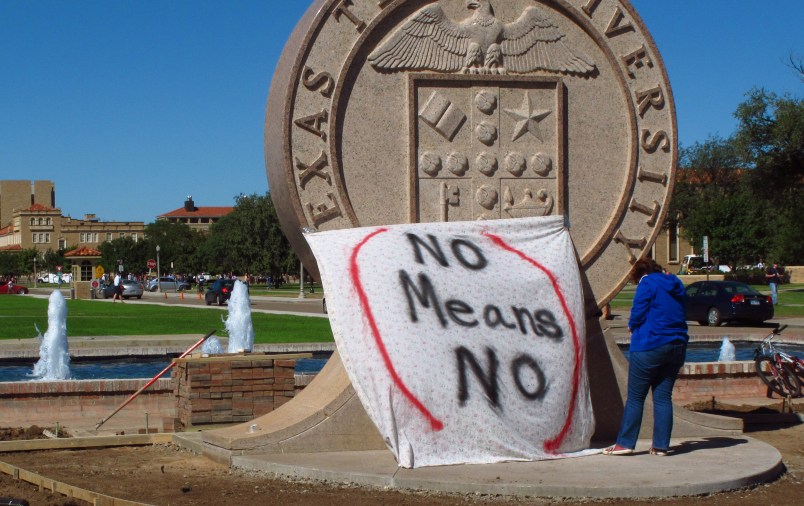
COLUMBUS, Ohio (AP) — A quarter of undergraduate women surveyed at more than two dozen universities say they experienced unwanted sexual contact sometime during college, according to a report released Monday.
The results of the Association of American Universities Campus Climate Survey come at a time of heightened scrutiny of the nation’s colleges and universities and what they are doing to combat sexual assault. Just last week, Vice President Joe Biden visited Ohio State University to highlight several new initiatives, including mandatory sexual violence awareness training for freshmen beginning next year.
The survey was sent to nearly 780,000 students at the association’s member colleges, plus one additional university. About 150,000 participated in the online questionnaire.
The results were generally in line with past surveys on sexual assault and misconduct on college campuses — and confirmed that alcohol and drugs are important risk factors.
Researchers cautioned against generalizations, partly because of different rates among women and men and students at different years in their schooling. It was not a representative sample of all the nation’s colleges anduniversities.
Some students attended schools that have recently grappled with reports of sexual assaults or misconduct, including the University of Virginia, the University of Wisconsin-Madison and Ohio State.
University of Virginia President Teresa A. Sullivan has said that a widely discredited and later retracted Rolling Stone magazine story about a gang-rape at a fraternity house harmed efforts to fight sexual violence and tarred the school’s reputation. Hazing that included excessive underage drinking and sexualized conduct prompted theUniversity of Wisconsin-Madison to terminate a fraternity chapter earlier this year. And Ohio State fired its marching band director last year after an internal investigation turned up a “sexualized culture” of rituals and traditions inside the celebrated organization.
Overall, 23 percent of undergraduate women at the participating universities said they had been physically forced — or threatened with force — into nonconsensual sexual contact. For undergraduate men, the percentage was 5 percent.
Freshman women appeared to be at greater risk than older students for the most serious sexual assaults — those involving penetration. About 17 percent of freshman females said they had been victims of this type of assault. For women asked about their senior year, the percentage was about 11 percent, the survey found.
The survey sample provided a rare glimpse into the experiences of the small percentage of students who are transgender or who don’t identify as either male or female. Undergraduates in that category reported the highest rate of the most serious nonconsensual acts, those involving penetration.
“Our universities are working to ensure their campuses are safe places for students,” AAU President Hunter Rawlings said in a statement. “The primary goal of the survey is to help them better understand the experiences and attitudes of their students with respect to this challenge.”
The association has provided the survey findings for participating schools to use in developing effective policies. He said the report should also assist federal policymakers considering legislative and administrative responses.
The study found that only a relatively small percentage of serious incidents was reported to the university or another group, including law enforcement. Across the institutions, it ranged from 5 percent to 25 percent.
The most common reason cited by students for not reporting an incident was that they didn’t consider it serious enough. Others said they were embarrassed or ashamed or “did not think anything would be done about it.”
Those who chose to report the incidents, however, said they had generally favorable experiences. Well over half said their experience with the organization that handled the report was very good or excellent.
Twenty-six participating institutions were AAU member research universities: Brown; California Institute of Technology; Case Western Reserve; Columbia; Cornell; Harvard; Yale; Iowa State; Michigan State; Ohio State; Purdue; Texas A&M; and the universities of Arizona, Florida, Michigan, Minnesota-Twin Cities, Missouri-Columbia, North Carolina at Chapel Hill, Oregon, Pennsylvania, Pittsburgh, Southern California, Texas at Austin, Virginia, Wisconsin-Madison; and Washington University in St. Louis. One non-member, Dartmouth College, also participated.
___
Online: http://www.aau.edu
Copyright 2015 The Associated Press. All rights reserved. This material may not be published, broadcast, rewritten or redistributed.







I am sad that my college is among those who reported this figure.
Most hetrosexual men will push themselves on to women they are attracted to and most white folks have prejudice against black/non-white folks.
I hate it when men and white people act like this isn’t the way it is. They know it is and I don’t know why they think the people this crap is being done to will believe it isn’t being done to them if they deny it.
A survey like this is useless without specifics. One reason freshmen women may feel more victimized is that their parents and feminists teach them to be hypersensitive about anything that might be in any way sexual. After a little time out in the big bad world they figure out that being inadvertently bumped in crowded situations is not sexual assault, and a guy showing interest in them is not a prelude to rape.
Most lazy generalizations are horseshit.
That is a unique theory. Usually the accusation is that college is a hotbed of feminist and radical thought which leads women to accept such worldviews. You seem to be suggesting that the women come in with the victimization world view from their parents and high school feminists, and get cured of it during their time at college.
I suppose something like that is necessary because the evidence here does not fit with the increasing radicalization hypothesis. It does fit with the fact that freshmen are more vulnerable than upper classmen, and so more likely to be victimized. But if one wants to reject the obvious explanation then I suppose something like your unconventional explanation would be necessary.