

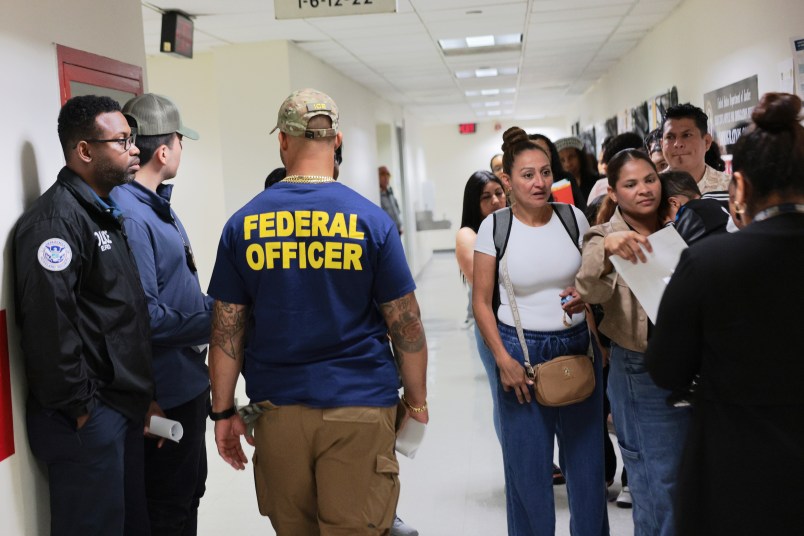
When I walked up to 290 Broadway early on a late June morning, an imposing building in New York City that houses a number of immigration courtrooms, a line of people stretched down the block, around the corner, and down that block, too. There had been a fire drill. People in suits were sparsely interspersed among dozens of young Black men in street clothes and Latino families trying to pacify young children.
As we all waited in line, 9 a.m., the time for many people’s appointments to go before an immigration judge, came and went. Melanie Zamenhof, a senior attorney at Neighbors Link community law practice, estimated that a third of the people in line risked having a judge call their case while they were still outside. “How many people are going to get ordered removed because they’re sitting in this line?” she wondered aloud. If that were to happen, they could file a motion to reopen their cases by providing affidavits and proof that they had arrived at the right time but hadn’t been allowed in. But doing so costs $550, and virtually no one going through the process without a lawyer would have any idea that it’s an option.
That’s common in immigration courtrooms across the country. Despite the enormously high stakes and labyrinthine legal landscape in immigration proceedings, there is no right to have a lawyer at one’s side. In the 3.5 million removal proceedings pending in immigration courts as of June 2025, 2.1 million people had no legal representation.
It’s a problem that may be slowly changing during the second Trump administration. In their recent legislative sessions, six states — California, Massachusetts, Missouri, New York, North Carolina, and Vermont — considered legislation that would enshrine a right to a lawyer in immigration court. California became the first state to actually pass legislation with a bill guaranteeing representation for children. “It’s getting a lot more serious discussion and attention than ever happened before,” said John Pollock, coordinator at the National Coalition for a Civil Right to Counsel.
“This administration has vastly expanded who is being targeted for deportation and detention and is arbitrarily and indiscriminately arresting people regardless of how long they’ve been here,” added Elizabeth Kenney, associate director of the Advancing Universal Representation Initiative at the Vera Institute of Justice. “This has really brought awareness to the fact that in our system, immigrants are left to fight their cases alone.”
It was 9:45 by the time I reached the waiting room outside Immigration Judge Diane Dodd’s courtroom on the 13th floor, where 139 people were on the judge’s mega master docket — a new tactic in which the Justice Department is bunching scores of cases together with the goal of speeding along deportations. All of the blue plastic bucket seats were occupied; people lined up along the walls. Only lawyers were allowed into the small, low-ceilinged courtroom lit with neon lights and carpeted in blue. Dodd briefly walked into the room, a short woman with long grey hair, apologized and promptly exited. Instead, a stressed clerk presided. “I’m sorry, it’s chaos,” she told the room. One by one, she spoke to the lawyers to find out their case numbers and what paperwork they had filed. If she was satisfied, she told them they and their clients could leave. Those without lawyers didn’t get off so easily: They would have to wait an indeterminate amount of time to see Dodd.
A Latina woman clutching a folder full of papers who had somehow ended up in the courtroom desperately tried to show the clerk her ID and case information on her phone; the clerk waved her away, refusing to talk to her. She sat, mute, seemingly unsure what to do. When the clerk reached another couple without a lawyer and asked if they had an attorney, they gestured at paperwork while speaking Russian. A lawyer sitting next to them, not theirs, who happened to speak Russian conferred with them; he reported that they filed a motion to change the venue because their lawyer is in Chicago. Only after that did the clerk tell them they could leave.
“What a fucking shitshow,” a different lawyer exclaimed aloud.
“In our system, immigrants are left to fight their cases alone.”
Elizabeth Kenney, associate director of the Advancing Universal Representation Initiative at the Vera Institute of Justice
Those waiting outside Tanawa Lebreton’s courtroom on the 15th floor fared even worse. Her docket, printed out on bright orange pages taped together, stretched to the floor and showed that of over 100 cases, just 32 had lawyers near their names. Over 50 people were still waiting by 11 a.m. without having seen a judge or even talking to a clerk. An elderly, white haired woman hunched down in her wheelchair; two mothers of toddlers, just barely walking, chased them around the room. As a volunteer with an organization that connects people to legal clinics moved through the crowd, asking in Spanish if they had lawyers, everyone shook their heads no. Plastic buckets attached to the wall under an “INFORMACION” banner offered pamphlets to answer various questions: “How to apply for asylum, withholding of removal and protection under the convention against torture,” “What if you disagree with a judge’s decision?,” “How to win your case for lawful permanent resident (LPR) cancellation of removal.” A disclaimer above the bins warned that it was not intended as legal advice. Next to those, fliers posted to the wall in multiple languages blared the dangers of skirting legal requirements. “Warning!” declared one. “Asylum fraud is against the law.” Another had a “message to illegal aliens” that listed the benefits of self-deportation.
One of the few people who made it before Lebreton before she took a break for lunch was a man from Senegal who was facing removal proceedings. Through a Wolof interpreter, Lebreton inquired as to whether he had tried to get an attorney after his last hearing. He had promised to try to find one, he said, but he had lost his job and couldn’t. Someone he had found just before his previous appointment turned out not to be a lawyer. “He scammed me and took my money,” he told her. Lebreton encouraged him to reach out to legal aid groups and other lawyers on a list he had been given. “Immigration law is very complicated,” Lebreton warned him. “Anything submitted on your behalf, you are responsible for.”
Then she read out the allegations lodged against him by the federal government, asking him to admit or deny each. Is it true he’s not a citizen? Yes, he replied. Is it true he’s a native of Senegal? Yes. Is it true that he arrived to the U.S. in Arizona? Yes. The judge stated the final allegation in legalese and then translated to lay terms: Is it true that he didn’t have legal permission to enter the country? Yes, he answered. Lebreton reiterated the question, double checking that was really how he wanted to answer. Yes, he said; he didn’t have the right paperwork when he entered the country. The judge designated Senegal as the country he would be deported to should it come to that. His next step would be a final hearing late next year. “It’s your responsibility to prove your case,” she told him before informing him he could leave.
It’s a line most people could recite from “Law & Order”: in criminal proceedings, Americans have the right to an attorney, and if they can’t afford an attorney, one will be provided for them. That’s been the law of the land since a 1963 Supreme Court decision. But immigration proceedings, despite their high stakes and the real possibility that they will result in detention, are civil. That means that no immigrant who goes through the system is guaranteed a lawyer.
And yet the impact immigration lawyers make on cases is clear. In Illinois, having a lawyer increased the likelihood of being granted full protection from removal by 366% and of being released from detention on bond by 46%, according to data from the Vera Institute of Justice. In New York, it resulted in a 1,100% increase in people being able to remain legally and those with lawyers were almost twice as likely to be released on bond. “The number of people who get relief without counsel is very small,” Pollock noted.
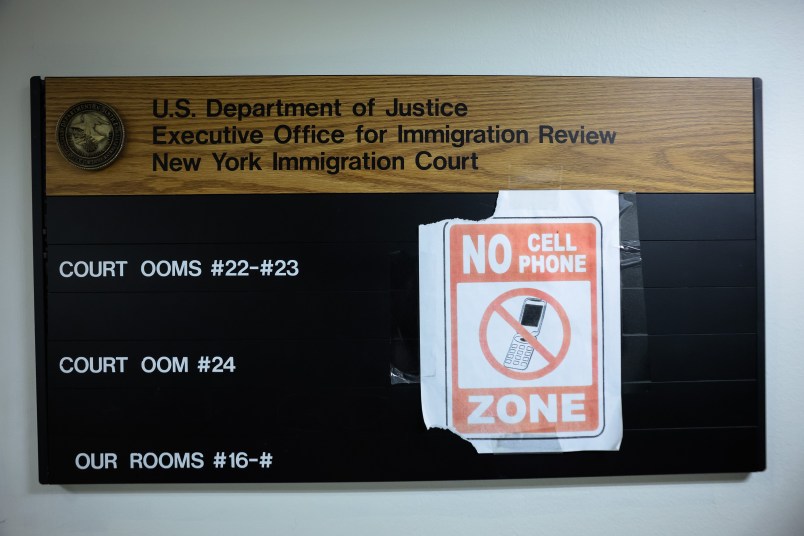
Immigration law is often deemed second only to the tax code in complexity. “It’s impossible to expect a person who hasn’t been to law school to understand the first thing about how to navigate it, and it’s an area of law that changes rapidly,” Pollock said. “Even lawyers struggle with immigration law.” Immigration court requires “extremely, wildly complex forms that need to be filled in a specific way,” Zamenhof said. Add language barriers to the mix, and then consider that there are children who go in front of immigration judges alone. Those in detention have even less access to legal defense. The barriers have only increased as the Trump administration makes changes to the process and erects more barriers to staying in the U.S. “It’s impossible to navigate even with the most intelligent, skilled legal team,” Zamenhof said.
On the other side of the case is a government prosecutor. “People are expected to face a trained government attorney without anyone to defend them, help them understand their rights and options and help them navigate their case, unless they’re able to afford a private attorney,” Kenney said.
The stakes are incredibly high. “Immigration proceedings are literally life and death in certain cases,” Pollock said. At least 138 people deported back to El Salvador between 2013 and 2019 were killed after they returned, Human Rights Watch found. Even less dire outcomes affect “all the other basic human needs,” Pollock said: “All of your access to your family, your access to your job, your access to literally everything.” People can also end up in detention for years at a time. “Our immigration system is the only time people can be detained against their will without having access to an attorney,” Kenney said. It’s “a complete devastation of due process.”
“Immigration proceedings are literally life and death in certain cases.”
John Pollock, coordinator at the National Coalition for a Civil Right to Counsel
Now that so many more people are being detained and deported under Trump, some states have decided to step up. Last year, California passed a bill enshrining a right to legal counsel for children in the state. Although it’s only for children, Pollock called it “groundbreaking” as “the first of its kind.”
Still, it was limited, and not just because it only applies to children. The legislation didn’t mandate funding for the program and didn’t come with an accompanying budget request. “A year later it has changed nothing because there was no money assigned to it,” said Hortencia Rodríguez Sandoval, director of state and local policy at the Acacia Center for Justice. “Only by investing long-term in the capacity and infrastructure of the legal organizations who have been doing this work for over a decade will we be able to make universal representation a reality.”
The lawmaker who introduced the successful legislation, Assemblymember Mia Bonta, this year introduced a bill that would ensure legal representation for all immigrants facing deportation, funded by the government. It didn’t pass, but it made it through two committees — more progress than such legislation has made in prior years. A new governor next year could also change the political calculus.
But even if California were able to pass a right-to-counsel bill for every immigrant, it would be nearly impossible to put into action right away. There just aren’t enough immigration lawyers. “Existing immigration attorneys are frankly overwhelmed,” said Hamid Yazdan Panah, advocacy director at Immigrant Defense Advocates. The state legislature has funded two programs that are chipping away at the problem: one sends legal fellows into underserved regions who then partner with larger, established organizations, and another staffs an attorney to consult with everyone at particular master hearings, or the initial hearings immigrants must attend. “To reach this aspirational universal representation model, you need to have a scalable approach,” Panah said.
New York has been working on these issues for years. The New York Immigration Family Unity Project pilot program was launched in 2013 in an effort to create a public defender system for detained immigrants. The state has yet to pass a guarantee, but it has invested heavily in it the past few years: Its most recent budget devoted $74.2 million for services that include legal representation.
Then in 2020, at the end of the first Trump administration, New York lawmakers introduced a bill to guarantee legal representation in immigration proceedings, the first such legislation in the country. It’s been reintroduced every session since. More recently, lawmakers introduced accompanying legislation that would help build a pipeline of attorneys to take on immigration cases so that there are enough to represent everyone should the right to counsel actually pass.
Despite all of the state activity, however, not much has changed for immigrants moving through the system across the country. “There are not currently any states that have a right to counsel and have sufficient funding to ensure that that right is available for everyone,” Kenney noted.
And even if some states do pass and fund such a right, “We know that’s not going to be possible in every state,” Kenney noted. “In order to ensure that people have access to high-quality counsel regardless of where they’re from or where they’re detained, we need to make sure that right applies throughout the country.” But Congress hasn’t acted. While bills have been regularly introduced for years to create a federal right to counsel in immigration court, they typically don’t even get hearings, let alone votes. The version introduced in 2023 by Sen. Kirsten Gillibrand (D-NY) and Rep. Norma Torres (D-CA) died after being referred to committee.
All eight people with pending asylum cases sitting on benches in Immigration Judge Sam Factor’s courtroom at 26 Federal Plaza in lower Manhattan in late June were there without lawyers. Factor moved quickly through the proceedings, ticking off an almost identical set of questions for each person in a sing-song voice reminiscent of someone reading a picture book to a child.
One man in matching white collared shirt and pants spoke to Factor through a French interpreter. He was already in removal proceedings and faced being sent back to Mauritania. “What that means is the government is saying you don’t have permission to remain in the U.S.,” Factor explained. “It’s a serious issue.” He told the man that most people have attorneys, but the man confirmed that he didn’t have one. “Ultimately it’s up to you to find an attorney because the government’s not going to pay for one,” Factor told him. The man thanked Factor in English before leaving. It was left unclear whether and how he would be able to find an attorney by his next court date.






There are six people on the Supreme Court who would read this horror story and think, “The system is way too soft on these [redacted].”