


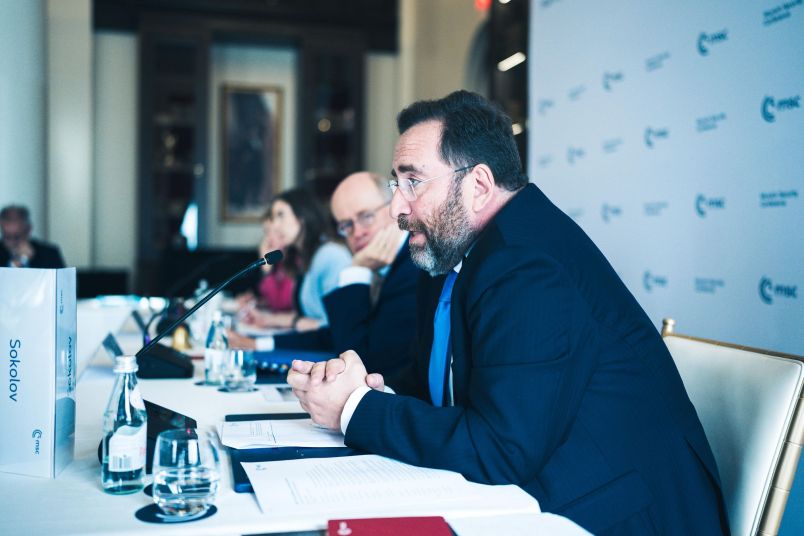
Ever since he contributed to the White House ballroom project last year, things have gone well for Konstantin A. Sokolov: the Treasury Department gave a company he manages a license to get around international sanctions against Russia. The State Department appointed him to run a $201 million foreign investment fund in the Caucasus. And, per sources familiar, he convened meetings to discuss investments related to Donald Trump Jr.’s VC firm, 1789 Capital.
It’s a remarkable winning streak for the Russian-American investor, who, until 2025, had a meager public history of political giving.
Per records obtained by TPM through FOIA, a Texas company for which Sokolov is listed as manager called Dynamic Frontier Holdings LLC first applied for a license from the Treasury’s Office of Foreign Asset Controls on October 27, 2025. OFAC issued the license around 10 weeks later, on Jan. 5, a timeline experts described to TPM as remarkably quick.
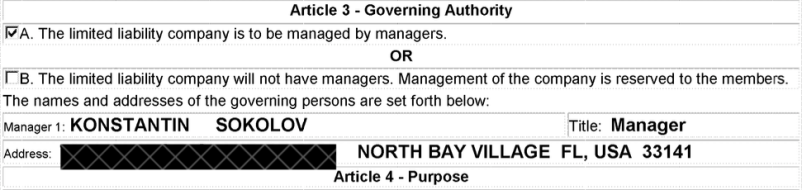
The company used the license in June to buy a copper mine in Armenia previously owned by VTB Bank, according to a July Radio Liberty report. The Treasury Department had sanctioned VTB as Russia launched its 2022 full-scale invasion of Ukraine, describing it as a “critical artery of Russia’s financial system” through which Moscow financed its war effort. The International Consortium of Investigative Journalists first reported the license’s issuance.
Over the past year, Sokolov has become a prolific political donor. He was listed by the White House as a contributor to the ballroom project days before Dynamic Frontier Holdings applied for the license. The amount he donated to the ballroom project has not been disclosed. He also, during the second Trump presidency, gave $12 million to a Trump super PAC, MAGA Inc., as well as hundreds of thousands of dollars to the National Republican Senatorial Committee, and $100,000 in support of Sens. Susan Collins (R-ME) and $120,000 for Pete Ricketts (R-NE). Since 2025, he has given more than $14 million to Republican causes, according to FEC records. Before that, his only contributions were in 2008: a combined $3,600 to Barack Obama and a PAC supporting him.
Over the last several months, the Trump administration not only opened the door for Sokolov’s business deal with VTB Bank, it also placed Sokolov in an influential position in the Caucasus. This summer, the State Department placed Sokolov in charge of a $201 million Trans-Caspian enterprise fund set to invest public money in the south Caucasus, a region that includes Armenia, as part of a “Trump road” initiative. The Guardian broke that news in July.
The fund exists to help provide access for the United States to raw materials used in microchips and the construction of AI data centers, regional experts told TPM. The fund and associated projects could allow resources from Central Asia and the Caucasus an easier path westward, towards the United States.
“He hardly would be my first choice,” Daniel Fried, a former State Department sanctions coordinator who worked on a similar fund in Poland, said of the Trans-Caspian Enterprise fund. Fried added that Sokolov having business interests in Armenia while running a fund devoted to investing public money in companies in the region could present an issue: “You have to ask yourself whether his involvement in [the Trans-Caspian Enterprise Fund] is going to lead to conflicts of interests.”
In addition to the acquisition of the copper mine, Armenia’s second largest, Sokolov has deepened his personal business investments in Armenia and Europe more broadly in recent years. In 2024, he and Zhe Zhang, co-investor who was described in securities filings as a former employee of MOFCOM, China’s Ministry of Commerce, acquired a stake in an Armenian telecommunications operator. They did so via a Cyprus company called Fedilco, the company said.
Another project appears to have intersected with the Trump family. A Gibraltar data center project called Pelagos lists Sokolov as its chairman; a representative of the company met with Donald Trump Jr. while he was visiting the enclave last year, per local press reports.
Around the same time, Sokolov convened a meeting to discuss foreign investments related to 1789 Capital, the investment firm where the president’s son is a partner, according to two people familiar with the trip. One of the people said Don Jr. attended. It’s unclear whether any investments — into 1789 Capital, or by 1789 Capital — resulted from the trip; both sources said that 1789 Capital does not invest in non-U.S. companies.
Sokolov, 51, has little in the way of a publicly documented business career before 2025, when he made a $100 million gift to the University of Chicago Booth School of Business. Sokolov is an alumnus of Booth’s Executive MBA program, and one of the only descriptions of his work over the last two decades comes from a 2014 article in the school’s alumni magazine, which describes him running an investment firm in Russia alongside a business partner, a fellow Booth alumnus who had previously worked in high-level roles at Russian oligarch Oleg Deripaska’s massive conglomerate, Basic Element.
A spokesperson for Sokolov didn’t return a request to make him available for an interview, and argued strenuously that there’s no conflict of interest in Sokolov’s activities related to the Trans-Caspian enterprise fund and that there’s no connection between his political contributions and the license that Treasury issued for the acquisition of the Armenian copper mine.
The spokesperson also argued to TPM that we had confused aspects of Sokolov’s biography with that of another person with a similar name, Konstantin Borisovich Sokolov.
TPM found that there are, in fact, two high-profile Konstantin Borisovich Sokolovs. One is a former managing director of Deripaska’s company, Basic Element, and was reportedly born in the late 1960s. The other Konstantin Borisovich Sokolov appears to be an alias used by Konstantin Kudryavtsev, an alleged Russian security services officer under Treasury sanctions for his purported involvement in the poisoning of Alexei Navalny.
Per Russian naming conventions, a patronymic is derived from the father’s first name. Neither of the other Sokolovs share the ballroom donor’s patronymic — Anatolyevich. Nor do they share Konstantin A. Sokolov’s birth year — 1975. Neither of the other two appear to have attended the University of Chicago’s Booth School of Business.
Konstantin A. Sokolov’s spokesperson didn’t return a follow-up request for comment about which aspects of this story they believe corresponds to the wrong Sokolov.
“Mr. Sokolov is a U.S. citizen and complies with all applicable laws and regulations,” the person said in a statement.
Chicago and Russia
Sokolov appears to have had little public profile before 2025. Several news outlets have described him as a newcomer to political giving, listing him among other brand-new entrants to the world of MAGA political contributions. NBC noted in January that Sokolov had gone “from making a handful of four-figure donations in the past to dropping more than $11 million into MAGA Inc.’s coffers in just one year.”
He largely emerged into the public eye in 2025, with his $100 million donation to the University of Chicago. In an interview with the Chicago Tribune, Sokolov estimated the gift at nearly 10% of his overall wealth.
“Chicago Booth played a very important role in my life,” Sokolov told the newspaper. “The business school served as a foundation of my career success and then my success as an entrepreneur.”
Sokolov was elected to the university’s board of trustees in August. Over the last year and a half, Sokolov has also become a player at the Munich Security Conference. The group listed him as having participated in its February 2025 event; in January 2026, the conference announced that he had given a major contribution to its foundation.
Before 2025, details of Sokolov’s life are sparse. TPM found some evidence of a life — social media profiles, an account on a wine-ranking website.
But the answer to how and where Sokolov gained his apparently immense wealth remains unclear.
Originally from St. Petersburg, Russia, Sokolov first immigrated to the United States in 1997, settling in Ohio. He eventually moved to Denver, before receiving an Executive MBA from Booth in 2005.
He seems to have lived in Chicago until the late 2000s; a biography on his website says that he worked for a British gas firm during this time. By 2011, records obtained by TPM show, Sokolov faced foreclosure on a condo he owned in downtown Chicago.
When a process server tried to deliver Sokolov a copy of a complaint in a separate case relating to unpaid condo fees on the unit, he was, according to court documents, told by another resident that Sokolov was living in Moscow, Russia. Documents filed in the 2011 fees case refer to Sokolov as “Konstantin A. Sokolov.” The case ended in a default judgment; Cook County Sheriffs sold the unit, the docket says.
That same year, Sokolov appears to have deepened a business career in Europe via the founding of an investment firm called Gotthard; Sokolov described himself as the founder and chairman of the company in a later SEC filing. Swiss corporate records from the firm’s 2011 incorporation described Sokolov as a “Russian citizen living in Moscow,” per a translation from the German.
An archived version of the 2014 Booth alumni magazine story also suggests that Sokolov, described as a 2005 Booth graduate, worked in Russia for several years. Per the story, Sokolov founded an investment firm in Russia called IFG Basis in 2008 along with a business partner, Evgeny Tonkacheev.
The story describes Tonkacheev as a dual physics and math PhD who in the early 2000s was CEO of Basic Element, the massive industrial conglomerate belonging to Deripaska, the Russian oligarch. A LinkedIn profile for Tonkacheev lists him as having worked as a CEO and managing director at Basic Element at the time. Deripaska is largely known in the United States for his financial ties to 2016 Trump campaign chairman Paul Manafort who, prosecutors found, offered Deripaska private briefings and information about the Trump campaign via an intermediary. A Senate Intelligence Committee report identified the intermediary as a Russian intelligence officer.
Tonkacheev left Basic Element for Booth, the 2014 alumni magazine story says. “I had no special business education but got a lot of experience working for this big company,” the story quoted Tonkacheev as saying.
Russian business news reports from the period describe IFG Basis as seeking to invest in Russian real estate and industry; one news report quoted Sokolov as saying he wanted to build a “five star hotel” in St. Petersburg’s historic center.
By 2021, it appears Sokolov’s business activities had returned to the United States. Gotthard moved to dissolve itself that year, corporate filings show, and Sokolov had embarked on a Wall Street career through involvement in two SPACs, publicly traded shell companies used to raise capital to buy privately held firms.
That appears not to have lasted. In August 2021, Sokolov was listed in securities filings as the chair of the audit committee of Alpha Star Acquisition Corp., one of the SPACs. The committee’s responsibilities included hiring auditors and reviewing issues that might affect the company’s financial statements. He left in October 2022. The company later merged with an Estonian fintech firm, but it also ran into some difficulties: in 2024, it told investors that its financial statements for 2021 and 2022 could no longer be relied upon. It had overstated its assets by $118,228,816.
In 2024, a Cypriot company called Fedilco acquired an Armenian telecommunications operator called Viva, according to a Viva press release. The announcement described Sokolov as an investor who was Fedilco’s “ultimate beneficiary” along with a businessman named Zhe Zhang, described in SEC filings as a former employee of MOFCOM, the abbreviation for China’s Ministry of Commerce.
Viva’s previous owner was Mobile TeleSystems PJSC, MTS, a Russian conglomerate subject to international sanctions.
From Trumpworld to Armenia
The Viva acquisition came months after fighting drew to a halt in Armenia’s war with Azerbaijan, which had been ongoing for years but flared up in 2023. Armenia had long relied on Russia for its security but, bogged down in Ukraine, the Russian government declined to intervene.
This left the country seeking American help. In August 2025, President Trump announced a peace deal to end the conflict: the two countries would gain peace through trade, he said.
The U.S. would create an Armenian development company (74 percent of the company’s shares would belong to Washington) and would sponsor a “Trump road” to knit the two previously warring nations together.
As part of this, the State Department agreed to create what it now calls a Trans-Caspian Enterprise Fund. The U.S. government created similar funds across the former Eastern Bloc after the fall of communism and in the Middle East: the idea is to have the U.S. government invest in companies and projects that might speed along development.
Projects launched as part of the initiative are largely focused on AI. U.S. officials have said that the project’s purpose is to create a “middle corridor,” allowing rare earths and other resources to make their way from Central Asia westwards while avoiding Iran, Russia, and China.
The Trans-Caspian Enterprise Fund was incorporated in Delaware in January 2026, corporate records show. The State Department appointed Sokolov as its chairman this year, and granted the fund $201 million. Federal records reviewed by TPM show that a Chicago attorney listed on several of Sokolov’s private businesses serves as the fund’s point of contact. The fund has said that it holds itself to the highest governance and ethical standards in compliance with U.S. laws and those of the countries in which it operates.
The fund is registered at an address whose listed owner is a Miami real estate agent who advertises his “discretion” and “distinguished reputation advising ultra-high-net-worth individuals, international investors.” Dynamic Frontier Holdings, the company that acquired the copper mine, is listed at the same address.

TPM sought more information about the $201 million the State Department granted to the Trans-Caspian Enterprise Fund; congressional staffers said that because the money came from a recently created “National Security Investment Programs” account, it would have minimal oversight. The president has vast authority over national security matters; so long as the State Department claims the investments are national security-related, Congress receives limited updates, they said.
TPM sought comment from as many people and entities as it could find that are tied to Sokolov. Some didn’t return our requests; others replied, only to describe our questions as having to do with information that is already public, and therefore not necessary to address, or information that is private, and therefore not subject to discussion.
UChicago didn’t respond to questions about Sokolov’s contributions to the school. The White House didn’t return a request for comment.
Pelagos Data Centres declined to comment; Viva Armenia, the telecom asset tied to Sokolov, told TPM that the company had “received all necessary authorizations from Armenia’s regulatory bodies.”
The State Department initially acknowledged TPM’s request, before failing to provide a response.



First
White House asks Kimberly Guilfoyle to resign as Greece ambassador | Fox News
Outstanding reporting! From having his condo foreclosed on to giving $100 million to the U of C and tens of millions to Shitler…just can’t imagine where he got his money. Russia, Russia, Russia, indeed. Everything goes back to Russia.
This is excellent reporting. Please send it to every single Congress person post haste. Then ask each and every Congress person to respond. Especially those that are defending their seats this cycle.
[With hands over eyes] Nothing to see here, move along….luckily I’m not a Republican, so I respect the truth here. Nice job.
A fine, detailed article but could use an executive summary with some bullet points.