


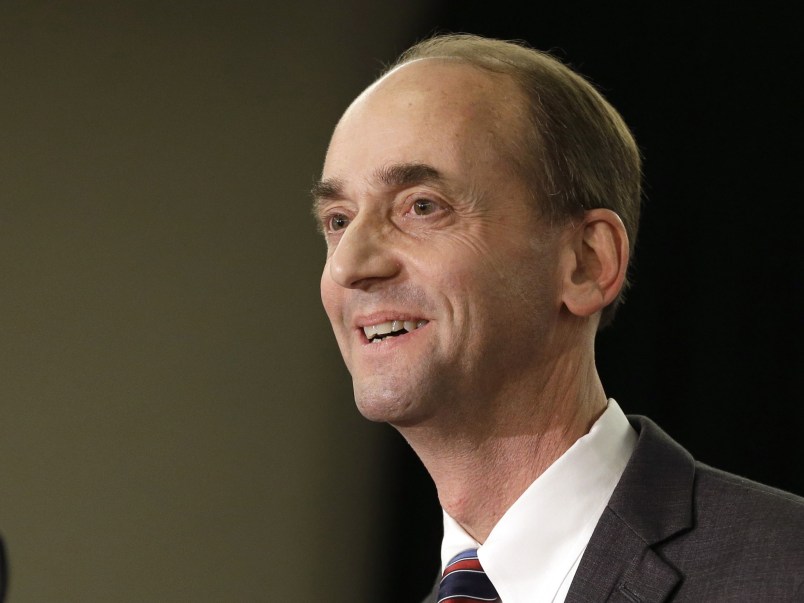
Police said Tuesday that they found no evidence to provide a motive for the suicide of former Republican gubernatorial candidate and Missouri state Auditor Tom Schweich, all but concluding their investigation into his death.
Clayton, Mo. Police Det. Lt. Don Bass told the St. Louis Post-Dispatch that investigators never found a note or anything else to provide a motive for the suicide in searches of Schweich’s cell phone and computer.
Later in a news conference, police released more findings from their investigation that added crucial context to Schweich’s death, including chronic illness and a history of suicidal thoughts.
Schweich took his own life on April 26, shortly after arranging for an interview with reporters later that same day. The gubernatorial candidate had planned to go public with allegations that the state’s Republican Party chair had been telling people he was Jewish in order to hamstring him in the primary. Schweich was an Episcopalian, though he had Jewish heritage.
Police suggested in the news conference that Schweich had contemplated suicide before the allegations of a “whispering campaign.” Det. Tom Bossch, who worked on Schweich’s case, said that the late auditor had confided in family members that he had suicidal thoughts before. Schweich’s wife told investigators that Schweich had mentioned those thoughts “on and off for several years,” Bossch said.
Schweich also suffered from Crohn’s disease. Bossch said that while Schweich had been prescribed 24 different drugs, including pain relief medications, an autopsy showed that the late auditor was not under the influence of any drugs at the time of his death.
“There were many factors that went into this,” Bossch said. “We can’t get into Mr. Schweich’s mind.”
When a reporter asked whether the alleged whisper campaign was still considered a driving factor in the gubernatorial candidate’s suicide, Bass responded: “I think it’s reasonable to say that the family thinks that’s the number one reason.”
For his part, the state’s GOP chairman, John Hancock, consistently denied any allegations of a so-called “whispering campaign” about Schweich’s religion.
Hancock did acknowledge that he may have told someone that Schweich was Jewish in an offhand manner because he said he’d been mistaken about the late auditor’s faith. But the chairman denied making any of the alleged statements in an interview with police, Bossch said.
Police added that their investigation had turned up no evidence of the whispering campaign beyond the allegations a local businessman and Republican donor, David Humphries, put forward last month in an affidavit.
Schweich’s spokesman Spence Jackson also committed suicide a little more than a month later, leaving behind a note that read “I just can’t take being unemployed again.”
Bossch said that there was no link between the two deaths and that the men had no relationship outside the auditor’s office.
The investigation was not completely closed as police were still in the process of seizing Schweich’s work computers.
This post has been updated.






He was terminally verklempt.
Really? You sure don’t get that impression from his election history, his being as state auditor, or his public speeches, of which this one seems typical.
Lots of folks suffer from depression, whether clinical, chronic, sudden onslaught, short interval manic-like or manic-offset-like, or long-set actual manic bipolar.
A whole bunch of those folks are successful even wildly so in singing, acting or directing in movies and TV, in newsertainment, CEOs of big companies, entrepreneurs, professors, scientists, physicians, artists, authors - all very creative contexts.
I’m guessing here, but I think it’s very likely we do NOT see nearly such a high percentage of depressives in politics as we do in other creative area, because so much of success in long-term or high-achieving politics is about showing up day after day week on week year on year decade after decade, and being consistently low or no-drama.
I also think that American politics as played by one entire party and even large chunks of the other, isn’t in th least creative, but instead more like rote discipline and service to a cause or more often to masters - whether those who own the official apparatus of one entire party or, at the other extreme, serving what he or she honestly thinks as the best interests of the largest number of people he or she’s been elected to represent.
Schweich’s job and public talks, those I’ve watched on video or read, seem characterized by the usual conflict that modern-day establishment Republicans tend to show between OTOH the demands of their public jobs and OTOH what they say about those in public, except maybe somewhat more of it.
IMO what one hears is a standard, old-timey pre-Obama conservative like Rep/President Ford, and Senators Robert Dole, Arlen Specter, Bob Bennett, Mike Castle, that ilk. All of them readily mouthed such platitudes as values that conservative voters believe in or say they do and at least buy into - except that Schweich appears (appeared) HIMSELF to have actually BELIEVED in all or a lot of that horseshit (I think that Mike Castle may still as well).
As state auditor, Schweich was assiduous in not only running his office but reporting to the state legislature and governor and the public in what his office was spending its resources looking at and - emphasis here - how the institutions his office audited performed against those homey-sounding platitudinous horseshit standards.
All that COULD be a source of internal conflict, but not clearly: belief systems that don’t add up or ultimately aren’t capable of surviving close scrutiny (let alone morbid over-thinking) on any objectively rational basis, like Teapsters certainly, but also including post-WWII American conservatism, seem mostly internally inculcated and moderated, like religious belief.
It’s certainly possible a garden variety establishment conservative Republican like Schweich could have suffered from loss of faith (others who suffered from it include Ike, John Dean, post-Watergate Goldwater, the guy who runs Media Matters, economist Bruce Bartlett, Specter, to some extent GW Bush, John McCain every alternative second Thursday p.m. for long enough to get thru the late night talk shows).
I’m maybe flattering myself that I know more than most about suicide dynamics, but I’ve professional and family bases for that. To me, one big lesson is this:
This is speculation, but Schweich was a public figure and this story is a public concern, especally in that deeply troubled state: I think it’s possible Schweich’s the biggest source of anxiety may have been that he just didn’t know those folks opposing his political ambitions, OR that he did know enough about them to lead him to distrust them and even fear the nihilism chaos they cause, and he was concerned that his answering multiple falsehoods and absurdly irrelevant half truths hurled at him constantly (Teapsters never have anything more substantial) might bring out unrelated true embarrassing facts or facts that were too complicated to deal with in a soundbite or a tweet (such as being haunted by loss of faith, or self-doubts, or fearing being the subject of and having to repeatedly deny ad hominem attacks, or WHATEVER, because we all got something going on).
I’m not saying it was a tasteful joke…
anything else to provide a motive
Jew’ve got to be kidding.
Oh, yet I get shit!