

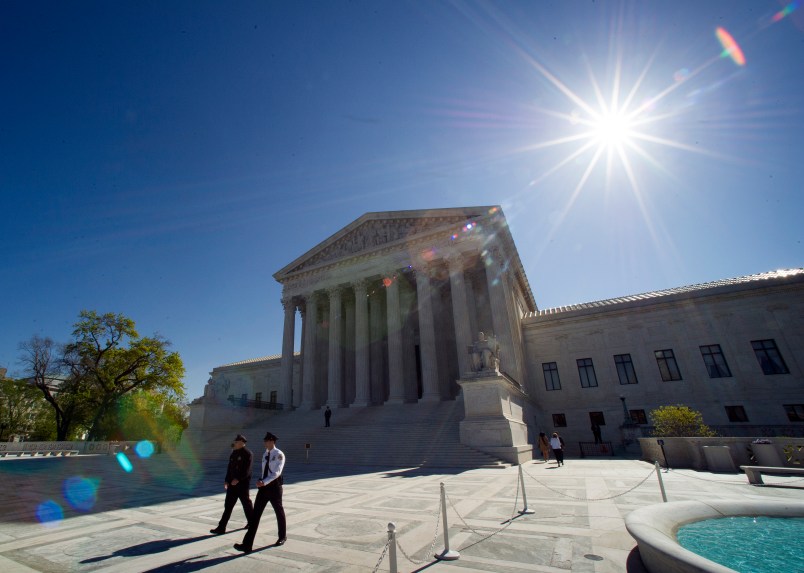
With the United States Supreme Court hearing oral arguments in Obergefell v. Hodges, the high court could make a landmark ruling opening the door to same-sex marriage. But that’s not the only important political case the Supreme Court is looking at this year.
Here is a list of other important cases on the Supreme Court’s docket:
King v. Burwell
King v. Burwell is the major case concerning Obamacare. In considering the case, the court will decide if three-dozen states have been getting tax subsidies through Obamacare unlawfully to help build their Obamacare health insurance marketplaces.
Oral arguments from earlier in the month left few clues about how the high court would rule on the case. Supreme Court Chief Justice John Roberts, who’s viewed as a critical swing vote in this case, was conspicuously silent during the arguments.
If the high court rules in favor of the plaintiffs in King v. Burwell, over six million people could lose their healthcare subsidies.
Williams-Yulee v. Florida Bar
In Williams-Yulee v. Florida Bar, the high court could potentially bar judicial candidates from personally seeking campaign contributions.
As The New York Times notes, the case centers on Lanell Williams-Yulee, a Hillsborough County, Florida judicial candidate who was publicly reprimanded and made to pay almost $2,000 in court costs over signing a fundraising letter. There are 39 states in the U.S. where judges fundraise from lawyers who appear before them.
In the past, the Supreme Court has been cautious about regulating money and political contributions. A recent exception was in 2009 when it found that there are times when elected judges should recuse themselves from cases where supporters are involved.
Reed v. Gilbert
Reed v. Town of Gilbert, Arizona concerns a town’s ordinance that limits political, ideological and directional signs. The question for the Supreme Court is if that ordinance violates the First Amendment.
The tone of the arguments in the case in the case, the Times said, hinted that the justices might end up giving a “modest or fractured decision” in the case.
Political signs, under the ordinance, can be 32 square feet and can stay in one place for months, according to the Times. Signs for church services, under the ordinance, are limited to being six square feet big, are limited to four for each property, and can be displayed before or after events.
Arizona State Legislature v. Arizona Independent Redistricting Commission
The Arizona State Legislature v. Arizona Independent Redistricting Commission examines if voters had the power to remove lawmakers’ authority of drawing district lines.
The case goes back to 2000 when voters in Arizona attempted to hand over redistricting power to an independent commission. Arizona Republicans in the legislature argued that the move violated the Constitution.
In early March, a number of justices on the high court suggested that it may have been a step too far to hand over redistricting power to the commission.


On the redistricting case, I would like to point out that it’s specifcially only Congressional Districts that are at issue here. The commission also draws the districts for the state senate and state house districts and everyone agrees that the voters have the right to take that out of the hands of the legislators.