

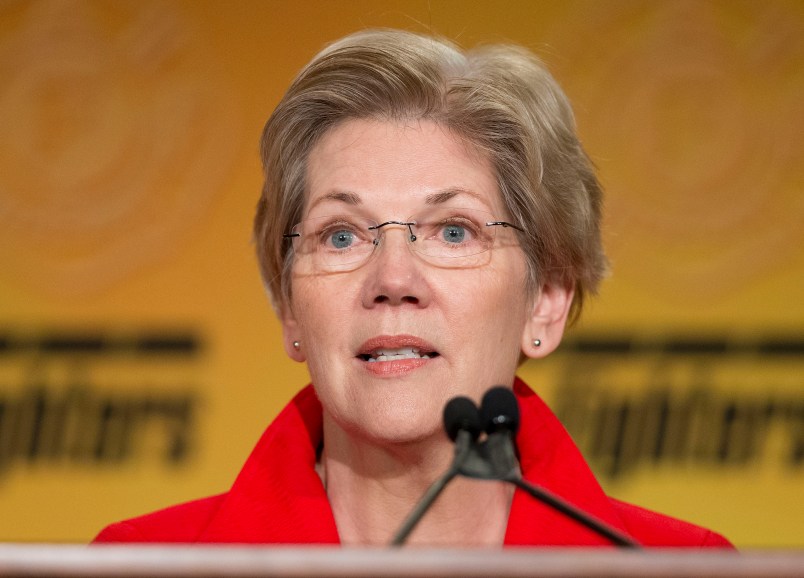
Sen. Elizabeth Warren (D-MA) ticked off a list of policy topics she’d like to hear former Secretary of State Hillary Clinton discuss more: minimum wage, equal pay for women, and trade policy.
Warren, who has repeatedly said she won’t run for president in 2016, made the remarks in an interview on CBS’s This Morning on Thursday.
“I’ll tell you where I stand on minimum wage, I’ll tell you where I stand on equal pay for equal work, I’ll tell you where I stand on expanding —” Warren said before being cut off by CBS’s Charlie Rose.
“Name to me one thing that you would like to see Hillary Clinton do and say and commit to that she has not committed to,” Rose said.
“Well, I’d like to see her address all of these issues. We have a big debate going on right now on trade within the Democratic Party,” Warren said. “I have real concerns about something called the investor-state dispute settlement that basically would permit multinational companies to sue other countries when they try to put regulations in place to protect their own workers, to protect their own citizens.”
Warren, along with Sens. Tammy Baldwin (D-WI) and Ed Markey (D-MA) have previously expressed strong concern for the investor-state dispute settlement that lets foreign companies challenge regulations of a government in front of an international tribunal, according to The Huffington Post.
Clinton has actually hinted that her 2016 presidential platform would emphasize income inequality and equal pay for equal work, in the process giving a tacit nod to Warren.
Warren, along with Sens. Jeff Merkley (D-OR), Al Franken (D-MN), and Senate Minority Leader Harry Reid (D-NV) have signed on to the Progressive Change Campaign Committee’s “Ready for Boldness” push which, among other things, calls for expanding Social Security benefits and “higher wages, and millions of clean-energy jobs.” The push is meant to move candidates like Clinton (if she runs) to the left.
Here’s the video, flagged by the Republican-leaning opposition research shop America Rising, of Warren’s interview:






“I have real concerns about something called the investor-state dispute settlement that basically would permit multinational companies to sue other countries when they try to put regulations in place to protect their own workers, to protect their own citizens.”
Would this be a good time to bring up the fact that Clinton changed her position on a Columbian labor dispute after receiving a donation from a Columbian oil company?
Love her. This is why we need her in the Senate, not as the target of some halfwitted over-excited progressive POTUS recruitment drive. She needs to be there bringing these issues to light and bringing the pressure to the Senate and, from there, on whoever is POTUS.
no way clinton will address the investor-state dispute unless specifically asked about it. and even then it would be a mealy-mouthed response. she’s a complete tool of wall street and the 1%; but her speeches on women’s equality earns her those progressive bona fides.
I sure hope the trade deals are submitted in draft form to the Congress soon, because there seems to be a lot of hand-wringing and hair-on-fire rhetoric over the investor-state dispute issue that will hopefully be cleared up.
Here is what I found on the US Trade Representative’s government website https://ustr.gov/trade-agreements/free-trade-agreements/trans-pacific-partnership/tpp-chapter-chapter-negotiating-3:
"With trade following investment, we are working to ensure that U.S. investors abroad are provided the same kind of opportunities in other markets that we provide in the United States to foreign investors doing business within our borders. That is why we are seeking to include in TPP many of the investment obligations that have historically proven to support jobs and economic growth, as well as new provisions to take on emerging investment issues.
Specifically, in the TPP we are seeking:
Liberalized access for investment in TPP markets, non-discrimination and the reduction or elimination of other barriers to the establishment and operation of investments in TPP countries, including prohibitions against unlawful expropriation and specified performance requirements;
Provisions that will address measures that require TPP investors to favor another country’s domestic technology in order to benefit SOEs, national champions, or other competitors in that country; and
Procedures for arbitration that will provide basic rule of law protections for U.S. investors operating in foreign markets similar to those the U.S. already provides to foreign investors operating in the U.S. These procedures would provide strong protections to ensure that all TPP governments can appropriately regulate in the public interest, including on health, safety, and environmental protection. This includes an array of safeguards designed to raise the standards around investor-state dispute settlement, such as by discouraging and dismissing frivolous suits, allowing governments to direct the outcome of arbitral tribunals in certain areas, making proceedings more open and transparent, and providing for the participation of civil society organizations and other non-parties.
For more information on investment, visit www.ustr.gov/issue-areas/services-investment/investment."
Granted, this is rather broad, but from what I have read I don’t share the concern of some liberals that the TPP, or its European counterpart proposed trade deal, would involve such a sell-out to corporate interests at the expense of national sovereignty or workers’ rights.
Tpp is a horrible agreement if believe exporting our broken copyright system, giving corporations an end run around courts, or just particularly like safe food and water, and clean air is a bad thing. I’m glad she is out speaking about her concerns. I have the same concerns. If you are a prime member there is en extensive thread you should check it out.