Behind the headlines of a looming solar trade war between the U.S. and China is a messy fight between two major sectors of the American solar industry — manufacturers against ‘downstream’ companies. The fight is centered on SolarWorld America, a U.S. subsidiary of a German company that’s been accused of racism over its characterization of China. The one thing that both sides agree on: If they don’t get their way, the American solar industry as we know it is in deep trouble.
The U.S. is teetering on the brink of a possible solar trade war with China after a memo from the U.S. Commerce Department was published on Monday, revealing that the agency is willing to impose retroactive tariffs on Chinese solar panels imported since December 3, 2011.
As the memo states: “We find there is a reasonable basis to believe” that China is violating world trade agreements by subsidizing solar panels and importing them in massive amounts, “dumping” them, purposely to put international competitors — in this case, U.S. manufacturers — out of business.
If found to be in violation, Chinese companies could have to pay 100 percent (or greater) import duties on all panels they’ve shipped into the U.S. in the past three months.
While the Commerce Department will not actually decide whether or not to impose the tariffs until March 2, the news went off like a thunderclap throughout the U.S. solar industry, revealing the deep fissures between several major American solar companies organized into two major trade organizations.A tale of two trade associations (with all-too similar acronyms)
The Coalition for American Solar Manufacturing (CASM) is a trade group formed in October 2011 specifically to push the trade case against China. It consists of seven major companies and another 156 smaller “associate members”, and claims to represent 14,659 American jobs and represents the majority of the American solar manufacturing business.
Its rival, the Coalition For Affordable Solar Energy (CASE), which was formed in November 2011 explicitly to counter CASM’s claims, purports to represent the “downstream” businesses — those that don’t manufacture solar panels but do all of the installation, service, financing and other development. CASE says it has 170 member companies representing over 13,000 employees.
Broadly speaking, it is CASM and the solar manufacturers who would likely benefit most from any potential tariffs, as tariffs would push up the price of Chinese solar imports (as low as $1.50 per watt on Wholesalesolar.com) and thus make slightly more expensive American-made alternatives (such as SolarWorld America’s $2.00 per watt panels) more attractive to buyers, although there’s some dispute over the short and long term benefits for American manufacturers.
Downstream companies represented by CASE, which have experienced tremendous growth in business lately precisely thanks to the low-cost Chinese solar panel imports believe the tariffs could significantly harm, even permanently damage, the American solar industry just as it’s about to blossom.
“We’re literally just at the point of taking off like a rocket in terms of demand globally,” said Jigar Shah, president of CASE, in a phone interview with Talking Points Memo, “And we’re just supposed to lay down our sword because of one company?”
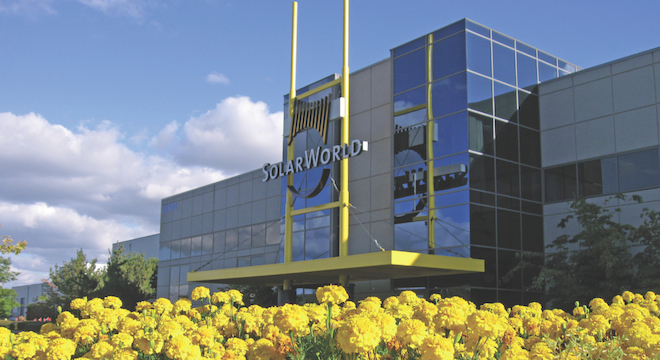
That one company that Shah refers to is SolarWorld America, a subsidiary of German SolarWorld AG, headquartered in Hillsboro, Oregon. SolarWorld America is by far the largest domestic manufacturer of photovoltaic (PV) solar panels in the United States, that’s the most common type of solar cell in the world. SolarWorld also happens to be the leading and only public member of CASM.
It was SolarWorld that first brought the trade case — under its name alone — to the Commerce Department and the International Trade Commission (ITC).
The other six companies that make up CASM’s main membership haven’t come out publicly for fear of reprisal from business interests in China, not to mention wanting to avoid further straining relations with their downstream American counterparts. That anonymity, however, its protected by Commerce Department rules, as the New York Times reported when the complaints were initially filed.
“As far as the other six companies go, this is a multinational business world,” said Ben Santarris, a SolarWorld spokesman, in a phone interview with TPM, “Companies may have ties to China where they fear reprisal. Shortly after we filed, China started bringing a whole bunch of other claims up, a real reprisal mentality. We as a country in the United States don’t do that. When someone accuses us of unfair trade, we say ‘let’s see the facts.’ We don’t counter the claim immediately.”
And indeed, the Chinese government has already intimated that it will begin looking into claims by Chinese companies of illegal dumping by American polysilicon manufacturers — the companies that synthesize the raw material from which PV solar panels are made.
Still, SolarWorld America, unsurprisingly, applauded Commerce’s recent memo and disagrees markedly with Shah’s assessment.
“We value Commerce’s decision, and we hope that it will send a clear message to the marketplace about Commerce’s commitment to using all of its tools to combat unfair trade,” said Gordon Brinser, president of SolarWorld America, in a release following Commerce’s memo on Monday.
“The current market isn’t sustainable for anyone,” said Santarris, “It’s not good for consumers if China drives out all the competition with artificially low, subsidized prices and then decides, once it has a monopoly, to raise prices.”
The reactions from SolarWorld America was expected given that CASM had asked for such retroactive tariffs to be imposed just days before Commerce announced its decision (as well as in October, when it first filed its complaints with Commerce and ITC).
Whose “green jobs” are worth more?
However, CASE dropped a fly and then some in CASM’s soup on Monday when a report CASE commissioned from the Brattle Group, a D.C. based economic consulting firm, was also published. The report painted a wholly bleak picture of what the U.S. solar industry would look like following the imposition of tariffs on Chinese solar panel imports: Up to 60,000 jobs lost and between $698 million and $2.6 billion in lost cost-savings to consumers.
The issue of job numbers is proving to be a big one in America’s internal solar fight. Nobody disputes that the “downstream” sector employed more people — 76,173 compared to the 24,064 that worked in the manufacturing industry in 2011, according to a study from the nonprofit Solar Foundation.
SolarWorld America alone employs more than 1,100 people, according to the company’s documentation.
“There are real jobs we’re talking about,” said CASE’s Shah, “The facts are the facts. In the solar industry, if you hit a certain price [of solar panels] you won’t get work…Solar isn’t like tires, which everyone needs to drive around on. If you’re a utility, and you’re looking at this situation, you might go, ‘Oh, those solar yahoos, we’re going to delay deployment by a year,’ and then if you’re on the downstream, you’re screwed.”
Still, SolarWorld and CASM pushed back hard against the Brattle report, releasing their own statement calling the study “highly speculative” and noting that “We do know that thousands of good-paying American manufacturing jobs have already been lost to illegal Chinese dumping and subsidies for solar products.”
SolarWorld and racism allegations
SolarWorld America’s German parent, SolarWorld AG, has engaged in a very aggressive marketing campaign questioning the quality of its Chinese competitors’ products. But the marketing materials have crossed the line into racially-charged China bashing and stung the company’s American subsidiary, too.

In mid-January, Sustainable Business Oregon broke the news that SolarWorld AG sent out a Christmas card to some German customers featuring a caricature of an Asian man in a Santa suit shrugging in the background as a hand in the foreground holds up a “Wishlist 2012,” with such features written down as “highest quality” and “safety guarantees,” apparently implying that the Chinese companies don’t have those qualities and their customers would like them.
The card became a minor news event in-and-of itself, with Politico Pro and PV Magazine also reporting on the card, after a man named Ocean Yuan, CEO of Oregon solar panel distribution company Grape Solar obtained a copy and found it so offensive and blatantly racist (he’s Chinese-American) that he sent a letter to Oregon Senators Ron Wyden (D) and Jeff Merkley (D), who have both expressed support for SolarWorld’s and CASM’s complaints.
“I would urge you to immediately disassociate yourself from SolarWorld’s efforts in view of SolarWorld’s outrageous and racist tactics,” Yuan told the Senators, Sustainable Business Oregon reported.
Grape Solar, it should be noted, is one of CASE’s members.
The Senators responded with a joint statement condemning the “inappropriate and offensive” card but saying that the trade complaints should be judged on their merits.
SolarWorld AG apologized in its own statement, saying the card had only been sent out to a “limited number of recipients,” and that it did not having anything to do with SolarWorld America.
“We told Germany that they shouldn’t use that,” SolarWorld America’s Santarris told TPM, “A few people somehow used it. They made a mistake and apologized.”
SolarWorld AG also released a German-language commercial featuring Larry Hagman of “Dallas” fame (in his J.R. Ewing getup) with a young boy, who brings him a broken helicopter toy. “Ah, you should’ve bought German,” Hagman says (in German).
“They’re saying ‘all Asian products suck, buy SolarWorld,'” said CASE’s Shah of the commercial, “I mean, I was beside myself when I saw it. Clearly, this guy has an agenda.”
“I don’t think anybody could make the case that the commercial is culturally insensitive,” said SolarWorld’s Santarris, “The U.S. is still adjudicating claims about poor quality Chinese products — melamine, kids jewelry, to name a few. There’s just not transparency there.”
Santarris went on to maintain that he thought the reason Shah and CASE were drumming up the racism allegations is because they aren’t in a position to defend against what Santarris points out “are the only relevant allegations in the case: The Chinese manufacturers are breaking international and trade law…”
One side note: Despite its hardline on Chinese solar products, SolarWorld AG actually had a lucrative partnership in 2009 to outsource 20 percent of its manufacturing output to one Chinese manufacturer specifically named in its complaint, Suntech, as The Business Insider reported on Tuesday (citing The Financial Times Deutscheland and Jigar Shah).
Politics as usual
The question remains: Will the Commerce Department and the ITC find China guilty of illegal subsidies and dumping, and if so, how big will the resulting tariffs be? More to the point, which way will the Obama Administration, which has made defending U.S. industries from China a priority, come down on this dispute?
So far, Washington seems to be leaning in support of CASM’s claims, with 63 federal lawmakers — all but 4 of them Democrats — signing letters to President Obama calling for tariffs to be imposed as swiftly if possible if Chinese manufacturers are found to be dumping on March 2.
CASE and CASM aren’t waiting to find out which side Commerce and the ITC come down on though: Both solar groups are lobbying hard in Washington, according to what their representatives told TPM, as well as taking potshots at one another in the press.
In late December 2011, CASE sent an open letter to SolarWorld America President Gordon Brinser pleading with the company to drop its complaints against China. Brisner replied to Reuters via email, saying the plea was “inappropriate bluster from Jigar Shah, who speaks on behalf of the Chinese manufacturers. Mr. Shah and these Chinese manufactures are well aware that their illegal trade practices are harming the U.S. economy and causing thousands of good manufacturing jobs to be lost.”
“I’m the president of CASE,” Shah told TPM in rebuttal to Brisner’s claims, “I don’t have any relationship with any Chinese companies. Eleven or twelve of the members of CASE are subsidiares of Chinese companies in America, but that’s out of 170 members.”
The International Trade Commission also has to agree to impose tariffs in order for them to be applied. But the ITC, too, signaled it was moving in that direction: The agency on December 2 put out a release stating it found a reasonable indication that the U.S. industry is “materially injured by reason of imports” of solar panels from China.
The endgame
At this point, it seems the only thing CASE and CASM can agree upon is that if their respective calls aren’t heeded, the U.S. solar industry could be irrevocably harmed.
“The fact that the Chinese are allowing us to put in lots of their panels is allowing us to create lots of jobs,” said Shah. “What I don’t want is some mistaken notion of American manufacturing to get out of hand. People are going to manufacture if there’s a lot of demand…There’s no value to a trade war. It’s not like the US is suddenly going to suddenly become the largest manufacturer of goods and services based on trade cases.”
“More than 1,300 people have invested themselves in building our operations here,” said Santarris “And we’re going to let China walk away with the whole thing?”
“Without meaning to sound too grandiose, I believe you could make a plausible argument that this struggle defines our current era,” Santarris later told TPM via email, “China/USA, fossil/renewable, domestic/export, energy security/dependence, environment/business and so forth.”
Correction: This article originally stated that SolarWorld America requested retroactive import duties on Chinese solar panel imports in January, just days before Commerce’s memo. In fact, while SolarWorld America’s counsel did say it wanted those duties in January, the company also requested the retroactive duties — what’s called a “critical circumstances” determination — when it first filed its cases in October. The article copy has since been updated to reflect these facts. We regret the error.