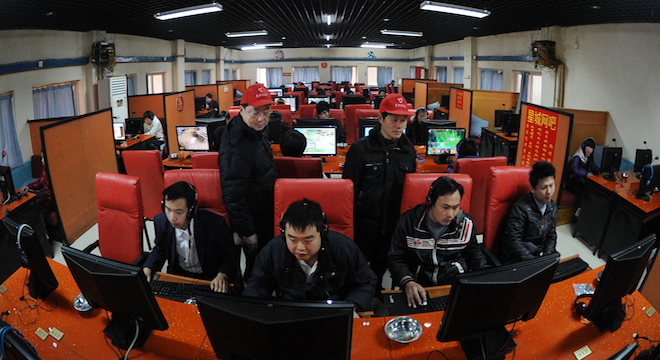
Something blocked many Chinese internet users from accessing all foreign websites for over an hour on Thursday, according to reports in The Wall Street Journal and UK newspapers The Guardian and The Telegraph.
China’s “Great Firewall,” a tight filtering and censorship system that prevents mainland Chinese Web users from accessing websites deemed inappropriate by the government, regularly blocks many popular foreign websites, including American-based destinations Facebook, YouTube and Google Plus.
But on Thursday, the blocking suddenly extended to seemingly all foreign websites as well as some within China, reportedly beginning around 11 a.m., according to the Wall Street Journal’s China Realtime Report.At the same time, users outside of the Chinese mainland weren’t able to view regularly accessible popular Chinese websites including portal website Sina.
Two popular theories about the disruptions emerged from Chinese internet users and internet-service providing companies: That sudden outages could have been the result of an undersea cable damaged in the massive earthquakes that struck off the coast of the Indonesian island Sumatra on Wednesday afternoon, or the result of China making adjustments to the Great Firewall that, deliberately or accidentally, placed previously accessible websites on the blacklist.
China, after all, has suffered apparent glitches in the Great Firewall before, such as some in February that temporarily allowed Chinese users to visit Google Plus and Facebook.
The Guardian described the two views from the country’s ISPs:
Xu Chuanchao, an executive at Sohu, one of the country’s biggest internet portals, wrote on his microblog: “This malfunction is caused by the failure of China’s backbone network and is under renovation.”
But one company, Data Centre for China Internet, posted: “Latest news: most foreign websites can’t be accessed. Analysis: for commonly known reasons, a large number of foreign URLs are blocked. It is possible that the great firewall is undergoing some readjustment, mistakenly adding many foreign websites to the blocking list. The details are unclear.”
But another others believed that the blocking was deliberate, perhaps a test of an “Internet kill switch.”
As the Telegraph quoted one employee at an unnamed Chinese Web company: “My own theory is that they were testing the great switch to turn off the internet.”
China’s Internet censors have been on high alert over the past month following the rise in commentary on social media (Chinese microblogs known as “weibo”) over a scandal that’s engulfed Communist party official Bo Xilai, and by extension, the Communist party.
Bo Xilai was abruptly ousted from his position in March and his wife has been arrested and named as a lead suspect in the death of a British businessman, Neil Heywood, in November 2011. Both Bo Xilai and his wife have been arrested, and he’s been stripped of his title.
In a struggle to control and limit the commentary of Chinese weibo users on the scandal, some of whom opined about a potential coup, the government shut down dozens of websites, detained some users and the country’s two most popular weibos, run by Sina and Tencent, and turned off their commenting functions for three days, according to Web access monitoring organization Herdict.
Whatever the cause, the sudden outage also came amidst attacks on the Great Firewall by self-identified members of the hacktivist collective Anonymous. It’s unclear at this time if the attacks, which have been dismissed by the Chinese government as ineffectual, had anything to do with the outage on Thursday, directly or indirectly.