Forget the ides, the American auto industry had a banner month in March. General Motors, Chrysler and Ford all reported some of their best sales numbers in years, with fuel-efficient vehicles, even some hybrids, accounting for much of the increases.
The data reflect unvarnished good news for the country’s economic recovery, and the companies’ production strategies seem neatly tailored to withstand car consumers’ squeamishness over high gas prices. None of these strides would have been possible if the U.S. auto industry had vanished in 2009. That broadly vindicates the government’s intervention at the height of the economic crisis, but it also masks a more complicated story about the degree to which the government’s actions led to Tuesday’s stellar figures.First the figures.
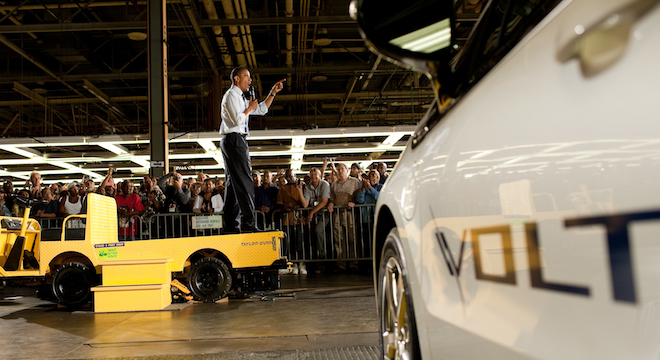
Sales of the Chevy Volt were so good — 2,289 units — that GM will resume production a week earlier than expected from a temporary shutdown.
Overall, U.S. auto sales increased 13 percent in March, the best figures in five years.

And the “Big Three” automakers expect the good times — and green cars — to keep on rolling.
“What you’re going to see going forward is success begetting success,” Jim Cain, GM’s manager of financial communications and sales, told TPM.
“We have an aggressive strategy that we’ll be rolling out over the rest of the year, with new products in segments representing 60 percent of the light vehicle industry by the end of the year,” Cain said.
In other words, GM — whose trucks and SUVs accounted for more than half its total sales just 10 years ago — hopes to be known for its fuel-efficient cars by the end of 2012.
“In 2002, for all intents and purposes, we were a truck company,” Cain told TPM. “Though we had some successes with our passenger cars, they weren’t as successful as they shouldn’t have been.”
Cain said that GM focused on trucks and SUVs simply because they were more profitable in the short-term. The low fuel prices of the late 1990s and early 2000s were “an enabler,” Cain said.
That of course was before GM’s 2009 bankruptcy filing and the collective $83 billion bailout of GM and Chrysler undertaken by the administrations of President George W. Bush and President Obama.
The government stepped in at a time when it was the only actor willing to or capable of financing the companies’ operations, and took equity in the hopes of receiving at least some of that money back. But it didn’t stipulate what types of cars GM and Chrysler should make.
Steven Rattner, the so-called “car czar” of the Obama administration who oversaw the bailout, told TPM that: “We certainly did not try to influence the designs of the cars. Those were all management decisions.”
The main function of the bailout, Rattner said, was to give the automakers “the financial tools to implement their business plan.”
“I think in fairness to GM it made better cars leading up to the bankruptcy and worked hard to improve quality,” Rattner said. “During the bankruptcy, they had better cars in the pipeline.”
In fact, Detroit’s switch to fuel-efficient vehicles enabled it to “[save] itself,” Brad Plumer at the Washington Post concluded Wednesday.
But Cain said that the bailout was responsible, too.
“A lot of the products being introduced today and the technologies to back them up were in the plan before the bankruptcy,” Cain said, “but being able to keep them on track and introduce them to the market today is obviously the result of the bankruptcy and the restructuring.”
But the government’s ownership stake in GM and Chrysler remains at the heart of the political fight over the bailout. The intervention’s ultimate success is hard to question but its critics insist that the government played an unnecessarily intrusive role in restoring the industry to profitability, when it could have simply stabilized things long enough to allow private actors to retake the helm.
“It’s good news from the broader recovery point of view,” said conservative economist Douglas Holtz-Eakin. “More evidence that we are slowly climbing our way out of this, emphasis on slowly.”
The bailout, Holtz-Eakin argues, “doesn’t shed much light on the efficacy or advisability of the auto bailout. You’re not going to find great evidence that the bailouts were the key,” to the recent resurgence. “I think it makes the case that the economy is recovering and buying more cars.”
Dean Baker, co-founder of the Center for Economic and Policy Research and a frequent liberal critic of the Obama administration, said the bailout illustrates the need for government intervention in times of crisis.
“This is one you’ve obviously gotta give Obama a lot of credit for,” he said. “It’s worth rubbing Republicans’ nose in this. Even within the administration, it was a tough debate. There were a lot of people who wanted to let Chrysler go down. They made the call — in retrospect the right call — to save them both. … That’s not an argument for everywhere and always you want the government to step in but you have limited cases where it’s worth the government making an intervention.”
Baker sees a fair arrangement, not an overreach. “Providing financing at below market rates and gaining nothing? It’s hard to see what the benefit of that would’ve been.”
It’s also hard to brand the government’s actions as inefficient or overly intrusive when the results have exceeded even its supporters’ expectations. The government didn’t force the newly successful products on the companies, but those products would never have reached the market if the government had stepped back entirely.
The critics who argued the government should have stepped back continue to second-guess the Obama administration’s actions and mischaracterize its role in shaping the new fleet.
For instance: Among GM’s new products is the hotly anticipated 2014 Chevy Impala, which was unveiled at the New York International Auto Show on Wednesday, following years of delays.
Mitt Romney attacked the Volt the same day the big three released their new numbers. “I’m not sure America was ready for the Chevy Volt,” he said. “I mean, I hope it does well, I don’t want to disparage any product coming out of Detroit. But I think instead of having politicians tell us what kind of cars we ought to make, we ought to let the people who are trying to understand the market make that decision.”
Romney also continues to struggle with his original position on the bailout — outlined in a memorable 2008 New York Times op-ed, “Let Detroit Go Bankrupt.”
“If by chance people don’t remember that editorial, we’re going to remind them of it,” said Don LaForest, chairman of the UAW’s bargaining committee at the Detroit Hamtramck plant, where the Volt is made.
Rattner believes it’s a safe bet that the bailout will become a major campaign issue.
“That the auto bailout has had a very positive impact on the country is the message you’ve seen the White House use and they should continue to use it,” Rattner told TPM. “There were some pretty amazingly incorrect predictions made by people who were against the bailout. They should step back and rethink their hypotheses.”
Rattner pointed out that the auto bailout was wildly unpopular when it was greenlit and said Obama “deserves credit for making the decision even though it was so unpopular,” though polls have shown that it’s become much more popular.
Still, Rattner said he would caution against anyone thinking that another bailout should ever be repeated.
“I don’t think anyone should think about this as another tool that should be employed in the future,” Rattner said. “These were very, very unique circumstances. Nobody should go through life thinking the government is going to be in reserve to bail out failed companies left and right.”