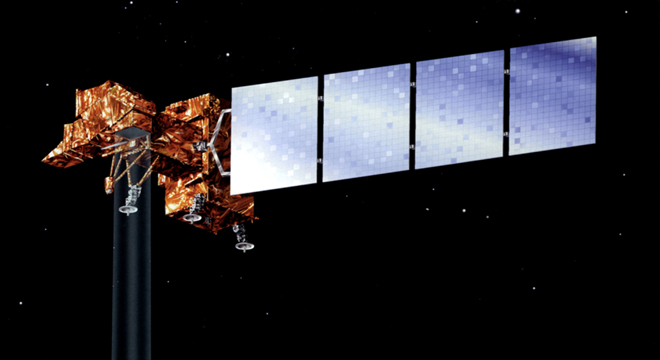
The final copy of a lengthy report from a Congressional advisory panel advising lawmakers on U.S.-China relations was released online Wednesday, containing, among numerous other revelations, a new assessment of the “malicious cyber activities” that hit two U.S. government satellites between 2007 and 2008.
The report was published by the U.S.-China Economic and Security Review Commission, an independent advisory panel to Congress made up of 12 experts with experience in government, industry and academia.
The Commission was created over a decade ago to “monitor, investigate, and submit to Congress an annual report on the national security implications of the bilateral trade and economic relationship between the United States and the People’s Republic of China.”In late October, a draft of the 2011 report was obtained by Bloomberg, which reported that the draft contained the admission that two U.S. government satellites, one controlled by NASA and the other by the U.S. Geological Survey (USGS), had each experienced two incidents of interference from “computer hackers, possibly from the Chinese military,” as Bloomberg put it.
NASA confirmed that its Terra AM-1 earth observation satellite had experienced “two suspicious events in the summer and fall of 2008,” but declined to further describe the incidents, saying only that “there was no manipulation of data, no commands were successfully sent to the satellite, and no data was captured,” and that it had referred the matter to the Defense Department.
Bloomberg also reported that the draft report theorized that the access point for the hackers was a Norwegian commercial satellite control station, used by NASA and the USGS, which was connected to the public Internet. The Norwegian satellite company that operates the station told TPM it had no record of any security breach or intrusion, and frankly didn’t know what the U.S. government was talking about.
The Commission also sent TPM the draft report, and here are the major updates on the satellite hacking incident that made it into the final copy:
- All mentions of the Norwegian Svalbard Satellite Station (SvalSat) have been excised.
- Both NASA and the USGS confirmed that their satellites experienced two separate incidents of interference each between 2007 and 2008. In the case of the USGS, “the U.S. Geological Survey confirmed two anomalous events related to the Landsat-7 satellite in 2007 and 2008.”
- The language describing the threats posed by the various instances of interference has been toned down considerably, from “Such interference poses numerous potential threats, particularly if achieved against satellites with more sensitive functions,” in the draft report to “If executed successfully, such interference has the potential to pose numerous threats.” This indicates that the report’s authors have concluded that the satellite interference experienced by the Terra AM-1 and Landsat satellites wasn’t necessarily “successful.”
That said, it is also worth mentioning just how much remained unchanged between the draft and the final report: The majority of it, including the inference that the Chinese military was behind the satellite hacking attempts.
The specific paragraph where this inference is made reads:
These events are described here not on the basis of specific attribution information but rather because the techniques appear consistent with authoritative Chinese military writings. For example, according to [Chinese document] Military Astronautics, attacks on space systems ”generate tremors in the structure of space power of the enemy, cause it to suffer from chain effects, and finally lose, or partly lose, its combat effectiveness.” One tactic is ‘”implanting computer virus and logic bombs into the enemy’s space information network so as to paralyze the enemy’s space information system.”
Here are other intriguing conclusions of the the new report:
China is a growing satellite power
“In 2010, China conducted 15 successful satellite launches, as many as the United States and behind only Russia, according to testimony to the Commission by Clay Moltz, associate professor at the Naval Postgraduate School.”
“China controls approximately 70 satellites,” 13 of them are commercial satellites, and the rest are government and military-controlled spacecraft.
China is following Europe in attempting to develop its own, independent version of the U.S. Global Positioning System (GPS). China’s project is called Beidou (“Compass”). Only three satellites, providing spotty regional coverage, are in orbit so far for Beidou-1. But the Beidou-2 system is expected to be up and running by 2012, consisting of 12 satellites. By 2025, it should have 35 satellites and attain global coverage.
China “operates few weather satellites, which could pose a problem for Chinese military operations, particularly in the absence of information from other nations.”
China wants to weaponize space
China’s military space efforts are concentrated on two objectives: The first is developing ballistic missile and strike capabilities, i.e. ”reconnaissance-strike complexes.” Although the report explains that the U.S. is currently the only country in the world with “combat-proven” global strike capabilities, China appears to have developed an automatic course-correcting antiship ballistic missile system, for attacking targets at sea.
China is also seeking ”counterspace” weapons to destroy other rivals’ space assets. “In each area, China’s military has demonstrated substantial improvements in the past several years,” the report notes.
“Chinese military theorists take a holistic view of counterspace operations. They advocate for the use of both ‘soft’ kill (i.e., infor- mational, temporary, or reversible) attacks and ‘hard’ kill (i.e., de- structive or permanently disabling) attacks against every aspect of space power: ground-based systems, space-based systems, and com- munications links.”
China’s manned spaceflight program has come at the cost of other space technologies
China has sidelined the potential to develop cheaper and more reliable space advances in telecommunications in order to put resources towards the flashier, more publicly understandable achievements in human spaceflight.
According to one of the Commission’s expert witnesses, “It is not a question of whether China will have a full range of human space flight capabilities, but a question of when and what they intend to do with those capabilities.”
China could launch a manned moon mission as early as 2024, although it doesn’t publicly have a human lunar exploration initiative.
That said, China’s space program is an economic growth engine
“China’s economy benefits from the country’s national space programs,” with “numerous firms,” mostly state-owned and/or operated, employing at least 200,000 people in the industry.
A major goal of China’s space program is to use space technologies to secure natural resources on Earth for its rapidly growing economy.
“China cooperates with other nations on various space projects in order to develop its domestic space capacity. A notable codevelopment project is the China-Brazil Earth Resources Satellite series, which include imagery capabilities sufficient for certain military applications. China has also secured space-related components or systems from Russia, France, the United Kingdom, and Germany.” Meanwhile, the U.S. and China have cooperated in space, but only “during several limited windows over the past 20-plus years,” and despite willingness from both countries’ space agencies to increase cooperation, current U.S. law prevents further collaboration.
China’s tight grip on its space program is hampering growth
China’s command-style control of its space programs are a double-edged sword: “China’s civil space endeavors face various constraints, including substantial bureaucratic and organizational inefficiencies.”
China’s commercial satellite industry isn’t internationally competitive — yet. The country suffered various satellite launch delays and failures over the past decade, which may encourage other countries to look elsewhere for launch services.
Conclusions
The report’s recommendations are perhaps most alarming in their specificity in the need for American readiness and “show of force deterrence” in the face of the rising Chinese military space complex.
For instance, the Commission recommends that “Congress require that the Department of Defense conduct periodic peaceful naval and air exercises in the East Asian maritime region to demonstrate the U.S. commitment to freedom of navigation,” and that “Congress direct the Government Accountability Office to evaluate the Department of Defense’s early warning systems to ensure that the department will have sufficient timely warning of a PLA (China’s People’s Liberation Army) attack in the event of a conflict.”
In addition, the Commission wants the Defense Department to “diversify its traditionally space-oriented capabilities,” in case of a cyber takedown from China, and train for a situation wherein U.S. space satellites and other systems have been partially or utterly destroyed.
Though apparently coincidental, the timing of the Commission’s report publication seems fitting given the implications of President Obama’s announcement on Wednesday of expanded U.S. military presence in Australia.