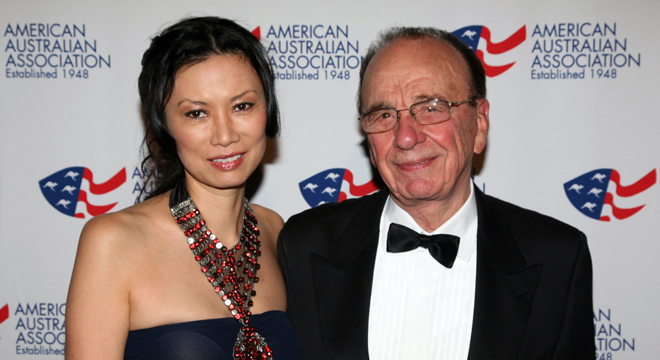
Just hours after he joined Twitter on New Year’s Eve 2012, arch-conservative Australian media mogul Rupert Murdoch found himself embroiled in a typically flighty Twitter controversy over a tweet he sent and quickly deleted, disparaging the British for taking “too many holidays.”
But now, that’s been overshadowed by a controversy with much wider, more serious implications involving his wife Wendi Deng’s Twitter account — or rather, a “Verified Account” attributed to his wife that was on Tuesday revealed to actually belong to an impostor.
Several media outlets reported that the Twitter accounts were real, encouraged by what appeared to be marital banter between the couple, with @Wendi_Deng playfully chastising Murdoch for his insensitive British-on-holidays tweet. But that all came to an abrupt end on Tuesday.“Hello Twitter,” @Wendi_Deng tweeted, “As News International has finally come to their senses, it’s time to confirm that yes, this is a fake account. I’m not Wendi.”
Indeed, News International, the UK division* of Murdoch’s global media empire News Corporation, appears to have been briefly hoodwinked by the impostor account as well.
BBC political correspondent Ross Hawkins tweeted on Monday that News International confirmed to him that both accounts were real. But on Tuesday he reported that News International had woken up about the @Wendi_Deng account, tweeting that the “person who told me it was [real] last night has just called to say she was wrong.”
We’ve reached out to News Corporation for more information on how the mixup occurred and will update when we receive a response.
But as the person behind the convincing @Wendi_Deng Twitter account pointed out, even more remarkable is the fact that Twitter somehow rubber-stamped the account as “Verified” as well.
“I was as surprised – and even a little alarmed – when I saw the Verified tick appear on the profile,” @Wendi_Deng tweeted on Tuesday, later adding “It might be only a small matter, but you have to worry about the management of News International and Twitter if……they can both readily confirm, for a while at least, that this was the account of a very noted personality.”
Twitter, for its part, remains tight-lipped about the controversy. The company, which began issuing “Verified Account” badges in 2009 in an effort to cut down on impostor accounts after complaints by celebrities, left the “Verified” badge on the @Wendi_Deng account on until Sunday night, according to the Washington Post.
Twitter did release a concise statement to the press on Tuesday, telling TPM:
“We don’t comment on our verification process but can confirm that the @wendi_deng account was mistakenly verified for a short period of time. We apologize for the confusion this caused.”
We asked Twitter for more information on the verification process, what led precisely to this error and how the company is working to ensure that it doesn’t happen in the future, but Twitter declined to comment.
The company’s own informational page on Verified Accounts doesn’t readily explain how the verification process works, either, saying only that Twitter is actively checking accounts for authenticity, although ordinary users have no way to request this feature for their own accounts.
“We have removed our public-facing verification request form,” Twitter’s verified accounts policy explains. “In the meantime, we’re still verifying some trusted sources, such as our advertisers and partners. If you’re one of our partners or advertisers, please follow up with your account manager for details.”
Still, there’s no denying that even “mistakenly verified” accounts are a problematic admission for Twitter, especially in the wake of the company’s efforts to expand its user-base beyond 200 million active accounts and appeal to a wider audience, in part by re-designing its user experience in December. If Twitter users can’t trust that the accounts of notable people and organizations they are interacting with are authentic, what else on the site can’t they trust?
The basic question Twitter has to answer now: Why should anyone trust that a “Verified Account” has truly been verified?
Other social networks, including Facebook and Google Plus, have grappled with their own account identification problems and introduced new features to combat the creation of fake accounts. But neither has suffered quite the high-profile embarrassment of “mistakenly” authenticating the false account of such a moneyed, infamous person.
The Hollywood Reporter even speculates that the Murdochs have grounds to sue the impostor over the incident, although News Corp. has stated it has “no plans to pursue any action” against the account holder or Twitter.
As Sophos security blogger Graham Cutley noted, “Although no harm was done on this occasion, it’s possible to imagine how someone with more malicious intentions could have taken advantage of the situation.”
Even the author of the @Wendi_Deng account, who has chosen not to reveal his or her identity yet, said that he or she applied restraint in their tweets.
“I also never made personal jokes about Wendi Deng,” the fake account holder tweeted. “It would have been very easy, for instance, to go on and on about the foam pie incident,” referring to the memorable incident in July 2011 when Rupert Murdoch was hit with a shaving cream pie to the face during the initial hearings into the phone hacking scandal, only to have the demure Deng leap to his defense and strike the attacker.
*Yes, News international is the same company behind the disgraced UK daily paper News of the World and related phone hacking scandal. The U.S. division of News Corp. owns Fox News, 20th Century Fox and the Wall Street Journal, among numerous other media properties.
Full disclosure: I worked for News Corporation’s iPad publication The Daily from November 2010 to August 2011.