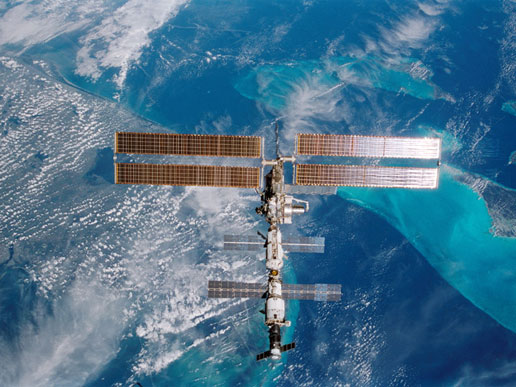
For the past 11 years, the International Space Station (ISS) has been continuously crewed by astronauts from NASA, Roscomsos (the Russian Space Agency) and other space programs around the world.
Now, for the first time since its first occupants arrived on October 31, 2000, it may be abandoned and left to float in orbit without a human crew, all because an unmanned Russian Soyuz rocket carrying supplies for the ISS – one similar to another manned Soyuz craft meant to ferry NASA astronauts to and from the station in the void left by the retired Space Shuttle – crashed and was destroyed shortly after take off last week.
“We’re gonna do what’s safest for the crew and the space station,” said NASA space station manager Mike Suffredini at a briefing this morning, The Houston Chronicle’s SciGuy reported.
The dilemma underscores just how vulnerable the current state of space operations is in the wake of the retirement of the Space Shuttle on July 21 with the final flight of Atlantis.
Suffredini confirmed that if the investigation into the crash continues in mid-November, the station will have to be remotely operated, as the current crew of six will be due back by then and the replacement crew of three cannot be flown back on a Soyuz rocket until the technical issues that lead to the crash in the first place are resolved.
Two Soyuz spacecraft are currently docked to the station, which allow the current crew to return to earth, but the vessels are only rated to spend between 200 and 210 days in space, putting the last possible return deadline to about mid-November, Space.com reported.
In fact, the crew will actually be halved even before then, as the first three members – two Russian cosmonauts and a U.S. astronaut – were due back Sept. 8. Now NASA has extended their mission by a week at least.
Meanwhile, their replacement crew, also made up of two U.S. astronauts and a Russian cosmonaut, were originally due to launch on the Soyuz MTA-22 on Sept. 22, but that’s been pushed back to at least late October, probably early November, according to The Wall Street Journal.
The Journal also reported, via Interfax, that the first results of Russia’s preliminary investigation into the crash are due by late next week. The crash of the Progress 44, launched aboard a Soyuz-U rocket in Kazakhstan on Aug. 24, occurred just 5 minutes and 25 seconds into its flight. Over 2.9 tons of cargo for the ISS, including oxygen, food and water, were lost, CNET reported. Suffredini said that despite the crash, the station had enough emergency supplies to last it for months, up until March.
Although Suffredini told reporters at the press conference that “everything we need to do” can be done by commanding the station remotely from Earth, he conceded that “there is a greater risk of losing” the $100 billion dollar project, and that the risk increase “isn’t insignificant,” the Journal reported. This just a few months after the final U.S. module was added to the station, completing the American portion of its construction.
Since the retirement of the U.S. space shuttle program, NASA has handed off all of its current low-orbital transport responsibilities to Russia, the only nation currently capable of ferrying cargo and people to the ISS.
(And don’t think that Roscosmos allowed the historic moment to pass unnoticed. As The Houston Chronicle pointed out, the same day as the final shuttle landing, Roscosmos boasted: “From today, the era of the Soyuz has started in manned space flight, the era of reliability.” A statement which has been proven not only boastful, but just plain wrong with the avent of the crash last week.)
In the meantime, NASA is funding private spaceflight companies, hoping they will be able to rapidly demonstrate successful, re-usable craft that can be launched from the U.S.
Currently, two private American companies are already slated to begin cargo supply test flights to the Space Station. But even these are a ways off, with California-based SpaceX’s Dragon rocket due to launch for the ISS on November 30, 2011, the first flight of a $1.6 billion contract with NASA Virginia-based Orbital Science Corp.’s Cygnus cargo craft is scheduled to launch for the station in February of next year. Just last week its cargo module arrived at a NASA facility in Virginia for pre-flight preparations.
Again — until either demonstrate reliability with cargo, they’re not going to be even considered for manned flights, which would put them well out of the timeframe necessary to re-staff the station this fall.