Updated 4:20 pm ET, Friday, April 6
Advocacy groups that led the fight against the failed anti-online piracy bills the Stop Online Piracy Act (SOPA) and the PROTECT IP Act (IP) have begun to mobilize their forces anew, anticipating that lawmakers, backed by Hollywood lobbyists, will attempt to resurrect the bills or launch comparable new legislation in an effort to crack down on piracy.
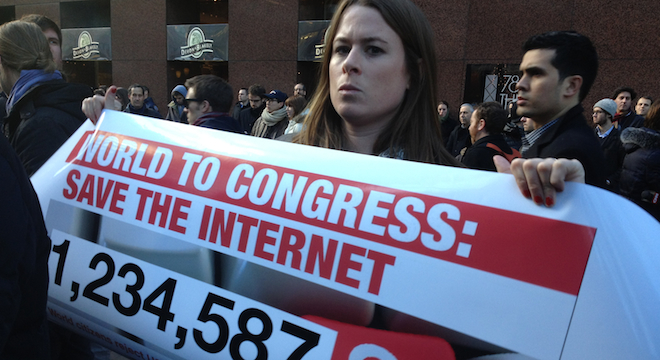
The sudden regrouping comes three months after a successful, massive one-day protest by millions of Web users and hundreds of thousands of sites, including Google, Wikipedia and Reddit, spooked legislators away from SOPA and PIPA and left the bills indefinitely stalled in Congress. No new similarly broad anti-piracy legislation has been introduced since.
But a recent report by an Obama administration official and comments by MPAA CEO Chris Dodd, the former Democratic Senator of Connecticut, have set the advocacy groups on high alarm. And now, they’re turning back to the Web in an attempt to re-engage the millions who joined them before.
On Friday, Fight For The Future, a small nonprofit advocacy organization based out of Worcester, Massachusetts that was at the heart of the online movement to kill SOPA and PIPA, sent an email to supporters asking them to sign a new petition in protest of what they anticipate could be new anti-piracy legislation.“Can you believe this?” wrote Fight For the Future co-founder Tiffiniy Cheng, in the email. “After the largest online protest in history, the Obama administration is still voicing support for SOPA.”
Fight For the Future has now launched a new online petition asking users to sign up and “tell Obama to promise: ‘I will never advance legislation that blocks websites or disconnects Americans’ internet access.'” Over 30,000 have signed up so far.
What set Cheng and Fight For the Future spinning was an annual report from the Office of the U.S. Intellectual Property Enforcement Coordinator, published online March 30. The 130-page report, preceded by a letter from Obama administration IP enforcement coordinator Victoria Espinel, outlines the office’s analysis of copyright and trademark enforcement in the U.S. over the past year and provides recommendations for Congress and the administration going forward.
Many news outlets interpreted the report as another example of the Obama administration’s previously stated opposition to SOPA and PIPA.
But a closer reading of the report does indeed show that the Office of the IP Enforcement Coordinator thinks that some provisions of SOPA had merit.
On page 49, the report lists “Other bills that have been introduced that incorporate the Administration’s White Paper recommendations,” and among them is SOPA, appearing no less than five times as an example of how the Obama administration would like to see Congress crack down on online piracy. SOPA is highlighted as a good example of a bill that would “amend laws to clarify that infringement by streaming, or other similar new technology, is a felony in appropriate circumstances.”
“I look forward to working closely with Congress on these legislative proposals that seek to strengthen US intellectual property rights,” Espinel writes in her letter preceding the report.
“We’re very concerned with them [the Office of the IP Enforcement Coordinator] asking Congress to take up this issue,” said Cheng, in a telephone interview with TPM. “We’re not quite sure why they are doing this now.”
Cheng said Fight For the Future had not yet contacted the Obama administration directly to express the group’s concerns, but that said that she hoped the two sides “would be in touch soon.”
“They really should’ve contacted us first to check and see if there would be support for any of this,” Cheng told TPM of the White House.
Meanwhile, on Thursday, MPAA chief Chris Dodd, the former Senator and arguably the most strident SOPA and PIPA supporter, gave an interview to The Hollywood Reporter in which he intimated that there were private conversations occurring between Hollywood representatives and members of Silicon Valley, which broadly opposed the bill, to craft new legislation or revive SOPA and PIPA.
“Between now and sometime next year [after the presidential election], the two industries need to come to an understanding,” Dodd told the magazine.
The MPAA on Friday walked back Dodd’s remarks and vehemently denied that SOPA was being revived. In an email to TPM, an MPAA spokesperson wrote:
“Sen Dodd did not say SOPA is coming back to life. He said the tech and entertainment industries need to come together to work on a new solution and those conversations are beginning. SOPA is gone. The path forward now is a serious conversation between all involved industries about new solutions, and that was Sen Dodd’s point.”
Those comments spurred left-leaning advocacy group Demand Progress, a major organizer of the online protests against SOPA and PIPA, to launch its own petition to “Tell Obama And Dodd: No Backroom Dealing, No New SOPA.”
SOPA and PIPA sought to crack down on Web piracy by forcing U.S. websites and companies to sever all electronic and financial ties to offshore Web domains accused of piracy by copyright holders, such as the film companies represented by the Motion Picture Association of America. Critics pointed out that the bills’ language was overly broad and could force the shutdown of sections of popular U.S. websites including YouTube, Reddit and Wikipedia, where users share links and content, some of which is pirated.
Late update: Rep. Lamar Smith, the original sponsor of SOPA, is not working on resurrecting his legislation, a staffer from the House of Representatives told TPM on Friday afternoon.
“Nothing new is happening with SOPA – zero movement and no discussions at this time,” the staffer said in a statement, referring back to a January release explaining that the House would “postpone consideration of the legislation until there is wider agreement on a solution.”