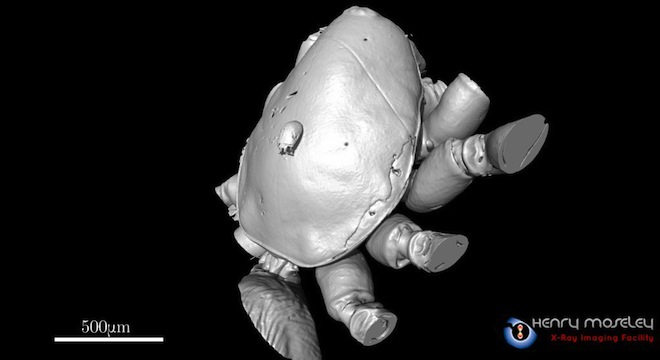
Researchers at the University of Manchester in England and their colleagues in Berlin, Germany have discovered what they believe is the smallest fossil of a mite, or any insect for that matter, in a 3D scan of tree resin from the Baltic region. The fossilized mite is only 176 microns long, or 0.000176 meters long.
Even more incredible, the fossilized mite was caught hitchhiking aboard the body of a larger insect, a spider, marking the oldest display of “phoresy,” when an organism uses another organism for transportation.
“Most amber fossils consist of individual insects or several insects together but without unequivocal demonstrable evidence of direct interaction,” said Dr David Penney, one of the study’s authors based in the Faculty of Life Sciences, in the University of Manchester release. “The remarkable specimen we describe in this paper is the kind of find that occurs only once in say a hundred thousand specimens.”
The team described their findings in a paper published in the journal Biology Letters on Wednesday.
The find is a win not only for the University of Manchester, but for their a new spin on the relatively old-school technique: X-ray computed tomography (CT), a medical scanning technique first demonstrated in 1972 that involves taking a series of 2D x-rays around an object and using computer algorithms to stitch them together and determine the 3D interior of the object.
Manchester and other institues have begun using nanoCT, an ultra-fine, ultra-close up version of CT scans that was devised at the Technical University of Munich in 2010.
“CT allowed us to digitally dissect the mite off the spider in order to reveal the important features on the underside of the mite required for identification,” said Penney.
The mite is the smallest arthropod yet discovered. Arthropods are part of a phylum that consists of invertebrates with exoskeletons, including insects and crustaceans. The phylum alone accounts for 83 precent of all animal species discovered, according to The University of Berkeley, California.