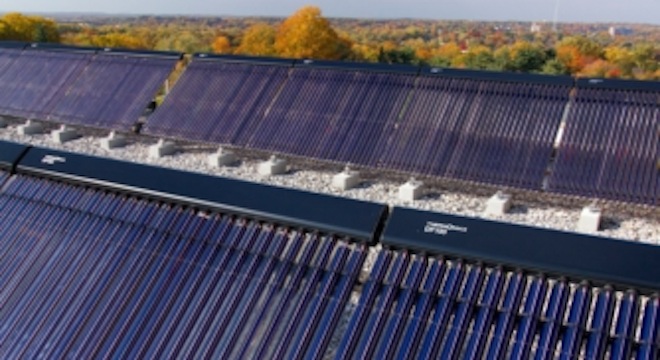
Hot water heating may seem like an unconventional target for clean energy innovation, but that’s not the way Zach Axelrod, President and CEO of solar hot water heating company Skyline Innovations sees it.
“A couple things made it appealing,” Axelrod told TPM in a telephone interview, of his decision to launch the Washington, D.C.-based company three years ago.
“A lot of us on the founding team came from the smart grid and smart metering world,” Axelrod said, “We saw that solar hot water heating has better fundamental economics than solar PV.”Here Axelrod refers to the most commonly recognized type of solar energy — photovoltaics — which basically includes all types of fixed solar panels that provide electricity.
By contrast, Axelrod’s team uses specially designed, roof-mounted glass boxes to trap sunlight and produce heat, the way a car gets hot and stays hot when sitting directly under the sun, even on a cold day. The company then transfers the heat to their customers’ boiler rooms, storing it in water or water-like substances (glycol) and then uses those to heat municipal water.
The technology works in conjunction with existing natural gas or electric water heaters and doesn’t replace them, only kicking in when it can provide hot water at a lower cost per BTU than the conventional fossil fuels.
“Solar hot water heating produces more energy per square foot than PV and yet its lower tech,” Axelrod continued. “It’s almost elegant in it’s simplicity. There’s tons of potential, but it just needed more sophisticated monitoring and analysis. The area where we bring something new to the table is on the back-end monitoring of energy usage.”
The company is clearly on to something: In late February, Skyline announced it had signed a 10-year deal with the Housing Authority of the City of Annapolis (HACA) to provide solar hot water heating services to 11 public housing buildings and 2,000 residents in the Harbor House and Glenwood Highrise complexes.
“Going solar with Skyline is a smart choice for our residents and Maryland taxpayers,” said HACA Executive Director Vince Leggett in a press release at the time. “By lowering our operating costs and providing clean energy, Skyline helps support our goal of ensuring availability of affordable housing and a better quality of life for our residents.”
“It’s one of our larger aggregate systems on the East Coast,” Axelroad said. The company has nearly 60 projects in total providing solar hot water to an estimated 20,000 people.
To be clear, Skyline doesn’t actually make of the solar hot water systems it installs itself. Skyline purchases the equipment mainly from four major manufacturers in the U.S. market and the implements its own back-end monitoring system to know when and whether to deliver the hot water, conducive with customer needs, the availability of the solar hot water and the comparative cost of fossil fuels.
“We are the end customer,” Axelrod explained to TPM, “We’re selling heat through something like a power purchase agreement,” an increasingly popular way to finance renewable energy projects, where one company provides the power generation system and a customer agrees to host the system on their site and purchase power from it, but doesn’t actually own or operate it.
Skyline guarantees that its customers will receive a cheaper energy bill using its services.
“We only bill a customer based on what we did deliver,” Axelrod pointed out to TPM. Indeed, guaranteed energy savings are the company’s main selling point on its website.
As for why Skyline started on the east coast, rather than in areas where solar is more predominant thanks to more annual sunshine — the Western U.S. — Axelrod pointed to the state and local renewable energy tax incentives specifically for solar hot water in D.C. and Maryland as major reasons.
A 2011 report by alternative energy monitoring firm the Enerf Institute backs Axelrod’s claim that state policies are intergal to helping to spurr the developing sector.
“We’re really happy to be based here,” Axelrod said, “We’re really fortunate and have had a good reception here. And D.C. actually has pretty good sunshine.”
Axelrod said that “a little over 1 percent” of buildings in D.C. had Skyline systems on their roofs so far, but that the company was looking to expand in the Los Angeles and San Diego markets.
But Axelrod acknowledged that it would be an uphill climb because the natural gas and electricity heating systems are so developed here.
“Around the globe, you’re seeing enormous customer adoption of this technology in markets with lower density natural gas. That’s the big differentiator.”
Still, Skyline is confident its model will work in the U.S. There’s clearly a hunger for it, with several online guides purporting to tell readers how to set up their own homemade solar hot water heaters. And polls by the Solar Energy Industries Association suggest strong support among Americans for the idea.
Correction: This post originally misquoted Skyline’s Zach Axelrod as saying that the company finances energy through “power purchase agreements.” In fact, he said that the company’s business model was “like a power purchase a agreement,” but distinct in that unlike a PPA, which typically provides energy to customers at a flat rate, Skyline has an adjustable rate depending on the cost of comparable fossil fuel. This post also originally incorrectly referred to Skyline enjoying tax credits in Virginia, when in fact, the company enjoys tax credits in Washington, D.C. We have corrected the errors in copy and regret them.