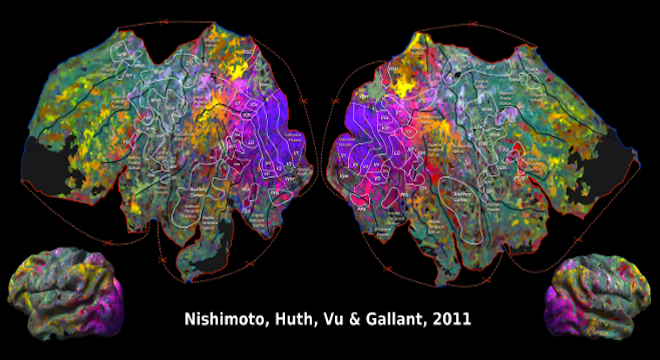
Reading another person’s mind is impossible. But it is now possible to see what’s going on in there visually, thanks to scientists at the University of California-Berkeley, who on Thursday announced they had managed to decode the brain signals of three individuals into watchable movies. YouTube movies, to be exact.
The team of neuroscience researchers led by UC professor Jack Gallant accomplished the incredible feat using an MRI machine to record the brain signals of three subjects – three members of their research team, in fact – while the subjects watched movie trailers.
Then, the team took the recorded brain signals and ran them through a database of 18-million-seconds of random YouTube clips, but specifically didn’t include clips of the trailers that the subjects had been watching in the first place.Berkley’s computer program was able to pick out new clips visually similar to the subjects’ brain imagery and mash them together into composites, creating eerie, hallucinatory new movies that replicate with startling accuracy the exact scenes that subjects saw in the trailers, frame-for-frame.
“This is a major leap toward reconstructing internal imagery,” said Gallant, “We are opening a window into the movies in our minds.”
Here’s a side-by-side of the composite video and the original movie trailer the subjects watched.
And here’s a view of the random, unrelated clips that Berkley’s program matched to the brain waves.
The breakthrough is even more impressive considering the fact that previous studies have only managed to use the same technology to reconstruct static images.
“However, no previous study has produced reconstructions of dynamic natural movies,” Gallant’s team pointed out on their website. “This is a critical step toward obtaining reconstructions of internal states such as imagery, dreams and so on.”
Ultimately, Berkeley believes the finding could be used to see what is going on in the mind of a coma patient, stroke victim, or a person who has suffered other brain damage and has no other means of communicating their thoughts to the outside world. It could also be used to help scientists understand visual hallucinations.
The team published their findings in a paper in the journal Current Biology on Thursday.
At the risk of attempting to read minds ourselves, any readers who think that this technology could be used to read people’s thoughts remotely or without consent are in for some relief: The team noted that the actual process took hours and necessitated the subjects’ informed consent, as each had to lie in the MRI machine. The team also had to build a different computer model for each subject’s brain.
“For this reason it is unlikely that this technology could be used in practical applications any time soon,” the researchers noted. However, they also added: “It is possible that decoding brain activity could have serious ethical and privacy implications downstream in, say, the 30-year time frame…The authors believe strongly that no one should be subjected to any form of brain-reading process involuntarily, covertly, or without complete informed consent.”