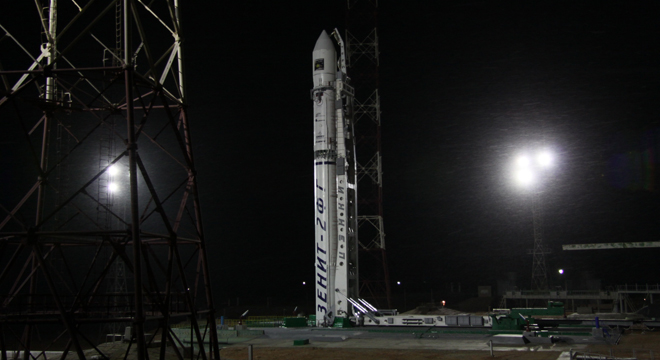
The Russian Phobos-Grunt (Phobos Ground) mission, designed to send an unmanned robotic probe to the Martian moon Phobos and return to earth with soil samples, is in serious trouble after a seemingly successful launch on Tuesday.
Russian engineers are struggling to communicate with the spacecraft, which has no bearings and is now stuck in low-Earth orbit, having failed to fire its engines on two occasions, according to the BBC.“I think we have lost the Phobos-Grunt,” Vladimir Uvarov, a former senior space official at the Russian Defence Ministry, told the government daily Rossiyskaya Gazeta, the BBC reported.
Worse still, if Russian engineers fail to gain control of the probe and cannot launch into a higher orbit, the drag that it endures at its lowest orbital point will eventually cause it to crash back to Earth in an uncontrolled descent, carrying a nearly-full supply of toxic fuels, the New York Times reported.
The European Space Agency (ESA) is now providing communications assistance from stations in French Guiana and Australia, the BCC noted.
The Times also quoted a NASA official saying that the U.S. would provide communications support if requested.
Roscosmos said on Wednesday that they had a two-week timespan to correct the problem before the craft’s batteries run out, Russian news outlet Ria Novosti reported.
Anonymous officials quoted by another Russian newspaper, Nezavisimaya Gazeta, believes that it will be a miracle if engineers are able to get the spacecraft back on track, Russian news agency Itar Tass reported. There’s little hope of getting Phobos-Grunt to Phobos as planned because even if engineers can re-establish contact and get the probe’s engines working again, when it emerges from Earth’s orbit, the overall distance and trajectory to Mars will have been sufficiently altered, and there may not be enough fuel left.
If the Phobos Grunt does crash to Earth, it’ll take an unpredictable path, making it the third large satellite to fall uncontrolled to Earth in the past few months after NASA’s UARS crashed into the Pacific Ocean in September and the German Aerospace Agency’s ROSAT plummeted into the Bay of Bengal in October. But there’s no guarantee that it would not end up plunging harmlessly into some uninhabited area.
In any case, the mishap is a bad sign for Russia’s renewed interest in space exploration efforts, specifically putting Russian cosmonauts on Mars after 2035. Six Europeans recently completed a 520-day simulation of a Mars mission in an earthbound isolated complex at Russia’s Institute of Biomedical Problems in Moscow precisely to obtain data for such a Mars mission.
The last time the agency launched a Mars mission was in 1996, when its $300 million Mars ’96 lander ended in failure, malfunctioning shortly after takeoff and plunging into the Pacific Ocean, Ria Novosti recalls. Before that, the agency attempted some 18 unmanned missions to the Red Planet, all of which failed.
In August, a Russian Soyuz rocket carrying a Progress cargo vessel to the International Space Station crashed shortly after takeoff, leading NASA to say that the space station might have to be temporarily abandoned while engineers figured out the problem, as the Soyuz is the only vehicle authorized to transport astronauts and cosmonauts into space following the retirement of the Space Shuttle in July. The Soyuz is also the “lifeboat” of the space station, and one must remain docked for every three-person crew aboard the space station at any given time in case of emergency evacuations.
The malfunction of the Phobos Grunt can’t be blamed on the Soyuz, though, as it was lifted into orbit aboard a Zenit rocket, which actually performed perfectly. It was only once the craft reached orbit and decoupled from the Zenit rocket that things began to go awry.
The Phobos Grunt’s rocky start is also bad news for China’s increasingly ambitious space program. The probe was also carrying China’s first Martian satellite, the Yinghuo-1.
At the time of this posting, Russia was still planning on sending a Soyuz to the International Space Station on November 14, carrying two Russian cosmonauts and a NASA astronaut, to replace a crew of three currently aboard, Ria Novosti reported.