The last-minute compromise reached by House and Senate leaders on Thursday to extend the payroll tax cut for another year was achieved partially by having both sides agree to pay for the cut by auctioning off $22 billion worth of licenses to the wireless spectrum — the portion of the electromagnetic spectrum over which radio waves and data can be transmitted.
The licenses, which are issued by the Federal Communications Commission (FCC), are currently held by national TV broadcasters.
But many of them have gone unused in recent years as broadcasters have switched over from analog to digital broadcasting, as they were mandated by Congress to do no later than June 2009.
“As Wi-Fi plays an increasingly important role in the spectrum ecosystem, the economic benefit created by unlicensed spectrum is estimated at up to $37 billion a year,” said FCC Chair Julius Genachowski, in a statement before the House on Thursday. The FCC has pressured TV broadcasters to give up unused spectrum for years.Those unused chunks of spectrum — also called “white spaces” — are coveted by the nation’s mobile wireless carrier companies — AT&T, Verizon, Sprint, T-Mobile — all of whom want the spectrum to augment their networks, which have been under increased load due to the increasing popularity of data-heavy smartphones and tablets.
The more spectrum a wireless company has, the more data it can transmit, and with less disruptions.
Not surprisingly, numerous wireless companies and other advocates of releasing the spectrum have come out in favor of the bill.
“Sprint supports the bipartisan compromise announced this morning by the House and Senate leadership and we hope that Republicans and Democrats in both the House and Senate will support it with a vote for final passage,” said Vonya B. McCann, Sprint’s senior vice president for Government Affairs, in a statement provided to TPM.
The Wireless Association (CTIA), an industry lobbying group, also cheered the move. “This additional spectrum will help CTIA’s members meet Americans’ voracious appetite for mobile Internet anywhere and anytime,” said CTIA CEO Steve Largent in a prepared statement. “While current usage is significant with more than 340 billion MB of wireless data used in the first half of 2011, mobile data usage is expected to grow by a factor of 16 over the next five years.”
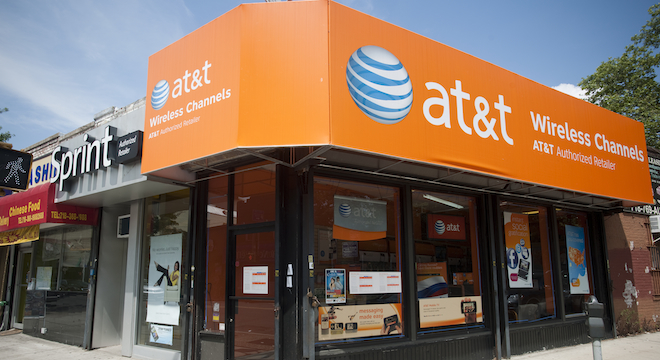
But in an unexpected note, even AT&T, which had eyed the compromise with suspicion, also applauded. AT&T had been concerned that Congress would give the FCC too much power to dictate the rules of the spectrum auctions.
“In our industry, there has been much focus in recent weeks on whether the FCC should or should not be able to exclude qualified wireless carriers from bidding in these spectrum auction,” said AT&T executive Jim Cicconi. “The final legislation speaks clearly on this point: the FCC may not do so as part of any auction proceeding.”
AT&T and the FCC haven’t gotten along well historically. But their relations took up an abrupt turn lately, as the FCC basically sounded the death-knell in AT&T’s plans to buy T-Mobile and use that company’s spectrum, releasing a report in November 2011 that said the deal would likely harm consumers and the marketplace. Sprint, too, had joined the pile-up, suing AT&T to block the merger.
Still, on this compromise, at least, everyone seems to be in agreement.
“Spectrum auctions have raised more than $50 billion for the U.S. Treasury, and economists regard the economic value created by FCC auctions as being about 10 times that number, or $500 billion in value,” said the FCC’s Genachowski, later adding “And freeing up unlicensed spectrum for ‘white spaces’ and other higher-power unlicensed use holds tremendous promise to become another value-creating breakthrough on the order of magnitude of Wi-fi.”
Furthermore, the compromise is also a matter of public safety: Homeland security officials have clamored for their own frequency reserved for disaster communications, following the September 11 attacks, when many experienced network outages. Congressional staffers hammered out a deal to take $7 billion of the proceeds from the spectrum auctions to create such a frequency, The Washington Post reported.
The Utilities Telecom Council (UTC), a trade group representing the nation’s major utilities companies and other so-called critical infrastructure, applauded this part most of all.
“UTC looks forward to passage of the legislation and working with the public safety community to promote sharing with utilities and other critical infrastructure industries,” said UTC CEO Connie Durcsak.
Of course, any auctions and network are still years away, so it remains to be seen just how nicely all the stakeholders will play once the spectrum actually gets dolled out.